
Shambles, from mini to omni

[amazon_link id=”1780742665″ target=”_blank” ]The Blunders of our Governments[/amazon_link] by the distinguished academics Anthony King and Ivor Crewe is a deeply fascinating, compelling book, one that deserves to be widely read by politicians, officials, policy wonks, journalists, students and for that matter citizens).

[amazon_image id=”1780742665″ link=”true” target=”_blank” size=”medium” ]The Blunders of Our Governments[/amazon_image]

Its claim is that the system of government in the UK (by which they explicitly mean that centred in Whitehall and Westminster) is so flawed that successive administrations preside over policy blunder after policy blunder, to an extent far beyond the experience either of pre-1980 UK governments or many overseas governments. By ‘blunder’ they mean cock-ups that fall far short of the objectives, and greatly over-run the intended cost or fail to deliver expected savings, but they exclude both judgement calls that went wrong and scandals. Examples in the book range from the huge and prominent (the poll tax, Britain’s ERM entry and exit, the Millennium Dome, the infamous NHS IT project) to the smaller and/or less well-known (Individual Learning Accounts, the Asset Recovery Agency, the London Underground ‘public-private partnership’).

The longest section of the book is a series of case studies covering a a dozen blunders from 1979 on. These occurred in both the Thatcher and Blair/Brown governments. The accounts are based on extensive reading and also personal interviews with participants conducted by the authors. It is both highly authoritative and absolutely jaw-dropping. “How could they have been so stupid?” you think.

The final two parts of the book try to answer that question, dividing the explanation into ‘human errors’ and ‘system failures’.

The former include the fact that people in the world of policy making – as any other world – bring their prejudices to their decisions. They are as prone as anybody to group think. Importantly, there is a ‘cultural disconnect’ between people in policy and politics and many other citizens, especially in the field of welfare policy. The clever middle class folk who go to university, read books, take foreign holidays, manage their money, and lead reasonably orderly and law-abiding lives, have no conception of other ways of life in their own land. This is certainly true: I have come across this innocence fairly frequently in my brushes with the policy world, and it is extraordinary that it is possible for people to spend a career in politics or the civil service with no other experience at all. This also helps explain another of the book’s list of  typical errors, namely the absence of any experience relevant to implementing policies, which are developed in an abstract, analytical way with no thought given to how they might be put into practice, in an ‘operational disconnect.’ Implementation is, it seems, scarcely thought of in policy debate. In addition, for various reasons, symbolism and spin have come to play a big part in modern politics.

Among the ‘system failures’ are: the lack of common purpose between Whitehall departments and excessive influence of the Treasury in distorting policies from elsewhere; the massively under-resourced role of the Prime Minister (I hadn’t realised how much of an outlier the UK is in not having a prime minister’s department); the extreme frequency with which ministers change jobs (the Federal Republic of Germany has had 15 ministers of economics since 1949; the UK has had 35); the related absence ways to hold specific invividuals accountable for what happens when policies go wrong; the lack of relevant expertise in Whitehall on project management; no genuine scrutiny role for parliament, and undue speed without proper deliberation of major policy initiatives.

The overall diagnosis is of a government system populated by people who lack relevant expertise, have dysfunctional relationships (especially between civil servants and ministers), where there are no proper checks and balances, and where an extreme fear of being seen to do a u-turn paralyses sensible changes. “The truth is that, looked at close up, British government turns out to be more chaotic than dictatorial,” the authors conclude. The burdens on ministers’ time are intense; they are doing constantly. This makes the loss of trust between ministers and civil servants, on whom they used to lean, all the more damaging.

The book has some suggestions. On the ‘human errors’, there are some obvious steps. People who fancy going into politics could do another job first, in between student politics and their first think tank job or between their think tank and their first constituency. Civil servants could be required to work in local government or the health service or the private sector for several years if they want to get to the top jobs. Ministers could chair their meetings using known techniques for overcoming group think and bias – for example, creating a formal ‘devil’s advocate’ moment when the group is asked to critique a decision. Profs King and Crewe suggest greatly expanding the role for parliamentary scrutiny, especially at the pre-legislative stage. The Project Manager should become a key figure in Whitehall (and many other organisations, public and private, for that matter).

The postscript indicates that the systemic failures continue with the present government. Although the Olympics and Paralympics avoided the errors of the Millennium Dome, we have had the pasty tax and ‘omnishambles’ budget of 2012, and the Universal Credit is showing every sign of shaping up to be a blunder, the authors write.

The thing about system failures is that nobody has a strong incentive to do anything about them. The risks are high, the potential rewards minimal. They are hard to sort out because it takes a long time and involves getting a lot of people to agree to change things in ways that make their lives a bit more difficult. There is no personal risk in continuing with things they way they are now.

British political culture is not conducive to reasoned reform: Punch and Judy are the role models for debate, any sensible change of mind is pilloried as a ‘u-turn’, policy pilots and experiments have to get past the hurdle of accusations of ‘postcode lottery’ and the demand for instant results.  For all that every policy looks like a shambles, whether mini or omni, it is also hard for diligent ministers to get anything done at all – see Chris Mullin’s superb account in the first volume of his diary ([amazon_link id=”1846682304″ target=”_blank” ]A View from the Foothills[/amazon_link]) of his repeated failure as a junior minister to introduce a modest measure tackling the suburban blight of overgrown leylandii.

So it would be easy to read [amazon_link id=”1780742665″ target=”_blank” ]The Blunders of Our Governments[/amazon_link] and despair. And yet the latest survey evidence suggests that Britons are divided between anger and boredom (47% fury, 25% boredom, 16% respect, 2% inspiration) when they think about politics. Surely Something Must Be Done? I take some hope from the fact that most of the politicians and officials I’ve met over many years have been sincere in their sense of public service, no matter how clueless or ambitious or plain unpleasant they’ve been. That means there is potential for a coalition for system reform.

Another ray of hope comes from the universal lip service paid to the idea of “what works” or “evidence-based policy.” (This does of course make you wonder what previous policies were based on.) I predict some tumult ahead when politicians discover that the evidence does not in fact support their prejudices, but meanwhile, the system has created some machinery for pointing out when policy proposals are blunders in the making.

I would hope that devolution in the UK could offer another perspective on the system failures. The book notes that officials in Scotland challenged the poll tax, on the basis of how impractical it would be to implement, as their counterparts in England did not – and were ignored. In the devolved arrangements we now have a variety of experience and some natural experiments. Of course, the devolved powers vary in different areas of policy, and the social, cultural and political context of each nation is different; but if comparable officials from each of the four nations could meet to discuss policy problems, what a great forum that could be for testing proposals and sharing experience.

It also seems to me worth thinking about the training we give our politicians and officials. I don’t know how many degree courses in government or economics or public policy contain modules on policy assessment and implementation, or project management skills, but suspect the answer is not enough.

A modest start would be to put this book on all relevant reading lists.
How to create a blockbuster

Anita Elberse’s [amazon_link id=”0571309224″ target=”_blank” ]Blockbusters: Why Big Hits and Big Risks are the Future of the Entertainment Business[/amazon_link] is published in the UK in January (it was out in the US earlier in 2013). It’s a clear and well-written series of case studies in how various branches of the entertainment business – movies, pop music, TV shows, books, sport – rely on a ‘blockbuster’ strategy as a business model.

[amazon_image id=”0571309224″ link=”true” target=”_blank” size=”medium” ]Blockbusters: Why Big Hits – and Big Risks – are the Future of the Entertainment Business[/amazon_image]

The economic analysis underlying the argument is not new. It can be traced back to Sherwin Rosen’s 1981 paper on the Economics of Superstars. I wrote about the way digital technologies were amplifying the superstar effect in my 1996 book, The Weightless World (pdf). However, Blockbusters provides plenty of examples of how the analysis translates to the real world. There are many interesting case studies in the book, albeit all American. Elberse also shows very convincingly how the blockbuster business model stacks up, based on her research experience talking to many of the firms she describes – she cites the revenue and cost data for specific movie releases, for example. A Harvard Business School professor, she clearly has terrific experience across a range of entertainment industries, and the details are fascinating. If you can afford to market a new release or title at scale, you’d be an idiot not too.

This means the [amazon_link id=”184413850X” target=”_blank” ]Long Tail[/amazon_link] idea is largely wishful thinking. The profit margins from the handful of blockbusters might support the production of a long tail but it isn’t even the case that there will always be a long tail because producers don’t know which will become hits. For although there is indeed great risk involved in releasing a possible blockbuster, few films or books or albums become blockbusters without a deliberate marketing effort. And scale in marketing is almost always decisive; the book cites a few grassroots successes, such as Lady Gaga’s first album, but they are obviously exceptional. So this means there is little prospect of Hollywood moving away from the model of putting resource including marketing into successful franchises, and most of what will be on offer will be of the same ilk as Harry Potter I to VII, The Hunger Games I to N, etc. Celebrities will only grow larger and more monstrous.

The book ends on the suggestion that the blockbuster strategy is going to have to be adopted by a growing range of businesses. Elberse gives the examples of Apple and Victoria’s Secret for their successful deployment of spectacle around a few products. “Apple releases fewer products and product variations than virtually all its competitors in computer hardware,” she writes. It makes just a few bets, in both production and marketing, in contrast to its competitors.

If I were an executive in any of the entertainment businesses, I’d regard this book as a must-read and consider its lessons very seriously. As a citizen, and a non-American, I found it a bit depressing. As a non-American because the US economic advantage of the scale of the domestic market is becoming even more pronounced than ever; the benefits of that scale are often overlooked anyway. They are even greater in digital markets where fixed costs (including or especially marketing) are high, and marginal cost is low to zero. As a citizen because –  although it would be overstating things to say everything is becoming Hollywoodised and dominated by celebrity – there is something in this.

It is obviously possible to declare independence from popular US-originated or US-inflected celebrity culture, and graze around the vast steppes of the internet for other cultural products. Other countries do succeed in different ways in supporting their own culture. There are different kinds of celebrity – Professor Brian Cox as well as Lady Gaga. Still, it seems it will have to be an increasingly active decision to opt out of Celeb-land. [amazon_link id=”0099518473″ target=”_blank” ]Brave New World[/amazon_link]?

Books from Santa

He’s got my number.

A book is for life, not just for Christmas

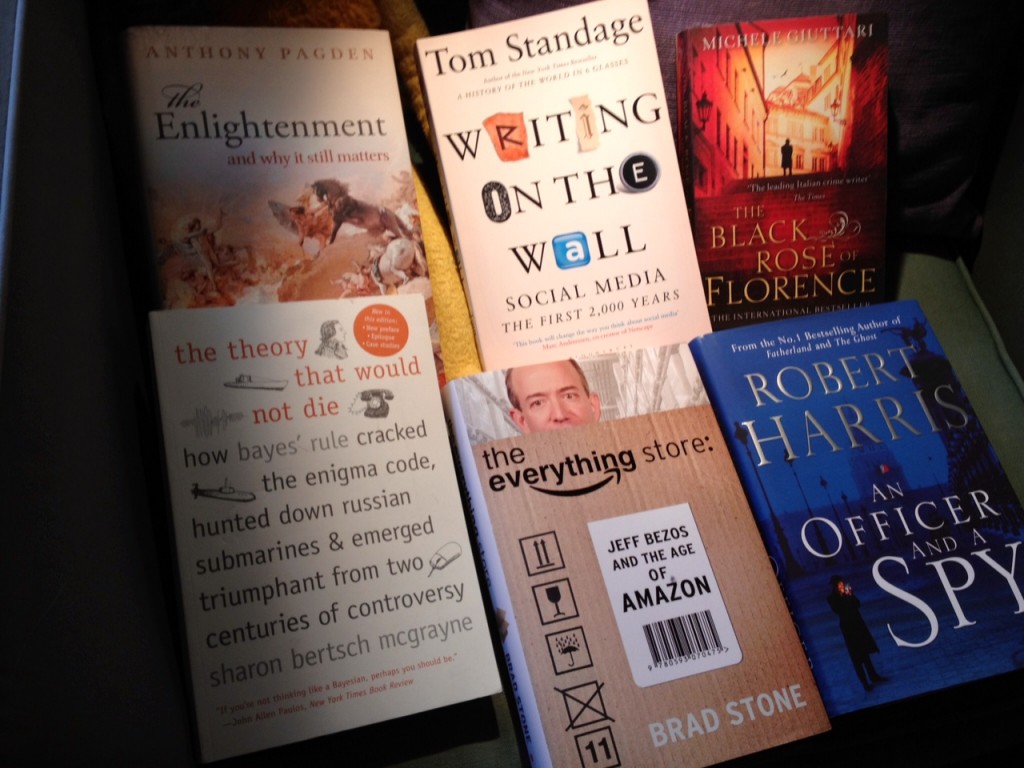
Given the name of my consultancy business, I might have to start with Anthony Pagden’s [amazon_link id=”019966093X” target=”_blank” ]The Enlightenment and Why it Still Matters[/amazon_link]. I’m very keen to read both [amazon_link id=”1408842068″ target=”_blank” ]Writing on the Wall[/amazon_link] and [amazon_link id=”0091944554″ target=”_blank” ]An Officer and A Spy[/amazon_link]. [amazon_link id=”059307047X” target=”_blank” ]The Everything Store[/amazon_link] has the imprimatur of the FT Business Book of the Year prize. [amazon_link id=”0300188226″ target=”_blank” ]The Theory that Would Not Die[/amazon_link] about Bayes’ Theorem was recommended by a reader of this blog. And what’s a holiday without a detective novel – the blurb on the back tells me [amazon_link id=”0349000115″ target=”_blank” ]The Black Rose of Florence[/amazon_link] is a global best seller, although I’m not sure whether that’s a good or bad thing.

The invisible modern

T.J. Clark’s essay ‘Lowry’s Other England’ in [amazon_link id=”1849761221″ target=”_blank” ]Lowry and the Painting of Modern Life[/amazon_link] is fascinating. He asks why modernism in art turned so decisively away from representing modern life. “There must have been something in the 20th century shape of things that meant that looking for modernity’s location, or its typical subjects, was in itself to misrecognise the way we live now.  … Why was there no ‘painting of modern life’ – or none that Degas and Baudelaire would have recognised? Because modernity no longer presented itself as a distinctive territory, a recognisable new form of space.” He goes on to argue that people who painted or created art came to lead a life physically entirely separate from the masses, Lowry being an exception because of his day job as a rent collector. The classes separated – “The ‘modern’ became a system of separateness – accompanied of course by a more and more coercive machinery of being together-in-what-you-buy.” And then increasingly modern life went indoors, has become personalised, focused on the TV and digital gadgets, and is now increasingly intangible too. Documenting modern life passed entirely from painting to photography.

[amazon_image id=”1849761221″ link=”true” target=”_blank” size=”medium” ]Lowry and the Painting of Modern Life[/amazon_image]

As a distinguished art professor, Clark doesn’t say that a taste for ‘modern’ art is very much acquired as part of a class-stratified upbringing and education, and the working classes (I generalise hugely) tend to like painters looked down on by the art establishment eg Jack Vettriano. And that part of the reason painters like Lowry have been controversial among the experts is not because they’re not good but because they’re popular.

Liking the unlikeable, on the other hand, is a badge of social status. The social elements make the art market absolutely fascinating, yet the most thoughtful economic analyses have come from Marxists (and a long time ago at that) such as Walter Benjamin in [amazon_link id=”0141036192″ target=”_blank” ]The Work of Art in the Age of Mechanical Reproduction [/amazon_link]and Theodore Adorno in [amazon_link id=”0415253802″ target=”_blank” ]The Culture Industry[/amazon_link]. Conventional modern economics seems mainly interested in whether or not buying paintings is a ‘rational’ investment.

[amazon_image id=”0141036192″ link=”true” target=”_blank” size=”medium” ]The Work of Art in the Age of Mechanical Reproduction (Penguin Great Ideas)[/amazon_image]

And of course, as per recent posts, paintings are supremely positional goods.

What does work look like?

I’m gliding into holiday reading, and have devoured a fine, albeit rather depressing, novel, Jon McGregor’s [amazon_link id=”0747561575″ target=”_blank” ]If nobody speaks of remarkable things[/amazon_link]. Now I’m well into the introductory sections of [amazon_link id=”1849761221″ target=”_blank” ]Lowry and the Painting of Modern Life[/amazon_link] by T.J.Clark and Anne Wagner, the catalogue of the recent, fine Tate exhibition they curated. It’s a brilliant essay – I’m a Lowry fan being from those parts.

They point out that: “England – we constantly shift between ‘England’ and ‘Britain’ in this book, and always on purpose – has been by and large so determined to evade, in representation, the dull catastrophe of its post-Imperial, post-Industrial-Revolution condition. Lowry does not.”

[amazon_image id=”1849761221″ link=”true” target=”_blank” size=”medium” ]Lowry and the Painting of Modern Life[/amazon_image]

This reminded me an essay by Hilary Mantel I read years ago, about the extremely narrow construction of English identity, in terms of stately homes, rolling green hills, cricket on the village green, CofE church socials run by Miss Marple, etc. Even Orwell (famously) caricatured it this way. What hope for a northern (English), working class, female of Irish Catholic descent, like her, to feel a sense of national identity, asked Mantel. (The other nations of the UK are different, of course.) I can’t track the exact quotation down now – I’d thought it was in her excellent memoir [amazon_link id=”0007142722″ target=”_blank” ]Giving Up The Ghost[/amazon_link], but can’t find it this morning.

The other aspect of modern life Lowry captures is of course work, work in the mills. Until around a decade ago there was very little English fiction about work. David Lodge’s [amazon_link id=”0099554186″ target=”_blank” ]Nice Work[/amazon_link] stood out as a bit of an exception. This was a great contrast with the days of [amazon_link id=”014143967X” target=”_blank” ]Dickens[/amazon_link], [amazon_link id=”014043464X” target=”_blank” ]Mrs Gaskell[/amazon_link], [amazon_link id=”046087781X” target=”_blank” ]George Gissing[/amazon_link] and their peers, writing about the effect of the Industrial Revolution on work and other aspects of life. I think this is changing now, and there is some fiction about post-Internet working life (nominations for good examples, please).

[amazon_image id=”0099554186″ link=”true” target=”_blank” size=”medium” ]Nice Work[/amazon_image]

However, visual representations of modern working life seem rarer – I can’t think of any. Cotton mills and assembly lines are iconic. But rows of people tapping away at terminals? Why is it so hard to visualise modern work?