
The value at the margins

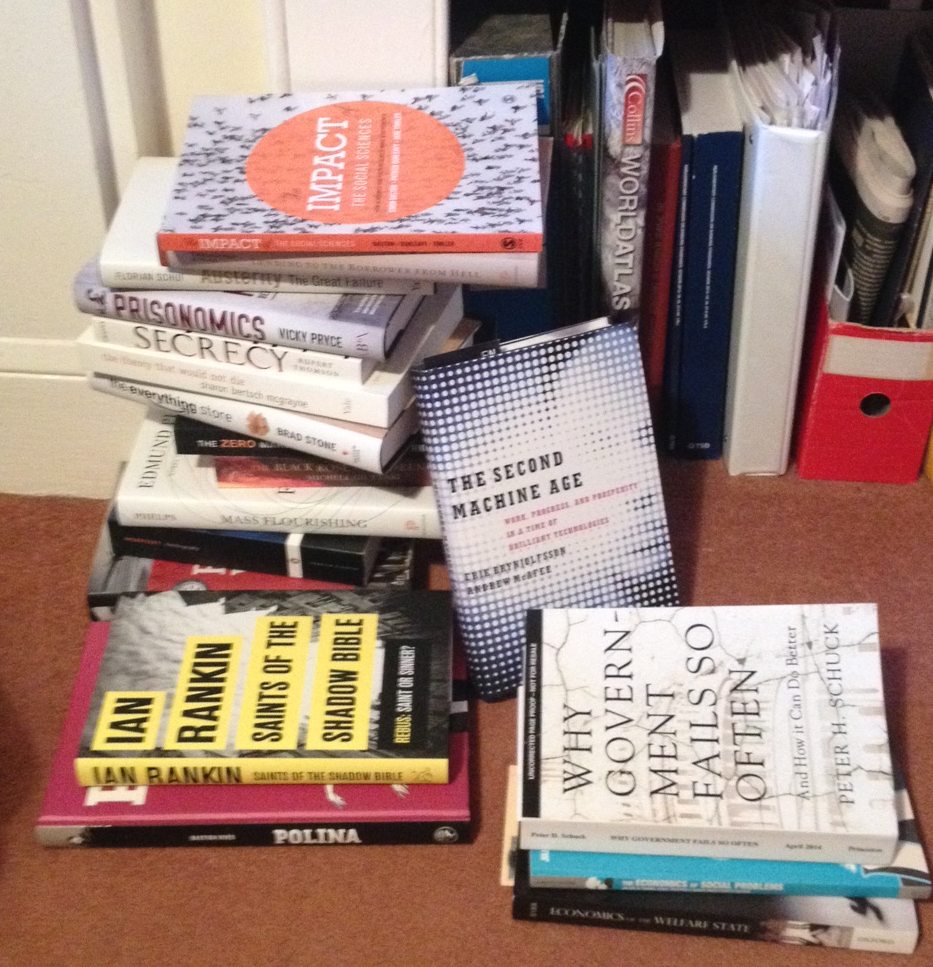
I’m enjoying [amazon_link id=”0393239357″ target=”_blank” ]The Second Machine Age[/amazon_link] by Erik Brynjolfsson and Andrew McAfee, and will review it soon. Meanwhile, though, I was struck by their discussion of the effectiveness of crowdsourcing for problem-solving or innovation. They give examples such as InnoCentive and Kaggle. I was particularly struck by this comment:

“Another interesting fact is that the majority of Kaggle contests are won by people who are marginal to the domain of the challenge.”

[amazon_image id=”0393239357″ link=”true” target=”_blank” size=”medium” ]The Second Machine Age: Work, Progress, and Prosperity in a Time of Brilliant Technologies[/amazon_image]

For instance, the best forecasts of hospital readmission rates came from people not involved in healthcare, while a contest to develop a computerised system for grading student essays was won by someone whose only expertise was a free online AI course offered by Stanford.

This reminded me a bit of [amazon_link id=”0691128715″ target=”_blank” ]Philip Tetlock’s debunking of professional expertise[/amazon_link], but more of Scott Page’s completely brilliant book [amazon_link id=”0691138540″ target=”_blank” ]The Difference[/amazon_link] (or its follow-up, [amazon_link id=”0691137676″ target=”_blank” ]Diversity and Complexity[/amazon_link]), about the value of diversity. Combining ideas that are ‘far apart’ in some way creates new ideas and insights that are more creative and innovative. Outsiders, the people in the margins, are exactly those who bring new ways of thinking.

Crowds are wise when they are composed of people with different experiences and views. If they are all the same, you get group-think and herding.

[amazon_image id=”0691138540″ link=”true” target=”_blank” size=”medium” ]The Difference: How the Power of Diversity Creates Better Groups, Firms, Schools, and Societies[/amazon_image]

Dostoyevsky and the utilitarian calculus

I’ve just finished Robert Harris’s brilliant novel about the Dreyfus Affair, [amazon_link id=”0091944554″ target=”_blank” ]An Officer and A Spy.[/amazon_link]

[amazon_image id=”0091944554″ link=”true” target=”_blank” size=”medium” ]An Officer and a Spy[/amazon_image]

His hero, Colonel Picquart, quotes Dostoyevsky’s [amazon_link id=”048627053X” target=”_blank” ]Notes from Underground[/amazon_link], a quotation that sent me scurrying to the book.

“And why are you so firmly, so triumphantly, convinced that only the normal and the positive–in other words, only what is conducive to welfare–is for the advantage of man? Is not reason in error as regards advantage? Does not man, perhaps, love something besides well-being? Perhaps he is just as fond of suffering? Perhaps suffering is just as great a benefit to him as well-being? Man is sometimes extraordinarily, passionately, in love with suffering, and that is a fact. There is no need to appeal to universal history to prove that; only ask yourself, if you are a man and have lived at all. As far as my personal opinion is concerned, to care only for well-being seems to me positively ill-bred. Whether it’s good or bad, it is sometimes very pleasant, too, to smash things. I hold no brief for suffering nor for well-being either. I am standing for … my caprice, and for its being guaranteed to me when necessary.”

[amazon_image id=”048627053X” link=”true” target=”_blank” size=”medium” ]Notes from the Underground (Dover Thrift)[/amazon_image]

Indeed, the whole book is a spirited rant against rational economic man, and the ‘palace of crystal’ constructed by scientific rationalism. I don’t agree, but equally counting utils isn’t the answer to everything.

It’s outside the remit of this blog, but if you want a cracking page turner of a novel that is also illuminating about modern European history and some current issues about surveillance, I can’t recommend the Robert Harris book too highly. Fabulous.

Macroeconomic regimes

As regular readers of this blog will know, macroeconomics isn’t my thing. Although unimpressed by the state of knowledge in macro, I’m even less impressed by my own expertise in it, and so avoid commenting on it.

Still, I try to keep up with the debates, and was reading the recent posts by Simon Wren-Lewis and follow-up by Paul Krugman on exactly this question of the state of macroeconomics and the various divisions. Broadly speaking, the former argues that looking to base macroeconomics on micro-foundations is an essential research strategy, while the latter says that insisting on microfoundations (“the insistence that everything involve intertemporal optimization”) excludes useful approaches to thinking about economic policy on the grounds that they are ‘ad hoc’.

With great diffidence, it seems to me that what you might or might not build micro-foundations for matters more. Whenever I think about the macroeconomy I turn back to a small book I read as an undergraduate, rarely cited these days, Edmond Malinvaud’s [amazon_link id=”063117690X” target=”_blank” ]Theory of Unemployment Reconsidered[/amazon_link].

[amazon_image id=”063117690X” link=”true” target=”_blank” size=”medium” ]Theory of Unemployment Reconsidered: Lectures[/amazon_image]

He begins by pointing out that the classical theory of unemployment (and its descendants) make the mistake of looking at each market as a partial equilibrium – so the labour market would clear, and unemployment would fall, if only the real wage fell. For macroeconomics, though, general equilibrium analysis is needed. That was the important step contributed by Keynes in [amazon_link id=”9650060251″ target=”_blank” ]The General Theory[/amazon_link]. Rationing in the labour market is closely linked to rationing in the goods market.

Malinvaud goes on to describe different ‘regimes’, depending on whether rationing prevails on the buy-side or sell-side of the labour and goods market at any moment – he labels them classical unemployment, Keynesian unemployment and repressed inflation. One would now surely add financial markets too, and a ‘debt hangover’, credit rationed state of the world. Policy prescriptions vary a good deal depending on which regime applies.

That’s as far as I’m going, the conclusion that the connections between markets can tip the economy into different rationed equilibria. When those connections and dynamics are clear, we could worry about how well microfounded the model is. Malinvaud also echoes another of my views: “The level of aggregation may hide some important complications.” Yup. This boils down to saying macroeconomics is fiendishly complicated, and after this brief excursion, I’m going back to avoiding it.

A dangerous obsession?

A theme of quite a few recent book arrivals here at Enlightenment Towers has been the relative position of the US and China.

A hive of activity at Enlightenment Towers (Image from Wellcome Library, London)

These have included Eswar Prasad’s [amazon_link id=”0691161127″ target=”_blank” ]The Dollar Trap [/amazon_link](global turmoil paradoxically strengthens the status of the US currency, and the renminbi isn’t going to take over as global reserve currency) – it’s just been reviewed in the New York Times as well as here.  Charles Kenny’s [amazon_link id=”0465064736″ target=”_blank” ]The Upside of Down [/amazon_link]argued that a thriving China is good for the US. Josef Joffe’s [amazon_link id=”0871404494″ target=”_blank” ]The Myth of America’s Decline[/amazon_link] says China isn’t after all poised to overtake the US as global hegemon, so enough with the declinism.

This weekend, [amazon_link id=”0300187173″ target=”_blank” ]Unbalanced: The Co-Dependency of America and China[/amazon_link] by Stephen Roach has entered the US-China debate. I guess the subtitle sums up the argument – this is co-dependency in the damaging but addictive relationship sense. He seems to end up saying both countries are experiencing an identity crisis and must reform themselves so they can move away from (on the one hand) financial engineering and (on the other) unbalanced hyper-growth. This doesn’t sound like it will end up well.

Stephen Roach is always interesting, so I’m sure it will repay reading. But perhaps the US-China relationship is becoming a dangerous obsession?

[amazon_image id=”0300187173″ link=”true” target=”_blank” size=”medium” ]Unbalanced: The Co-Dependency of America and China[/amazon_image]