Not-so-green economics

I’ve been mulling over some statements in [amazon_link id=”0262028573″ target=”_blank” ]The Container Principle[/amazon_link] by Alexander Klose. He says logistics has become the “third largest sector of the economy”. That in Germany 10% of energy use is accounted for by data centres – and that there are more than 5 million worldwide, whose CO2 emissions (from their production and use) is approaching those of global air traffic.

[amazon_image id=”0262028573″ link=”true” target=”_blank” size=”medium” ]The Container Principle: How a Box Changes the Way We Think (Infrastructures)[/amazon_image]

A modest amount of rooting around online hasn’t enabled me to verify these rather eye-opening facts, if they’re correct. Does anybody know of sources for such figures? (This Scientific American article reports some signs of decoupling of CO2 emissions from growth in the aggregate; prior to 2000, the energy-intensity of GDP growth had apparently been declining.)


Shipping containers redux

Regular readers will know of my interest in shipping containers. It pre-dated Marc Levinson’s excellent [amazon_link id=”0691136408″ target=”_blank” ]The Box[/amazon_link].In fact it must date back a long way – one of my favourite TV series when young was The Onedin Line.

Recently I’ve been following these Postcards from a Supply Chain, and also read Rose George’s [amazon_link id=”1846272998″ target=”_blank” ]Deep Sea and Foreign Going[/amazon_link] (which I reviewed here). The latest in this genre is [amazon_link id=”0262028573″ target=”_blank” ]The Container Principle: How a Box Changes the Way We Think[/amazon_link] by Alexander Klose.

[amazon_image id=”0262028573″ link=”true” target=”_blank” size=”medium” ]The Container Principle: How a Box Changes the Way We Think (Infrastructures)[/amazon_image]

A collection of essays, this touches on the history of the industry and the economics of transportation and trade. But it is more concerned with the wider question of the cultural impact of containerisation. “Containers play as decisive a role in the organization of people, programs, and information as they do in that of goods,” writes Klose. “They not only physically appear in every imaginable place in the city (such as subway stops and airports) and in rural areas, they also appear in such cultural domains as architecture and urban planning, psychology, philosophy, pedagogy, business administration, communications and information, film, television, theatre and art.”

And cliches. Thinking outside the box, anyone?

There are chapters that riff on various aspects of containers, of which my favourite was the one about logistics, which is largely historical. Klose argues that modernity has a logistical logical structure, making the shipping container its “most successful material object to date…. Containerization is a prevailing cultural technology of the 20th and early 21st century.” I think I buy that argument. The book has lots of fantastic illustrations. It suffers a little from critical/media studies-speak but only a little, and more than makes up for it by bringing a different lens to this very familiar object.

Economics and humankind

Sitting in my colleague Terry Peach‘s office, I picked up Alfred Marshall’s [amazon_link id=”B009AJCWT4″ target=”_blank” ]Economics of Industry[/amazon_link]. I knew the phrase ‘the ordinary business of life’ of course, not least because Roger Backhouse used it as the title of [amazon_link id=”0691116296″ target=”_blank” ]his book on the history of economic thought[/amazon_link]. What I’d never realised was just how good the whole intro of Marshall’s book is:

“Political economy, or economics, is a study of man’s actions in the ordinary business of life; it inquires how he gets his income and how he uses it. It follows the actions of individuals and of nations as they seek, by separate or collective endeavour, to increase the material means of their well-being and to turn their resources to the best account. Thus it is on the one side a study of wealth, and on the other and more important side, a part of the study of man.”

In fact, it was hard to put it down once I’d started. It turns out to be a cracking read. I like the sentiment (making due allowance for the archaic use of ‘man’) and the way it’s expressed. I certainly see economics as part of the study of humankind, sitting alongside other human sciences – not only the social sciences but psychology and relevant parts of biology too.

[amazon_image id=”B009PCAIL0″ link=”true” target=”_blank” size=”medium” ]The Economics of Industry, by Alfred Marshall and Mary Paley Marshall[/amazon_image]   [amazon_image id=”0691116296″ link=”true” target=”_blank” size=”medium” ]The Ordinary Business of Life: A History of Economics from the Ancient World to the Twenty-First Century[/amazon_image]

One for font addicts

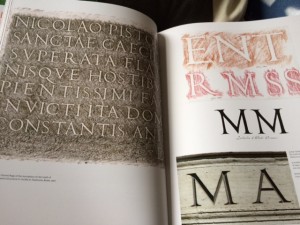
To my delight, [amazon_link id=”0262029014″ target=”_blank” ]The Eternal Letter: Two Millennia of the Classical Roman Capital[/amazon_link] turned up in the post. I know there are plenty of font addicts out there. It’s a beautiful book, a hymn to traditional serif fonts. Although a sans serif person myself, the essays and pictures in this are a delight.

[amazon_image id=”0262029014″ link=”true” target=”_blank” size=”medium” ]The Eternal Letter: Two Millennia of the Classical Roman Capital (Codex Studies in Letterforms)[/amazon_image]

Beautiful letter

Beautiful letter

How to change the world

If you’re involved in your community as a school governor or in a local campaign, or if you’re planning a revolution, I can’t recommend Srdja Popovic’s [amazon_link id=”1922247871″ target=”_blank” ]Blueprint for Revolution [/amazon_link]highly enough. Popovic was a founder of Otpor!, the Serbian anti-Milosevic movement, and of CANVAS, the organisation passing on the lessons of that success to others around the world.

[amazon_image id=”B00RYGKVAW” link=”true” target=”_blank” size=”medium” ]Blueprint for Revolution: how to use rice pudding, Lego men, and other non-violent techniques to galvanise communities, overthrow dictators, or simply change the world[/amazon_image]

[amazon_link id=”1922247871″ target=”_blank” ]Blueprint for Revolution [/amazon_link]does not at all gloss over the fact that every situation is different, and some are much harder to change, so the book is not a detailed ‘how to’ guide for all occasions. But the principles it describes are surely universal: above all, non-violence is vital because (a) if you choose violence you’re taking on your strongman where he is strongest and (b) most people are not violent so you have to choose that route if you want most people on your side. There is also a particular emphasis on using humour as the most effective and universal way of dissipating fear.

I also particularly like just the sheer pragmatism of the book. Start with small issues that lots of people care about – Popovic quotes the immortal line of Liz Lemon, saying most people want a quiet place to sit to eat their sandwich. Go step by step towards a clear ultimate goal (democracy, say) and have a strategy to get there but also be flexible about tactics. Identify the pillars on which your target regime rests and go after them. Plan, plan, plan. Build coalitions: a huge [amazon_link id=”0261103253″ target=”_blank” ]Lord of the Rings[/amazon_link] fan, he notes that while it was the hobbits that won it in the end, it took a group of squabbling elves/dwarves/wizards/humans/hobbits together to ensure victory. Be prepared for the long haul, and don’t think things are over when you topple your dictator (i.e. if your ultimate goal is democracy, there is much further to go after the Tahrir Square moment….)

The book tells the stories of a number of revolutions but makes it clear that the practical lessons apply to any kind of activism from this largest scale to the smallest. Read, digest, and start thinking about the practical jokes.