
More on game theory

The death of John Nash with his wife Alicia in a car accident is a sad, sad end to a remarkable life. The story of Nash’s genius, madness and recovery is well known thanks to the movie based on Sylvia Nasar’s wonderful biography, [amazon_link id=”0571212921″ target=”_blank” ]A Beautiful Mind[/amazon_link]. There have been many obituaries and appreciations. This VoxEU column is an excellent outline of why Nash’s work was so important for economics.** John Cassidy has a nice New Yorker column. [amazon_link id=”0691095272″ target=”_blank” ]The Essential John Nash[/amazon_link] is certainly worth a go – there are pdfs of the introductory material on the Princeton University Press website – and there is plenty of material on the Nobel prize website.

[amazon_image id=”0691095272″ link=”true” target=”_blank” size=”medium” ]The Essential John Nash[/amazon_image]   [amazon_image id=”0571212921″ link=”true” target=”_blank” size=”medium” ]A Beautiful Mind[/amazon_image]

For more on game theory, one very enjoyable historical perspective – looking too at other uses of mathematics in economics – is Paul Strathern’s [amazon_link id=”0140299866″ target=”_blank” ]Dr Strangelove’s Game: A Brief History of Economic Genius[/amazon_link]. It starts with John Von Neumann (giving the impression that Peter Sellers as Dr Strangelove only slightly overacted the role), and Morgenstern ad Von Neumann’s [amazon_link id=”0691130612″ target=”_blank” ]Theory of Games and Economic Behaviour[/amazon_link] and ends with John Nash. Interestingly, Strathern focuses on the difference between co-operative and non-cooperative games rather than zero and non-zero sum. As for the uses of game theory in life, rather than just economics, my favourite book is Dixit and Nalebuff’s [amazon_link id=”0393337170″ target=”_blank” ]The Art of Strategy[/amazon_link] – it has a website where you can read an excerpt.

Step one in using game theory in life is just to think about how other people will react to your actions – something so easy to say, yet so rarely done.*  And how paradoxical that something that seems like common sense had its roots in unusually tortured genius.

[amazon_image id=”0140299866″ link=”true” target=”_blank” size=”medium” ]Dr. Strangelove’s Game: A Brief History of Economic Genius[/amazon_image]  [amazon_image id=”0691130612″ link=”true” target=”_blank” size=”medium” ]Theory of Games and Economic Behavior (Princeton Classic Editions)[/amazon_image]  [amazon_image id=”0393337170″ link=”true” target=”_blank” size=”medium” ]The Art of Strategy: A Game Theorist’s Guide to Success in Business and Life[/amazon_image]

Dr Strangelove, an atypical economist

Dr Strangelove, an atypical economist

*I remember once saying to a room full of policy economists that figuring out the Nash equilibrium in the context of a decision different EU governments were making at the same time meant our policy advice was a no-brainer; not all of them got the point.

** Update for econ anoraks: Note the nice description here of Nash’s bargaining solution as a Possibility Theorem, published at the same time Arrow developed his Impossibility Theorem. I think it’s the unrestricted domain axiom that makes the difference.

Sheep and economists

[amazon_link id=”1846148545″ target=”_blank” ]The Shepherd’s Life: A Tale of the Lake District[/amazon_link] by James Rebanks has been at the top of the bestseller list for a while and deservedly so. It’s a terrific read and very interesting. Anybody who follows the author (@herdyshepherd1) on Twitter will need no encouragement; everybody else should go ahead and read it.

[amazon_image id=”1846148545″ link=”true” target=”_blank” size=”medium” ]The Shepherd’s Life: A Tale of the Lake District[/amazon_image]

This memoir about running a small hill farm is set in a part of the country I love, having grown up in the North West of England and spent many holidays there, including my honeymoon. Most of the Lake District is a National Park, and one of the many themes of the book is the way the economic imperative for more tourism sometimes sits uncomfortably with the needs of farming and the simple fact that there are people who live and work there all the time. The holiday homes crowd out young local families, walkers let their dogs off the lead resulting in sheep dying or aborting their lambs, roads get crowded with cars. The tourists are affluent, the local families usually not – which is why so many run B&Bs on their farms. Herdy Shepherd himself has a second job as a consultant to Unesco on how to ensure tourism helps local communities. “Sometimes I am doing my other work while I am standing in the sheep shed…. A colleague on the phone might say they just heard a sheep. I tell them they imagined it.”

The book is a good reminder to visit and spend, but be respectful. And to keep your dog on its lead.

It also made me reflect about the role of agriculture in advanced economies, and small farms in particular. The Common Agricultural Policy is costly and inefficient. It substantially raises food prices in the EU, makes it harder for farmers in poor countries to sell into world markets, and mainly benefits big farmers in the UK. I certainly don’t think we should only consume home grown food; food imports are a benefit to consumers, because of variety as well as keeping prices down. The repeal of the Corn Laws was a Good Thing.

However, I’ve mellowed slightly in my views over the years. The economists’ market efficiency lens is an important one but in many context not the only one that matters – and the ability to produce local food of high quality with a respect for tradition touches on other important values.

Lakeland sheep, New Year 2005

Lakeland sheep, New Year 2005

A persistent large deficit on food imports is a concern – why are British producers not better able to export? And I now think subsidising small farms (so they can compete against the industrial scale ones), rural tradition and also outcomes such as biodiversity is desirable. At least to a degree: we Brits should ideally be willing to pay a bit more for food to increase the quality of what we eat, and a bit in tax to provide appropriate subsidies, but there are a lot of people in this country with not enough money.

There’s a passage in The Shepherd’s Life about foot and mouth disease in 2001, and the family’s having to slaughter its sheep and cattle. It was an awful time in rural Britain. Rebanks writes: “Had it spread west by a few more fields, the disease would have got onto the unfenced Lakeland fells where it would have decimated the ancient hefted flocks on the commons. Ninety five percent of the Herdwick sheep in the world exist within 20 miles of Coniston and were at grave risk of being wiped out. But an essentially urban government didn’t understand …. The idea that something precious was on the edge of destruction was never really grasped.” Although many flocks were destroyed, not all. Thank goodness.


Heatwave

There are terrible stories emerging from India, suffering an intense heatwave – such as this one from Vice News: Poor people are most affected as hundreds die in Indian heatwave. The story links to a study reporting an increase in the number of urban heatwaves over the period 1970-2012; and now more than half of us live in cities.

Reading these reminded me of Eric Klinenberg’s amazing 2002 book [amazon_link id=”0226443221″ target=”_blank” ]Heatwave: A Social Autopsy of Disaster in Chicago[/amazon_link]. The first warning of impending heatwave was broadcast on Wednesday 12 July 1995; the next day the temperature soared to 106F and the ‘heat index’ to 126F. Roads buckled, trains derailed, city workers sprayed the bridges with water to maintain the structures. People opened fire hydrants and water pressure around the city fell. “The body’s  defenses can only take about 48 hours of uninterrupted exposure to such heat before they break down,” Klinenberg writes in the opening chapter. So from the Friday many people started falling ill. The heatwave lasted until 20 July. There were so many deaths (over 700) that the city had to store bodies in refrigerated trucks in the parking lot of the morgue.

[amazon_image id=”0226443221″ link=”true” target=”_blank” size=”medium” ]Heat Wave: A Social Autopsy of Disaster in Chicago (Illinois)[/amazon_image]

Of course, extreme weather is a natural disaster, but its incidence is uneven because of social, economic and cultural structures. Klinenberg studied the ‘excess’ (i.e. above normal for the place and season) mortality rate in different parts of the city. Not surprisingly, poor people suffered the highest ‘excess death’ rate. The eye-opening thing about the research, though, is that some low income groups had a far worse experience than others. Matching districts for employment rates and average incomes, there was a higher death rate among African-American than among Hispanic people. Because the city authorities responded too slowly, because public services were poorly equipped, vulnerable people such as the elderly and those living alone had only their families and neighbours to rely on, and those social structures were at the time more intact among the recent Hispanic immigrants. Of the 700 who died over those few days, 41 ended up unclaimed by any relatives.

“This book has shown that extreme exogenous forces such as climate have become so disastrous partly because the emerging isolation and privatization, the extreme social and economic inequalities, and the concentrated zones of affluence and poverty in contemporary cities create hazards for vulnerable residents in all seasons,” he writes. None of which has changed anywhere in the 12 years since the book was published. He identifies as causes for concern the increase in the number of people living alone, growing spatial inequality separating social groups, the huge social distance between city governments and the people they serve, and the fact that we have government by PR with few mechanisms for holding the authorities to account on results.

The book ends with a plea to understand the consequences of natural disasters as societal events. That lesson is hardly ever put into practice, unfortunately.

Grass roots

There’s an interesting evaluation of Jane Jacobs in The Architectural Review, arguing that her fabulous book [amazon_link id=”067974195X” target=”_blank” ]The Death and Life of Great American Cities[/amazon_link] misses the real target in attacking ‘planners’ instead of developers, and discounting the scope for state involvement. This made conservatives fond of her, essay author Sharon Zukin argues. But it concludes warmly: “Jacobs’s challenge to maintain the authenticity of urban life still confronts the fear of difference and the hubris of modernising ambition. At a time in which local shopping streets are the target of attacks against a broader alienation, we urgently need to connect her concern with economic development and urban design to our unsettled social condition.”

[amazon_image id=”067974195X” link=”true” target=”_blank” size=”medium” ]The Death and Life of Great American Cities (Vintage)[/amazon_image]

The essay cites the famous ‘sidewalk ballet’ in the second chapter in [amazon_link id=”067974195X” target=”_blank” ]The Death and Life[/amazon_link]:

“Under the seeming disorder of the old city, wherever the old city is working successfully, is a marvelous order for maintaining the safety of the streets and the freedom of the city. It is a complex order. Its essence is intricacy of sidewalk use, bringing with it a constant succession of eyes. This order is all composed of movement and change, and although it is life, not art, we may fancifully call it the art form of the city and liken it to the dance — not to a simple-minded precision dance with everyone kicking up at the same time, twirling in unison and bowing off en masse, but to an intricate ballet in which the individual dancers and ensembles all have distinctive parts which miraculously reinforce each other and compose an orderly whole. The ballet of the good city sidewalk never repeats itself from place to place, and in any once place is always replete with new improvisations.”

Echoes of course of that other grassroots philosopher Adam Smith. Not only: “It is not from the benevolence of the butcher, the brewer, or the baker, that we expect our dinner, but from their regard to their own interest,” from [amazon_link id=”1505577128″ target=”_blank” ]The Wealth of Nations[/amazon_link], but also this from [amazon_link id=”0559612168″ target=”_blank” ]The Theory of Moral Sentiments[/amazon_link]:

“The man of system…is apt to be very wise in his own conceit; and is often so enamoured with the supposed beauty of his own ideal plan of government, that he cannot suffer the smallest deviation from any part of it… He seems to imagine that he can arrange the different members of a great society with as much ease as the hand arranges the different pieces upon a chess-board. He does not consider that in the great chess-board of human society, every single piece has a principle of motion of its own, altogether different from that which the legislature might choose to impress upon it.”

  [amazon_image id=”0143105922″ link=”true” target=”_blank” size=”medium” ]The Theory of Moral Sentiments (Penguin Classics)[/amazon_image]   [amazon_image id=”B00JVST6CA” link=”true” target=”_blank” size=”medium” ]The Wealth of Nations[/amazon_image]

The Social Framework

[amazon_link id=”B0081H4KUA” target=”_blank” ]The Social Framework[/amazon_link] is the title of a short book by John Hicks published in 1942. It’s an introduction, for the general reader, to the then-new fangled concept of national income accounting – beautifully clearly written and very straightforward.

[amazon_image id=”B0081H4KUA” link=”true” target=”_blank” size=”medium” ]The Social Framework. An Introduction to Economics. Third Ed.[/amazon_image]

The book is upfront about the limitations of the exercise. For example, Hicks explains that it is progress if people work on average fewer hours to produce the same quantity of goods and services, even though the national income or output will not rise. Progress can be “deliberately taken out in the form of increased leisure.”

There is a very interesting passage concerning which part of government spending should be counted as national income – in short, the part used to purchase services people would otherwise buy for their own consumption. So police instead of hiring a bodyguard, education and healthcare rightly are included in the total. But – ideally – public spending incurred to facilitate the production of private goods and services should not be. Hicks writes that in principle the total should exclude policing that is a response to general crime (hiring a night watchman would be a cost of production), or military spending needed to fight an aggressor. Interest on national debt should be excluded too. Spending on roads should be included to the extent that travel is final consumption, excluded to the extent that it is an intermediate input into other consumption. This was of course all too hard so the whole of G is included in GDP.

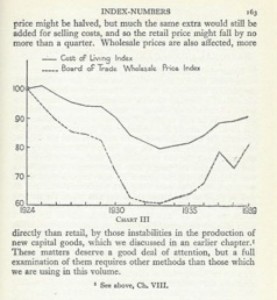
The chapters on price indices and the calculation of real national income are also full of caution, compared to modern usage of the figures. Hicks cautions against over-interpreting changes in real national income: “When there has been a great change in circumstances, as may sometimes happen even with years which are very close together…, any kind of comparison needs to be made with great circumspection. There is a nice chart to remind us what deflation really looks like:

Deflation

Deflation

There are other interesting observations. For instance, that owners (shareholders) have no responsibility for the upkeep or state of the capital equipment they ultimately own; whereas landlords are held responsible for houses or buildings they own and rent to others: “The modern landlord still performs a real function in looking after the capital goods in his ownership, while most other property owners hardly do so any longer.”

The book closes with chapters on progress and inequality. The former is a discussion of the various reasons why national income does not measure progress even though it is the best single indicator possible. The latter chapter ends: “It is important that [inequality of income] should be kept in check; but it is still more important for the future of human freedom that we should not open the door to other devils in its place.” Hicks regards inequality of power as an inevitable feature of society and argues it is better to grow the national income: “Working class standards of living are much more likely to be raised by increases in production… than by changes in distribution.”

Finally, the tone of the book is fascinating. It’s a primer, and so – with the few exceptions noted above – describes the national accounts as if there are no conceptual choices to be made. This is all inevitable or a matter of pure logic. But of course the idea of national accounting was brand new and Hicks was doing a marketing job with this little book.