Economists behaving badly

I woke up this morning to find Roger Farmer and Noah Smith had been discussing my review of Richard Thaler’s excellent new book [amazon_link id=”B00SSKM714″ target=”_blank” ]Misbehaving[/amazon_link]. Roger and Noah are presumably asleep now, giving me the opportunity to chip in again.

To recap, I expressed some unease about the eagerness with which economics is embracing behavioural psychology. Roger agreed, tweeting:

farmerrf
My new post on Behavioural Economics: The Economics of George Orwell http://t.co/mkCiZUmzGe @dine1859 @MarkThoma @Noahpinion
29/06/2015 05:10

Here is his follow-up post on the subject. Noah replied:

Noahpinion
@farmerrf @diane1859 @MarkThoma I already smashed the argument that behaviorism = oppression!
29/06/2015 05:20

His Bloomberg column argues that we economists need to accept whatever the empirical evidence tells us about how people behave and using it to improve our models. The fear of Big Brother government is overdone, he argues.

My anxiety is not really about the paternalism involved in using nudges, because to govern is to be paternalistic which is why elections are vital; and of course it’s preferable to have better than worse outcomes. I’m more worried by the habit almost all economists have of thinking about policy as if society is our play pen and we are benign, omniscient deities, outside society. My sense is that the enthusiasm for behavioural “anomalies” is that it gives us new toys to play with. There is a characteristically striking Adam Curtis blog post on this tendency, which I suggest my students look at when I do the behavioural policies lecture in my course.

So my conclusion is not that we reject behavioural insights, but that we develop a more becoming humility. We pay far more attention to how the data we use are created and what they mean. We remind ourselves that “rational” is not the benchmark from which human behaviour diverges in anomalous way (cf [amazon_link id=”0141015918″ target=”_blank” ]Gerd Gigerenzer[/amazon_link]). We recall that not everyone is like us (especially as most of ‘us’ dominating economic thinking are male, white, western). We note that people change their behaviour in response to policies (as @billwells_1 pointed out in the Twitter debate, arguing it is better to inform people about the consequences of their ‘non-rational’ choices).

billwells_1
@farmerrf @diane1859 If don’t just provide info, unstable over time as people realise they are being conned. https://t.co/kmZhSVZhHy
29/06/2015 07:32

In short, we recognise that economics is a social science characterised by performativity, reflexivity, and great uncertainty. That’s all. (I’ve gone on about this before – anyone interested might like to look at my Tanner Lectures (pdf) and Pro Bono Economics lecture.)


(Ain’t) Misbehaving

Despite having read plenty of the behavioural economics books, of course I had to read [amazon_link id=”B00SSKM714″ target=”_blank” ]Misbehaving: The Making of Behavioural Economics[/amazon_link] by Richard Thaler, one of the first people to introduce and then popularise (through [amazon_link id=”0300122233″ target=”_blank” ]Nudge[/amazon_link] in particular) the introduction of psychological empiricism into economics. Nor do I regret it. It is a very good read. Although it goes over much familiar territory, it’s very interesting to read Thaler’s account of how a highly resistant discipline became accepting and then positively enthusiastic about behavioural models. Too enthusiastic – but more on that later.

[amazon_image id=”B00SSKM714″ link=”true” target=”_blank” size=”medium” ]Misbehaving: The Making of Behavioural Economics[/amazon_image]

[amazon_link id=”B00SSKM714″ target=”_blank” ]Misbehaving[/amazon_link] combines a broadly chronological account of Thaler’s career and work with a highly accessible explanation of what behavioural economics is, how it differs from the previously conventional kind, and the evidence from psychology about how people make decisions. The book starts by explaining why economists had adopted an unrealistic model of rational choice, and why it made economics so powerful: “That power derives from the fact that economics has a unified, core theory from which nearly everything follows.” Certainly early resistance to ‘behavioural’ assumptions tended to be that these derived from an ad hoc list of patterns of choice with no theory behind them, never mind that rational choice is ad hoc with respect to the facts. This seems to be hard for some economists still to accept perhaps because – as Thaler recounts – economists make choices far more often in conformity with their own models than do other groups of people. Misbehaving tells of a survey conducted among wine connoisseurs designed to explore how people regard sunk costs and opportunity costs, in which the people who gave the ‘correct’ answer were economists.

The book has lots of examples that will be useful to people teaching behavioural economics, including classroom experiments. I also very much enjoyed all the anecdotes, like the story of a vigorous debate with Richard Posner at a conference on law and economics, or a session on behavioural finance that had smoke coming out of Merton Miller’s ears. Resistance among distinguished economics professors who had built their glittering careers on rational choice models is, of course, entirely rational. Less rational, more human, was the behaviour of a group of University of Chicago economics faculty in selecting their offices in a brand new building.

Behavioural economics is now one of the most popular areas of the subject, and seminars on behavioural papers are packed. Sometimes it seems pretty much everyone I know has a new paper applying behavioural insights to their own sub-field. Perhaps this is just me being contrarian, but the new embrace by economists makes me uneasy. This is not just because of the well-known debate about paternalism (as discussed by Gilles St Paul in [amazon_link id=”0691128170″ target=”_blank” ]The Tyranny of Utility[/amazon_link] or Julian LeGrand and Bill New in [amazon_link id=”0691164371″ target=”_blank” ]Government Paternalism: Nanny State of helpful Friend?[/amazon_link]) It is because the sight of economists delighting in a new tool to engineer society is alarming – it’s the same old reductionism in more fashionable clothes. I happened to read this morning this essay by historian Ian Beacock on Arnold Toynbee. This quotation jumped out: “We’ve begun to treat vexing social and political dilemmas as simple design flaws, mistakes to be rectified through a technocratic combination of data science and gadgetry.”

I’m 100% in favour of empiricism. Why would you not do ‘what works’? But the behavioural rules of thumb are in danger of being seen as a new policy gadget.

[amazon_image id=”0691128170″ link=”true” target=”_blank” size=”medium” ]The Tyranny of Utility: Behavioral Social Science and the Rise of Paternalism[/amazon_image]   [amazon_image id=”0691164371″ link=”true” target=”_blank” size=”medium” ]Government Paternalism: Nanny State or Helpful Friend?[/amazon_image]

What has Bill Clinton been reading?

To my surprise (especially when I saw the crowd gathered there), I was invited to hear Bill Clinton speak at the ‘Inclusive Capitalism’ conference in London yesterday.

Bill Clinton speaks

Bill Clinton speaks

His speech urged the gathered City folk to behave better, which struck me as worthy but a bit motherhood and apple pie – and therefore not very political. Still, it was interesting, and I noted that he cited three books: Amartya Sen’s [amazon_link id=”0141027800″ target=”_blank” ]Identity and Violence: The Illusion of Destiny[/amazon_link]; E.O.Wilson’s [amazon_link id=”0871403633″ target=”_blank” ]The Social Conquest of Earth[/amazon_link]; and [amazon_link id=”0470398515″ target=”_blank” ]Enough: True Measures of Money, Business and Life[/amazon_link] by John Bogle. I hadn’t heard of the last of these but for obvious reasons like the title.

[amazon_image id=”0141027800″ link=”true” target=”_blank” size=”medium” ]Identity and Violence: The Illusion of Destiny[/amazon_image]  [amazon_image id=”0871403633″ link=”true” target=”_blank” size=”medium” ]The Social Conquest of Earth[/amazon_image]  [amazon_image id=”0470398515″ link=”true” target=”_blank” size=”medium” ]Enough!: True Measures of Money, Business, and Life[/amazon_image]

Growth, happiness and misbehaving

I’m enjoying reading Richard Thaler’s [amazon_link id=”B00SSKM714″ target=”_blank” ]Misbehaving: The Making of Behavioural Economics.[/amazon_link] At about the half way stage, there hasn’t been anything startlingly new in terms of the economic content, as the book is addressing general readers rather than economists who have already read widely on the subject. It is very well written and also interesting to hear from Thaler what it felt like to be one of the pioneers in this field.

[amazon_image id=”B00SSKM714″ link=”true” target=”_blank” size=”medium” ]Misbehaving: The Making of Behavioural Economics[/amazon_image]

There are also some very interesting new (to me) insights. For instance, I’d never really thought before about the importance of changes from the reference point in prospect theory. Thaler writes: “Kahneman and Tversky recognized that we had to change our focus from levels of wealth to changes in wealth. This may sound like a subtle tweak, but switching the focus to changes as opposed to levels is a radical move….. Changes are the way humans experience life.”

This is the consequence – obvious when you think about it – of the hedonic treadmill, of acclimatising to a situation. Over in the well-being literature, this is often taken as helping explain the Easterlin paradox, the implication being that “we”/policy should help push people off the hedonic treadmill above high-enough income levels, by demoting or even somehow halting growth. But it seems to me to imply the contrary, that it makes growth very important for well-being. Just as some of the empirical work indicates.

I’ll review the book when I’ve finished – which will be at the weekend as I need something smaller to pack in my bag for the train tomorrow.

Cities, infrastructure and growth

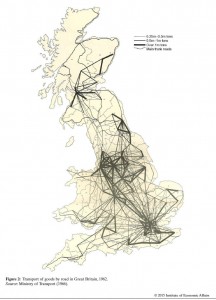
By way of a follow up to yesterday’s post on the new book [amazon_link id=”1781952515″ target=”_blank” ]Urban Economics and Urban Policy[/amazon_link], I read recently a very interesting paper by David Starkie (Investment and Growth: The Impact of Britain’s Post-War Trunk Roads Programme, In Economic Affairs, Feb 2015) in which he argues that the construction of the British motorways in the 1960s and 70s had no discernible effect on productivity and growth. One reason was that pre-existing commercial traffic was intra-regional whereas the motorways radiated out from London. Contrast yesterday’s map of how the motorways were planned:

Motorway planning

Motorway planning

with this map from the article showing road freight patterns in the 1950s, before the construction of the motorways.

1950s road freight

1950s road freight

A second reason was that the productivity advantage from time saving was eaten by higher real wages and lower labour productivity. Although it is always hard to discern the effect of specific investments or technologies in GDP growth figures (as the cliometrics literature dating back to Vogel has found over and over – see Nick Crafts on why one should not read too much into the small numbers), I wholly agree with David’s conclusions:

“First, economic relationships are complex and changes can lead to unexpected consequences….Second, the time taken for institutions and commercial structures to
adapt to change can extend over decades, which suggests that the impact on output and growth will be long-term… [Third], as the structure of the economy adapts to transport improvements, there is not necessarily a (sizable) net gain but a partial shift in activity into new economic sectors and geographical areas.”

I’ve argued on the FT’s blog The Exchange that standard cost-benefit analysis does not do a good job when it comes to big infrastructure projects (like a motorway or HS2) because it is a tool for assessing marginal changes, not ones which might involve large non-linearities – behaviour changes or network effects.There is some work being done on non-marginal CBA (eg Cameron Hepburn’s paper for example) but it is not (yet?) standard practice.

Like many/most economists, I think we need much more infrastructure investment now – see for example the report of the LSE Growth Commission, [amazon_link id=”1909890022″ target=”_blank” ]Investing for Prosperity[/amazon_link]. My reading of the trunk roads article is that David Starkie would be more sceptical than I am but we certainly share the point about complex, long and uncertain responses; it isn’t about saving 20 minutes on your journey time to increase the amount of time you can spend in a meeting at the other end.

[amazon_image id=”1909890022″ link=”true” target=”_blank” size=”medium” ]Investing for Prosperity: A Manifesto for Growth[/amazon_image]