
Measuring and markets

I’ve been reading Michel Callon’s introduction to the edited volume [amazon_link id=”0631206086″ target=”_blank” ]Laws of Markets.[/amazon_link] It’s about the performativity of economics, a question that interests me (although I do struggle with the academic jargon of sociology; at least my own subject’s jargon is familiar). Callon writes: “The most interesting element is to be found in the relationship between what is to be measured and the tools used to measure it. The latter do not merely record a reality independent of themselves; they contribute powerfully to shaping, simply by measuring it, the reality that they measure.”

[amazon_image id=”0631206086″ link=”true” target=”_blank” size=”medium” ]Laws of Markets (Sociological Review Monographs)[/amazon_image]

Needless to say, the question of how the classification and structures embedded in economic statistics shape the reality of the economy (through affecting understanding, behaviour and policy) is of keen interest to me. For instance, part of the debate about productivity is about what it measures, but also partly about what it defines. What is productivity when products play a minority role in economic activity? The Callon intro doesn’t ultimately enlighten: it seems to me to place too much weight on economics as a subject, for markets existed long before economists did. There has to be some two-way influence between reality and the attempt to make systematic a description of it. In fact, I don’t think economics is as different from some other subjects as the performativity analyses suggest. For instance, classification in biology is not completely dissimilar. I also wish other social scientists would acknowledge that economists *do* think a lot about the specifics of markets as social institutions – see, for one, John McMillan’s brilliant book [amazon_link id=”0393323714″ target=”_blank” ]Reinventing the Bazaar.[/amazon_link]

[amazon_image id=”0393323714″ link=”true” target=”_blank” size=”medium” ]Reinventing the Bazaar: A Natural History of Markets[/amazon_image]


Still, there is something in this territory. It’s particularly important for sustainability that the concepts and measurements economists define and gather place ‘the economy’ in nature and the physical world. To be continued…
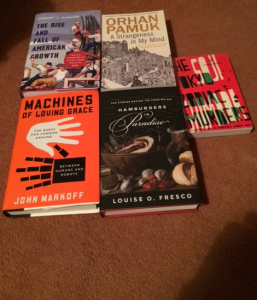
Holiday reading

All lined up, just in case Santa doesn’t bring me any books. What about the rest of you?

Lined up for the holiday

Lined up for the holiday

[amazon_link id=”0691147728″ target=”_blank” ]The Rise and Fall of American Growth[/amazon_link] – Robert Gordon

[amazon_link id=”0062266683″ target=”_blank” ]Machines of Loving Grace[/amazon_link] – John Markoff

[amazon_link id=”0571275974″ target=”_blank” ]A Strangeness in My Mind[/amazon_link] – Orhan Pamuk

[amazon_link id=”0691163871″ target=”_blank” ]Hamburgers in Paradise[/amazon_link] – Louse Fresco

[amazon_link id=”1782271384″ target=”_blank” ]The Tokyo Zodiac Murders[/amazon_link] – Soji Shimada

Bringing ideas to the world

Last week I attended the European Advisory Board meeting of Princeton University Press, the theme of the discussion being the role of university presses in the globalized 21st century. A while ago Sam Leith had an interesting article in the Guardian praising university presses for their stewardship of non-fiction publishing at a time when many commercial publishers have become fearful ‘me-too’ merchants. It could seem paradoxical: the university presses’ freedom from short term commercial pressure has created the conditions for longer term success, at least for some. Happily, Princeton University Press is one of those that’s thriving. There is a huge appetite for ideas, and the scholarly presses publishing books that address a wider audience than only academics and their libraries have been there to meet it. The appetite is also global, and again a small group of university presses have addressed the global market (much of PUP’s recent growth has been outside its home market in the US).

The other question is what will the ‘university’ part of ‘global university press’ look like in a decade or two? Higher education is ripe for disruption. It seems clear now this will not take the form of MOOCs, although they will have their market. Yet who knows what shape exactly it will take. One of my advisory board colleagues suggested publishing could be able to provide the true interdisciplinarity modern global issues require, whereas traditional university departmental silos discourage it. My hunch is that keeping a clear focus on the ‘product’ being the provision of ideas and scholarship to readers of all kinds around the world, and being agnostic about the exact means of delivering those ideas, will be the way to ride out disruptive technologies. A ‘freemium’ approach looks a good bet too: for example, the open access Digital Einstein website alongside the Quotable Einstein along with many other of his books for sale. (I note by the way there’s a holiday discount at the moment on purchases via the PUP website!)

My latest three books have been published by Princeton, and I’m delighted to be associated with such a distinguished purveyor of ideas to the world. During the holidays I’ll do my look ahead to forthcoming books in 2016 (publishers – do send me catalogues if you haven’t already) but here’s a trailer for just a few PUP titles for 2016: [amazon_link id=”B017MVYMSA” target=”_blank” ]Money Changes Everything: How Finance Made Civilization Possible[/amazon_link] by William Goetzmann; [amazon_link id=”0691167400″ target=”_blank” ]Success and Luck: Good Fortune and the Myth of Meritocracy[/amazon_link] by Robert Frank; and – just arrived at Enlightenment Towers, due for publicaiton on 27 January, Robert Gordon’s [amazon_link id=”B0131KW67U” target=”_blank” ]The Rise and Fall of American Growth: The US Standard of Living since the Civil War[/amazon_link]. I’m really looking forward to reading this over the holiday, & spoiling for a fight with Prof Gordon – but who knows, maybe he’ll win me over to his ‘innovation is so over’ thesis.

[amazon_image id=”B017MVYMSA” link=”true” target=”_blank” size=”medium” ]Money Changes Everything: How Finance Made Civilization Possible[/amazon_image]  [amazon_image id=”0691167400″ link=”true” target=”_blank” size=”medium” ]Success and Luck: Good Fortune and the Myth of Meritocracy[/amazon_image]  [amazon_image id=”B0131KW67U” link=”true” target=”_blank” size=”medium” ]The Rise and Fall of American Growth: The U.S. Standard of Living since the Civil War (The Princeton Economic History of the Western World)[/amazon_image]


Debt, debt, debt, debt

I’m rather late to [amazon_link id=”022627165X” target=”_blank” ]House of Debt[/amazon_link] by Atif Mian and Amir Sufi, which is recently out in paperback. It argues eloquently and persuasively that the Great Financial Crisis was not only a banking crisis but also a household debt crisis, and that the length and severity of the downturn can largely be explained by the private debt overhang. This is not the received wisdom, of course. All the policy attention has focused on the near-catastrophe of the banking meltdown, and it is terrifying even now to think how serious the economic consequences would have been if the payments systems had stopped working, as they almost did in the UK. The book acknowledges that the authorities were absolutely right to act swiftly to prevent banking meltdown, and argues that more would have been better – more in the sense of the famous ‘helicopter money’ drop advocated by Adair Turner, for one, in his recent [amazon_link id=”0691169640″ target=”_blank” ]Between Debt and the Devil.[/amazon_link]

[amazon_image id=”022627165X” link=”true” target=”_blank” size=”medium” ]House of Debt: How They (and You) Caused the Great Recession, and How We Can Prevent It from Happening Again[/amazon_image]

However, Mian and Sufi also point out that while political campaign contributions can be shown to have led the US Congress to support bank bailouts, there was next to no household debt relief. The core of their argument is that the effects of household leverage spilled over to the whole US economy, and that writing off some of the debt owed by homeowners underwater (not because of idleness or irresponsibility but because of a macro shock) would have benefited everyone. I found their argument convincing, along with the corollary that you can not fix an excess debt problem by getting people to take on more debt. The book makes a strong case for reducing the attractiveness of debt, due in large part to the tax system. They write:

“Debt instruments lead investors to focus on a very small part of the potential set of outcomes …In a world of neglected risks, financial innovation should be viewed with some degree of scepticism. If investors systematically ignore certain outcomes, financial innovation may just be secret code for bankers trying to fool investors into buying securities that look safe but are actually extremely vulnerable.” They are also critical of the extent of the bailouts for the financial sector: “The fundamental business of a bank is lending, just as the fundamental business of a furniture company is to sell furniture. Few economist believe that the government should promote the sale of bad furniture by stepping in to protect the creditors and shareholders of a poorly performing furniture company.” This understates the externalities involved in a bank failure, of course, and – as I noted – Mian and Sufi do not condemn the authorities’ response in 2008/9.

Given where we are, they advocate instead a range of measures to reduce debt dependence in future, including levelling the tax code as between debt and equity, and encouraging the use of more equity-like financial instruments, including in lending for home purchase. They cite approvingly Bob Shiller’s suggestions for instruments to insure against macro risks (in his book [amazon_link id=”B00C791JJI” target=”_blank” ]Finance and the Good Society[/amazon_link]) and [amazon_link id=”B00HZ634AU” target=”_blank” ]Admati and Hellwig'[/amazon_link]s advocacy for far higher levels of equity as opposed to be debt to be required on banks’ balance sheets. These kinds of arguments are slowly making headway in both economics and in policy circles. But slowly. Meanwhile, what is terrifiying is the evidence of a re-inflating of the debt bubble in some economies, including the UK. Can we really be ready to risk going around the same hamster wheel again, just because the financial sector lobbies so effectively?

Thinking about welfare economics – or not

I’ve been reading I.M.D.Little’s [amazon_link id=”0198281196″ target=”_blank” ]Critique of Welfare Economics[/amazon_link] (1950 originally – I have Andrew Sentance’s slight musty, rescued from his garage, 1973 paperback). He wrote: “There can be no significance in national-income comparisons unless a value judgement about changes in distribution is presupposed. But statisticians … do not, of course, wish to make any such presupposition.” He continues that they can tell us that the market value of consumption goods has increased, but cannot conclude that consumption has increased. “There is, after all, no such thing as consumption, the size of which can be measured.”

[amazon_image id=”0198281196″ link=”true” target=”_blank” size=”medium” ]A Critique of Welfare Economics[/amazon_image]

Winging its way to me now, courtesy of a recommendation by Martin Wolf, is [amazon_link id=”0521094461″ target=”_blank” ]Theoretical Welfare Economics[/amazon_link] by J de V Graaff (1957), which one contemporary review described as “an elegantly executed demolition of ordinary welfare theory.” I don’t need a lot of persuading about the demolition-worthiness of the theory but it does leave rather a huge question about (a) what we think we’re measuring with the national accounts and (b) what we think standard evaluations of public policy are telling us. The answer, of course, is that mostly we don’t think about it.

[amazon_image id=”0521094461″ link=”true” target=”_blank” size=”medium” ]Theoretical Welfare Economics[/amazon_image]