Ghetto injustice

I’ve been dipping into Dark Ghettos: Injustice, Dissent and Reform by Tommie Shelby. It’s a philosophy text so I’m unlikely to read the whole book – the professional language of philosophy is hard work. However, the main argument seems well worth social scientists reflecting on. Shelby’s argument is that the debate about ghettos (and he’s writing about black urban ghettos in the US but it would apply to other communities segregated by low incomes, bad housing, inadequate services, ill health, cirme etc etc) is that it is an error to see them as ‘problems’ that need fixing. The ‘what works’ debate, what he refers to as the ‘medical model’, has serious limitations. “Policymakers working within the medical model treat the background structure of society as given and focus only on alleviating the burdens of the disadvantaged.” The aim is to fit the inhabitants for greater success within an existing social system (whether you diagnose the ‘problem’ either as specific external barriers or the attitudes and/or culture of the people themsevels). “Features of society that can and should be altered get little scrutiny.”

He adds that technocratic reasoning removes the political agency of the inhabitants – and indeed blinds policymakers to the possibility that what they see as social dysfunction is in fact rational resistance to injustice. The book must have been written long before the politcal shocks of this year, but that comment about the limits of technocracy certainly strikes a chord now. This perhaps isn’t a new tension, Daniel Bell having pointed it out a generation ago, but it has reached a critical point now.

51es4qxcdbl

Accounting for knowledge

I’ve just read Frtiz Machlup’s 1973 The Production and Distribution of Knowledge in the United States. It seems very prescient. For instance, “There is probably … validity in the hypothesis that the increase in the ration of knowledge-producing labor to physical labor is strongly associated with the increase in productivity and thus with the rate of economic growth,” (although he also notes that some argue the opposite, that there are diminishing returns to knowledge-production – see this for a recent update). And, “Much of the production of knowledge depends on governmental appropriations.”

My favourite: “The facts that the production of knowledge of several types is paid for by other than the users of the knowledge, and that these types of knowledge have no market prices, raise questions of their valuation for national income accounting as well as for welfare-economic considerations.” Yes indeedy.31asgpfk1l

When Michael Lewis came to dinner

That Michael Lewis came to dinner at our house once. This was about 30 years ago, when he was dating a friend of mine for a while, and before Liar’s Poker made him famous. He was charming – working in finance – but if only I’d known who he’d turn into, I’d have quizzed him closely about his stellar writing technique.

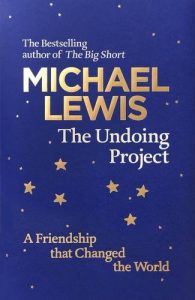
I’ve just devoured The Undoing Project, his much-trailed book about Daniel Kahneman and Amos Tversky, and their launching of the behavioural revolution in economics, over two evenings. It’s a wonderful book. I heartily recommend it as a Christmas gift for the economists in your life, or a treat for yourself over the holiday.

The book weaves together the personal and intellectual biographies of its protagonists. It explains the ideas, including the paradoxes requiring one to think about probabilities, beautifully clearly. It’s also just a terrific human story about an intense creative friendship as it flowed, and ebbed, over the decades and continents. If they’re not always totally likeable, the two characters are always immensely sympathetic.

It will surely send many readers on to Kahneman’s Thinking Fast and Slow, which requires some mental effort but everybody who fancies themselves an intelligent, educated person ought to have read. Although I’ve read loads of behavioural economics books and papers, and so think I know about a lot of the insights the literature has given us about how our decision-making processes function, there were still some new (to me) ones in The Undoing Project. These are two I found. Tversky had a rule that you must wait a day before replying to any invitation, even one you wanted to accept. It becoms much easier to decline the ones you don’t want. This is advice I definitely need to follow.

The other comes from thinking about reversion to the mean. An exceptionally (beyond average) good or bad performance is usually followed by one that is less good or less bad (closer to average).  Yet coaches and teachers and bosses often hold that if you praise someone for doing well, they do less well next time, and if you shout at someone for doing badly, they do better next time.  “Because we tend to reward others when they do well and punish them when they do badly, and because there is regression to the mean, it is part of the human condition that we are statistically punished for rewarding others and rewarded for punishing them,” wrote Kahneman. This strikes me as profound and something one ought to act on.

It was surprising to learn that at the height of his fame, in the years before his death, Tversky was bugged by the criticism of their work by Gerd Gigerenzer. I’ve never seen Gigernenzer’s argument that heuristic rules of thumb were rational because they economized on brain energy as a fundamental attack on Kahneman and Tversky, more an extension. There’s surely loads still to be discovered about decision making (especially under uncertainty), not least when decisions are conventionally ‘rational’ versus when ‘behavioural’ behaviour kicks in.

As economics is all about decision-making in the domain of resource use and allocation, this overlap with psychology and cognitive science is an exciting area – even though I’m deeply uneasy about the eagerness with which some economists and policy makers are leaping to adopt ‘nudges’ as another handy tool for social engineers to get the people to behave as they ought. We certainly ought to be teaching this at A level and in universities. The Undoing Project is a great book to introduce behavioural economics – and a cracking good story, told by a master.

41nlqhg0xl

Another 2017 book to look forward to

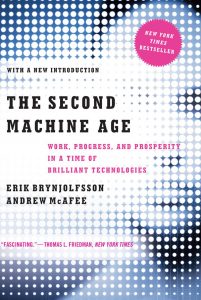
This one, from Norton’s Spring catalogue, is the latest from Andrew McAfee and Erik Bryjolfosson, Machine, Platform, Crowd: Harnessing the Digital Revolution.

I’m sure their follow up to The Second Machine Age  and Race Against the Machine will be just as interesting as the others. Here’s the blurb: “We live in strange times. A machine plays the strategy game Go better than any human; upstarts like Apple and Google destroy industry stalwarts such as Nokia; ideas from the crowd are repeatedly more innovative than corporate research labs. MIT’s Andrew McAfee and Erik Brynjolfsson know what it takes to master this digital-powered shift: we must rethink the integration of minds and machines, of products and platforms, and of the core and the crowd. In all three cases, the balance now favors the second element of the pair, with massive implications for how we run our companies and live our lives. In the tradition of agenda-setting classics like Clay Christensen’s The Innovator’s Dilemma, McAfee and Brynjolfsson deliver both a penetrating analysis of a new world and a toolkit for thriving in it. For startups and established businesses, or for anyone interested in what the future holds, Machine, Platform, Crowd is essential reading.”

51tmnmc05ll

71dsb9qnoll

Have we run out of innovations?

I’ve been reading old articles about about hedonic adjustment and followed one trail to a 1983 paper by William Nordhaus about the productivity slowdown between the 1960s and 1970s. He wrote: “Is it not likely that we have temporarily exhausted many of the avenues that were leading to rapid technological change?” (1981 working paper version here). Timothy Bresnahan and Robert Gordon pounce on this in their introduction to the 1996 NBER volume they edited on The Economics of New Goods: “The world is running out of new ideas just as Texas has run out of oil. Most new goods now, compared with those of a century ago, are not founding whole new product categories or meeting whole new classes of needs.” (Apropos of Texan oil, see this: Mammoth Texas oil discovery biggest ever in USA, November 2016.)

Gordon has, of course, doubled down on this argument in his magisterial The Rise and Fall of American Growth. (It is btw a great holiday read – curl up under a blanket for a couple of days.)

This reminded me I’d seen this post by Alex Tabarrok at Marginal Revolution:  A Very Depressing Paper on the Great Stagnation.

I haven’t yet read the paper it refers to, nor the earlier Jones one, and will do of course. It’s just that it seems we’ve been running out of ideas for over 30 years. I’ll say nothing about sequencing the genome and the consequent medical advances, new materials such as graphene, advances in photovoltaics, 3G/wifi/smartphones, not to mention current progress in AI, robotics, electric cars, interplanetary exploration. Oh, and chocolate HobNobs, introduced in 1987. Excellent for productivity.

For the time being, I’m going to stick with the hypothesis that we haven’t run out of ideas.