
Learning about (machine) learning

Last week I trotted off for my first Davos experience with four books in my bag and managed to read only one – no doubt old hands could have warned me what a full-on (and rather weird) experience it is. The one (and that read mainly on the journeys) was The Master Algorithm by Pedro Domingos. I was impressed when I heard him speak last year & have been meaning to read it ever since.

The book is a very useful overview of how machine learning algorithms work, and if you’ve been wondering, I highly recommend it. On the whole it stays non-technical, although with lapses – and I could have done without the lame jokes, no doubt inserted for accessibility. The book also has an argument to make: that there is an ultimate ‘master algorithm’, a sort of Grand Unified Theory of learning. This was a bit of a distraction, especially as there’s an early chapter doing the advocacy before the later chapters explaining what Domingos hopes will eventually be unified.

However, the flaws are minor. I learned a lot about both the history of the field and its recent practice, along with some insights as to how quickly it’s progressing in different domains and therefore what we might expect to be possible soon. Successive chapters set out the currently competing algorithmic approaches (the book identifies five), explains their history within the discipline and how they relate to each other, how they work and what they are used for. There is an early section on the importance of data.

As a by the by, I agree wholeheartedly with this observation: “To make progress, every field of science needs to have data commensurate with the complexity of the phenomena it studies.” This in my view is why macroeconomics is in such a weak state compared to applied microeconomics: the latter has large data sets, and ever more of them, but macro data is sparse. It doesn’t need more theories but more data. Nate Silver made a simliar point in his book The Signal and the Noise – he pointed out that weather forecasts improved by gathering much more data, in contrast to macro forecasting.

Another interesting point Domingos makes en passant is how much more energy machines need than do brains: “Your brain uses only as much power as a small lightbulb.” As the bitcoin environmental disaster makes plain, energy consumption may be the achilles heel of the next phase of the digital revolution.

I don’t know whether or not one day all the algorithmic approaches will be combined into one master algorithm – I couldn’t work out why unification was a better option than horses for courses. But never mind. This is a terrific book to learn about machine learning.

[amazon_link asins=’0141979240′ template=’ProductAd’ store=’enlighteconom-21′ marketplace=’UK’ link_id=’9a717446-0355-11e8-b4b1-ab0c19ae6d50′]
Moral sentiments and economics

Having read it some years ago, I’ve been looking through Economic Analysis, Moral Philosophy and Public Policy by Daniel Hausman and Michael McPherson while revising a paper for publication. It reminded me – if ever I absorbed it properly in the first place – that economists use the word ‘normative’ in a specific sense. It means, to us, the opposite of positive, something involving ethics or value judgements, and therefore outside the scope of what economists aim to do. We concentrate on ‘positive’ questions, following the distinction famously made by Milton Friedman, and Lionel Robbins before him.

However, as Hausman and McPherson argue, while economists claim ethical issues are a sphere apart, they/we often assume rationality – and that itself implies a moral stance. “Like morality, rationality is normative. One ought to be rational. One is wicked if not moral and foolish if not rational.” The book goes on to argue the case that the “moral principles implicit in standard views of rationality are implausible.” As a card carrying economist, I don’t agree with all they say here, but do wholeheartedly agree that economics and ‘moral sentiments’ cannot be separated. The impartiality economics aims for in trying to insist on being a ‘positive’ science is laudable, and economics should continue to distinguish the technical and value-laden elements of analysis. But we should not continue to shy away from the ethical debate. Doing so has not served the reputation of economics at all well.

[amazon_link asins=’B01K2OJW5M’ template=’ProductAd’ store=’enlighteconom-21′ marketplace=’UK’ link_id=’11571e98-02ad-11e8-81e4-e1ad487aeb46′]  [amazon_link asins=’0143105922′ template=’ProductAd’ store=’enlighteconom-21′ marketplace=’UK’ link_id=’29f945b3-02ad-11e8-8fe7-af3979fb499a’]

What are top people reading?

It’s always interesting to hear what books people refer to at a conference. At the end of last week I attended one with people in the UK and French business and policy worlds. These were the titles I noted being mentioned:

Life 3.0 by Max Tegmark

[amazon_link asins=’024123719X’ template=’ProductAd’ store=’enlighteconom-21′ marketplace=’UK’ link_id=’28202214-fea6-11e7-9f80-b930bb5a1cf8′]

WTF by Robert Peston

[amazon_link asins=’1473661293′ template=’ProductAd’ store=’enlighteconom-21′ marketplace=’UK’ link_id=’300e0278-fea6-11e7-882d-016f53bb0e26′]

I, Robot by Isaac Asimov

[amazon_link asins=’000753227X’ template=’ProductAd’ store=’enlighteconom-21′ marketplace=’UK’ link_id=’373ed436-fea6-11e7-9e41-7df8851a935e’]

Homo Deus by Noal Yuval Harari

[amazon_link asins=’1784703931′ template=’ProductAd’ store=’enlighteconom-21′ marketplace=’UK’ link_id=’3e4f9b04-fea6-11e7-ac38-09b16fdcf4cf’]

Les trentes glorieuses by Jean Fourastié

[amazon_link asins=’2818501997′ template=’ProductAd’ store=’enlighteconom-21′ marketplace=’UK’ link_id=’474463d6-fea6-11e7-8621-691ddd55ed64′]

Devil’s Bargain by Joshua Green

[amazon_link asins=’1911617125′ template=’ProductAd’ store=’enlighteconom-21′ marketplace=’UK’ link_id=’4f9991dd-fea6-11e7-b789-5339f3e9ee8e’]

This week I’m going (for the 2nd time – the 1st was in 2001) to the World Economic Forum in Davos – feeling a bit like one of the entertainers on board a cruise liner, as I’ll be talking about measuring the economy. I’ll report back on the reading materials of the global elite. I’ll miss Donald Trump’s speech on Friday but doubt he’ll be citing many books, so that’s ok.

Growth, no growth, degrowth

I just read the 2nd edition of Tim Jackson’s now-classic Prosperity Without Growth, which has been out for a few months, and it’s a book I’d recommend to anyone but especially economics students. Although most students do now learn about environmental constraints and trade-offs, we do socialize them quickly into thinking about economic growth as the objective of policy. It is all too clear that the failure to take account of externalities and the depletion of natural capital assets means we’ve paid a high price for past growth. Measuring these better to ensure they’re incorporated in the choices society makes is part of my own research.

Havings said this, and commending the book, I have one central problem with its argument, as with some others making similar arguments. And that turns on the understanding of what (GDP) growth consists in. Even those who acknowledge the importance of services in the economy – as Tim Jackson does – then consistently talk about growth as consumer demand for material products, for stuff: “How is it that with so much stuff already we still hunger for more? Would it not be better to halt the relentless pursuit of growth in the advanced economies and concentrate instead on sharing out the available resources more equitably?” So stuff and growth are conflated.

As I’ve been pointing out for 20 years, growth in the advanced economies is increasingly non-material – accepting that we import stuff embodied in goods, which must be accounted for. The archetype of modern growth is a new idea – that an aspirin can avert cardio-vascular problems as well as cure headaches; that apps on one device can replace multiple material objects.

This is why indicators like the Genuine Progress Indicator, that flatline from the 1970s on while GDP rises, are so unpersuasive. I disagree with Tim when he writes: “[T]he continued pursuit of economic growth doesn’t appear to advance and may impede human happiness.” So although I agree completely that the usefulness of GDP as a welfare measure is declining, I don’t think we know how to weigh against each other the environmental minuses and innovation pluses. This is why I’m obsessed with how we conceptualise and measure society’s economic welfare, including measuring assets to give us a handle on sustainability; but many of the innovations do advance human well-being. I remember the 1970s, and though the music was better, many aspects of life were far less satisfying. Patti Smith and Siouxsie & the Banshees aren’t enough to make me want to turn the clock back.

This is an important, possibly existential debate, so I hope the book is being widely read. I also appreciate its (only slightly lukewarm) defence of economics: contrary to the impression some environmetalists seem to give, many economists care passionately about our environment and sustainability, & we think our intellectual tools can make a useful contribution.

[amazon_link asins=’1138935417′ template=’ProductAd’ store=’enlighteconom-21′ marketplace=’UK’ link_id=’296b0ae2-fea1-11e7-b656-83c781ce09d8′]

Exact Thinking in Demented Times

I bought Exact Thinking in Demented Times by Karl Sigmund for the genius title, and absolutely loved the book. The subtitle explains what it’s about: The Vienna Circle and the Epic Quest for the Foundations of Science. Karl Sigmund, the flyleaf tells me, is a maths professor at the University of Vienna and one of the pioneers of evolutionary game theory. He also co-curated an exhibition on the Vienna Circle, the inter-war group of philosophers, mathematicians and physicists who between them revolutionised the world’s understanding of – well, the world. Against idealism and metaphysics, seeking the unity of science, their logical positivism transformed Anglo-American philosophy, not least because so many of the Circle’s members had to flee Austria in the 1930s.

Who would have thought this could make a rip-roaring read? The book explains the philosophy and maths in just enough detail – there were a few bits about the maths I decided not to re-read – and weaves the ideas with the personalities, friendships and jealousies. It adds up to a wonderful intellectual history of a place and time. Jenny Uglow’s equally wonderful The Lunar Men would be a good comparator.

I’m not a big fan of logical positivism, or so I thought. Exact/Demented sent me back to my undergraduate copy of A J Ayer’s Language, Truth and Logic, which introduced the ideas to the British public (well, bits of it). I wrote the date inside, and I must have bought it enthusiastically in my first week at Oxford. Looking again reminded me how frustrating I found what seemed like meaningless quibbles about words – “easily understood by the layman”, the back cover claims. Hah! However, Exact/Demented gives a much richer account of the strands of thought in the Vienna Circle and makes it clear that the linguistic rabbit hole was but one element of the underlying empiricism. The account also completely reinforces my belief that Wittgenstein’s work is objectively meaningless and what’s more he was a complete pillock. (Although when I tweeted something from Douglas Hoftstadter’s intro to the book to the same effect, it turned out there are a few pro-Wittgenstein trolls on Twitter, so I’ll get into trouble with them again.)

Other obvious characters feature in the story, such as Kurt Godel, Rudolf Carnap and the positivism critic Karl Popper, as well as Einstein, and lesser known (to me) people, including the Circle’s leading light Moritz Schlick, and some economists orbiting around (Oskar Morgenstern, John von Neumann). The story is bookended by two murders of philosophers, and two tragic world wars. The Vienna Circle survivors ended up split between universities in the US and UK – on one occasion Bertrand Russell, Albert Einstein, Kurt Godel and Wolfgang Pauli all ended up socialising in Princeton, discussing time travel. What an occasion.

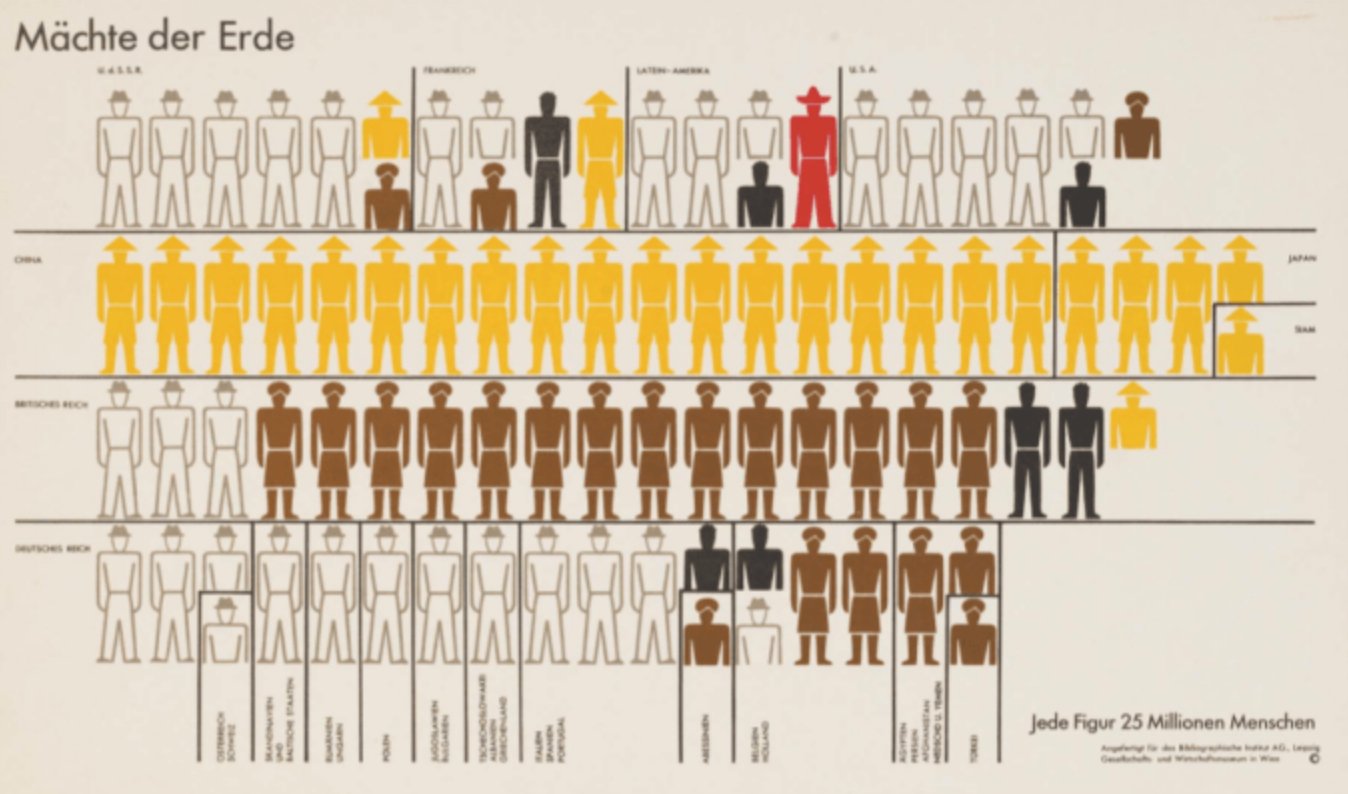
Given my own research interest at the moment, I was particularly pleased to learn about Otto Neurath’s innovative data visualization method, through his Institute for Pictorial Statistics, designed to present socio-economic statistics in a form most people could understand. The signature style was the use of rows of little human figures, which ended up being called ‘Isotype’. Who knew infographics were invented in the 1930s?

Poignantly, in 1939 Otto Neurath published a bestseller called Modern Man in the Making. “It employed a tight mesh of texts and pictures to describe the dawning world of globalized exchange, international migration and limitless progress.” How his readers must have been wishing that were true.

And this is the other attraction of this wonderful book. Its subtext throughout is both the need for and the threat to Exact Thinking in Demented Times, a message relevant today.

[amazon_link asins=’0465096956′ template=’ProductAd’ store=’enlighteconom-21′ marketplace=’UK’ link_id=’36b4c5e3-f931-11e7-9b5d-2fc3a9a6874f’]