Economics and philosophy

UPDATE 2 – I’ve now done some sorting of the list. OK, the categorisation is inevitably arbitrary but it seemed helpful as the list got so long. More suggestions in the comments. And huge thanks to all who contributed.


Econtwitter is wonderful. Yesterday, an undergraduate emailed me to ask for book recommendations about the overlap between economics and philosophy. I recommended:

Agnar Sandmo Economics Evolving 
and
D M Hausman and M S McPherson and D Satz Economic analysis, moral philosophy, and public policy 

Then I asked Twitter, and here is the resulting, much longer, list. I won’t editorialise about them, although some are not good undergraduate intros in my view. One striking thing is how few recent overviews there are, however (as @esamjones also pointed out on Twitter). Huge thanks to all who made suggestions. This is a fantastic collective list.

UPDATE Now even more added – but this goes far beyond the original brief for an introduction for an undergraduate. There’s also a bias in the recommendations toward books critical of economics (or at least its ‘mainstream’) and, again, I think for an economics undergraduate a more neutral intro would be a better starting point. Anyway, I leave this here as a list, not a curriculum.

General

The Worldly Philosophers, Robert Heilbroner

Jon Elster’s Nuts and bolts for the social sciences

General philosophy

Julian Reiss, Philosophy of Economics

Frank Hahn and Martin Hollis’s Philosophy and Economic Theory

Joan Robinson, Economic Philosophy

Harold Kincaid, Don Ross Oxford Handbook of Philosophy of Economics

Cartwright & Montuschi Philosophy of Social Science

Ethics/markets/justice/social choice

Nozick Anarchy State and Utopia

Rawls A Theory of Justice

Contested Commodities – Margaret Reading

The Value of Nothing Raj Patel

Several books by Martha Nussbaum

Ken Binmore’s Playing Fair, Just Playing, or Natural Justice

Tomas Sedlacek’s The Economics of Good and Evil

Hausman & McPherson’s Economic analysis & moral philosophy

Emma Rothschild, Economic Sentiments

Jerry Muller, The Mind and the Market: Capitalism in Modern European Thought

L’Enfer Des Choses Dupuy & Dumouchel

The Moral Economy Sam Bowles

John Brooms Weighing Goods

Debra Satz Why Some Things Should Not Be For Sale

Ben Friedman The Moral Consequences of Economic Growth

Jesse Norman, Adam Smith: What He Thought & Why It Matters, chapters 6-10

Will MacAskill Doing Good Better

Anything by Toby Ord

If You’re an Egalitarian How Come You’re So Rich G A Cohen

M White The Oxford Handbook of Ethics and Economics

Methodology

Deirdre McCloskey The Rhetoric of Economics

Kenneth Boulding Economics as a Science

Francesco Guala’s work, eg Methodology of Experimental Economics, then Understanding Institutions

Explanation and Human Action by A R Louch

Tony Lawson Reorienting Economics

Sheila Dow Foundations for New Economic Thinking

Wade Hands Reflection without Rules

Better ways of doing economics

Albert Hirschman, Exit, Voice & Loyalty

The Social Limits to Growth, Fred Hirsch

Thomas Schelling Micromotives and Macrobehaviour

Mahbub-al-Haq. The Poverty Curtain

Paul Seabright The Company of Strangers

Robert Sugden The Community of Advantage

Kaushik Basu The Republic of Beliefs

Dani Rodrik Economics Rules

Other classics

Adam Smith Theory of Moral Sentiments

Michel Foucault Birth of Biopolitics

F Hayek The Market and Other Orders


The value of time

I ran across a reference to Elizabeth Cohen’s The Political Value of Time online somewhere and was interested because I’ve been working with Leonard Nakamura on time use as an alternative economic welfare measure. It’s really a very interesting book, though a bit dry and somewhat repetitive. The key point is that “time is a valuable good that is frequently used to transact over power.” States have temporal as well as geographic borders. States have the power to command citizens’ time – through age limits for voting, or prison sentences or curfews.

Time is also one of the constituents of democratic order through processes such as the length of election campaigns or the age of majority: process is what makes durational time political. “Time works elegantly as a means to translate intangibles like loyalty and civic virtue into precisely measured political terms.” Indeed, time has a useful dual function of appearing to be objective and at the same time able to be situate in a specific social context and political order.

The book considers the critique that attempting to make different values commensurable is inherently reductive: “temporal commensuration in particular is able to wring procedural solutions from contradictory points of view.” Cohen refers to Cass Sunstein’s idea of Incompletely Theorized Agreements (ITAs), which allow people to agree on the specifics of a decision without agreeing on the principles – such as agreeing sentencing guidelines without agreeing whether the aim of punishment is retribution or rehabilitation. Many – most? – political systems are built on contradictions. Processes inscribed in time are one means of reaching decisions.

Although value pluralism, be it Aristotle or Elizabeth Anderson or Amartya Sen – is intuitively appealing, states do take decisions and there is always an implicit reduction to one dimension. This is an issue that’s becoming pressing as AI algorithms start to take government decisions – they’re uber-utilitarians who decide super-fast. Cohen argues in this book that using time as the common measure is less reductive than money. It’s a very interesting approach.

[easyazon_link identifier=”1108412254″ locale=”UK” tag=”enlighteconom-21″]The Political Value of Time: Citizenship, Duration, and Democratic Justice[/easyazon_link]

51eFg0IVt6L._SX331_BO1,204,203,200_

The second lesson

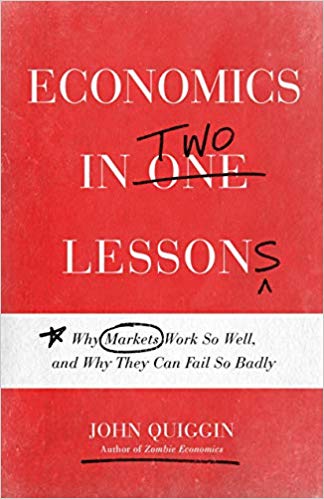
John Quiggin has a mission to correct the perception that economics implies markets are always marvellous and government intervention terrible. The title of his new book, Economics in Two Lessons, riffs on a comment by Paul Samuelson about a 1946 bestseller called ‘Economics in One Lesson‘: “When someone preaches ‘Economics in one lesson,’ I advise: Go back for the second lesson.”Apparently, Economics in One Lesson by Henry Hazlitt, a ‘free market’ advocate has sold over a million copies and been continuously in print – who knew? I’ve never read it. Quiggin’s response in Economics in Two Lessons is an attempt to battle the perpetual appeal of simple answers to complex problems.

Economics in Two Lessons: why markets work so well and why they can fail so badly is essentially all about the many ways in which markets can fail. The books starts with Lesson One:  the concepts of opportunity cost, gains from exchange and equilibrium, then introduces complexities: time, information (lack of) and uncertainty. Some nice applications follow, such as price controls, ‘free’ goods, spectrum auctions, road pricing. Quiggin uses the concept of opportunity cost as a frame for the remainder of the book, including when market prices diverge from opportunity cost.

“Most of the questions of principle involved in public policy can be illuminated by the careful application of the idea of oportunity cost and its relationship to market prices.” Lesson One is that market prices reflect and determine opportunity costs in production and consumption. Lesson Two is that there are social opportunity costs to be taken into account as well.

Hence the book then moves on to the ‘second lesson’, turning to income distribution, unemployment, natural monopolies, externalities like pollution and financial bubbles. The final section turns to policy prescriptions for a market failure world. For example, a chapter on income distribution looks at unions, minimum wages, and issues relating to income ‘predistribution’ such as intellectual property and limited liability.

There are plenty of examples and the book is very clear, making it an attractive supplement for undergraduate courses – I guess this is the target market as each chapter has further reading. I like the way Quiggin weaves in the history of economic thought on these issues. It’s a shame he feels the need to knock ‘mainstream’ economics so much; there’s little here for a mainstreamer to disagree with, except swipes like these: “The term ‘externality’ is one of those bits of jargon that most economists would be at a loss to explain.” What a bizarre claim. I have other quibbles – for instance, I’d disagree that Mill-ian utilitarianism is inherently more egalitarian than post-Pareto welfare economics.

On the whole, though, this is a highly readable introduction to the intellectual framework of modern policy economics, with plenty of lively examples (although I hope that those teaching public policy economics will also consider my forthcoming – late 2019/early 2020 – Markets, States, People……). It doesn’t dethrone my favourite book to recommend to newcomers to economics, John McMillan’s Reinventing the Bazaar either, but is well worth reading. Just remember – this isn’t anti-mainstream economics, it’s what economics is.

[easyazon_link identifier=”0691154945″ locale=”UK” tag=”enlighteconom-21″]Economics in Two Lessons[/easyazon_link]

41wR762OwVL._SX322_BO1,204,203,200_

Not learning lessons from the past

You would expect a book about the 2008 financial crisis by three of the key policymakers dealing with it to aim to explain and justify the actions they took throughout the crisis. Firefighting: The financial crisis and its lessons by Ben Bernanke, Tim Geithner and Hank Paulson does this. But it doesn’t come across as being particularly self-serving. Obviously they make their case in arguing that the counterfactual world would have been far worse. But they also acknowledge the role of luck, both good and bad, and do a good job of explaining the political and institutional/legal constraints on policy responses, and the complexity, speed and chaos of the situation.

The book, which is short, with an interesting series of charts at the back, is a chronological account running from the pre-crisis boom and the relaxation of regulatory constraints on the financial sector all the way to the post-crisis… relaxation of regulatory constraints on the financial sector. It ends up being a pretty uncomfortable read as they authors think the whole shebang could happen again, but with less ability for their successors to handle it. “Somehow,” they conclude, “Washington needs to muster the courage to restock the emergency arsenal with the tools that helped end the crisis iof 2008.”

“Somehow.”

This is a US focused account, and is not trying to be a comprehensive account of the crisis. It zooms out to describe the outlines of events and the policy debates and processes. Major steps – such as the Fed becoming lender of last resort for the world through extending repo lines to foreign central banks (rightly empahsized in Adam Tooze’s Crashed as a significant step) get a sentence. There are some insider nuggets. I hadn’t known that Paulson’s brother had a senior role at Lehman just before it went under, for instance. AIG shareholders and executives do not come out of it well. It is surprisingly well-written for a book jointly authored by three senior economic policy guys.

I guess the hoped-for audience is Congress. The overwhelming message I took away is that the firefighting policy response was massively hindered by a fragmented regulatory landscape and a zeitgeist of not getting in the way of the markets. It is hard to know when the situation is moving from normal if large correction to crisis, but when that point is identified the government has to act swiftly and decisively. Many of the mis-steps identified at the time and withhindsight were due to legal limitations on the power of the Fed or Treasury to act.

Leverage has diminished somewhat (not nearly enough) since the crisis. But as we’re back in a context of a “prevailing mood” of light enforcement, and ‘regulatory arbitrage’ by the finance sector to evade what regulation there is, no greater cohesion among financial regulators in the US than before, and a long expansion with lax credit conditions – oh, and less scope for monetary and fiscal relaxation – this is all pretty alarming. Will it take another financial firestorm for the “prevailing mood” to change. Read Firefighting and worry.

[easyazon_link identifier=”1788163362″ locale=”UK” tag=”enlighteconom-21″]Firefighting: The Financial Crisis and its Lessons[/easyazon_link]

[amazon_link asins=’1788163362′ template=’ProductAd’ store=’enlighteconom-21′ marketplace=’UK’ link_id=’80cea980-b510-4c15-812d-8e0ff1cfd3f5′]

Amartya Sen

My colleague Lawrence Hamilton has written a terrific summary of the work of Amartya Sen, in a book in Polity’s Key Contemporary Thinkers series, just called Amartya Sen. It’s a fantastic introduction to the oeuvre written in a very accessible manner. I’ve read Sen’s books most relevant to my own discipline, and his work on social choice is of course pretty technical; nevertheless, it is clearly explained here.

The deep interest all economists ought to have in Sen lies in his profound – and successful –  challenge to utilitarianism, the philosophical foundation on which economic theory has been constructed. Much of what I do now is motivated by the need to rethink the practicalities of economic policy given that the social welfare standard we think we use to compare different policy outcomes is so flawed. So for example, our Bennett Institute Wealth Economy project looking at people’s access to certain types of asset is one attempt to find a set of economic statistics to measure progress that speak to the idea of Sen’s capabilities and functionings – just as GDP growth speaks to utility.

510RyO1f3CL._SX361_BO1,204,203,200_

Having said that all economists ought to be interested, relatively few are. When I once wrote an op ed along these lines, a very distinguished senior economist emailed me to say if I wasn’t a utilitarian, I wasn’t an economist. Another very distinguished economist couldn’t see the disjuncture between Paretian welfare economics and the fact that policy economists make social welfare judgements all the time in cost benefit analysis, competition assessments, evaluations of tax policy etc. We are socialised so early and thoroughly into utility-thinking that it’s hard to step outside it.

Lawrence’s book introduces Sen’s key ideas in social choice and his concept of capabilities. I found very helpful the way it highlights the importance of incompleteness of information in turning Arrow’s work into a possibility rather than an impossibility theorem.  It also very elegantly critiques Sen’s work, largely its failure to address the practical political and institutional realities, and undue optimism about people – for instance, in Sen’s emphasis on deliberative processes. What is the role of expertise? How does political power as it is distributed in reality affect the process of deliberation? Very topical challenges, to which Sen’s work does not offer answers. As the book says, “Theories of social choice have tended to assume that people’s preferences are given, but it is a fact of life in democratic politics that on a lot of issues people do not have clear preferences.

This is an issue for economics too: the construction of the deflators used to turn nominal pound or dollar GDP into ‘real’ GDP, on which so much policy hangs, relies on a theory of constant, known preferences which determine the utility of consumption, and yet modern economic growth is all about creating wants for new goods and services for which preferences have to be created. So at a time of rapid innovation it is not at all clear what the deflators and ‘real’ GDP measures are measuring.

What is nevertheless compelling about Sen’s approach is its focus on human agency, which “Drives [Sen’s] major conceptual innovation or development but also for assessment of standards of living in all contexts: his capability approach.” It isn’t the goods that matter but what people can do with them.

In short, all economists ouht to read Sen’s major works, but if they haven’t definitely ought to read this introduction. Excellent for students too, and for people in the policy world who would like an overview.

[easyazon_link identifier=”1509519858″ locale=”UK” tag=”enlighteconom-21″]Amartya Sen (Key Contemporary Thinkers)[/easyazon_link]