A celebration of economics, strange as it seems

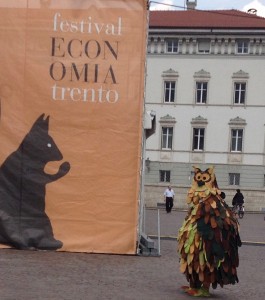
I’ve just returned from the Trento Festival of Economics, founded by Tito Boeri, full of enthusiasm for the idea. The programme included lots of interesting speakers. As the photo below shows, publishers take full advantage of the occasion to show off their wares – the Italian edition of my book prominent among them.

The book tent at the Trento Festival of Economics

The most exhilarating aspect, however, was the audience. The talks were all full of people, some economists but many not. One woman I met taught economics in a high school, another has a son who has started to study the subject at school. There were bankers, local politicians, parents with their teenage children, and I suppose the kind of people who go to all of these literary and ideas festivals, the concerned reader of newspapers worried about the state of the world. One of the many paradoxes of our times is that economics is in such disrepute and yet people are so interested in the subject.

It’s a little odd to find economists being so celebrated – there were huge posters of previous speakers hanging above the streets, including Gary Becker, below. Yet how marvellous to confront economists with people. Surely we must have a Festival of Economics in the UK to make sure our academic economists, and business economists and policy makers, regularly meet each other and normal people too.

Gary Becker in the Trento sky

The war economy

I finished reading a terrific book (recommended to me by the terrific Tim Harford), [amazon_link id=”1594482675″ target=”_blank” ]The New Kings of Non-Fiction[/amazon_link] edited by Ira Glass. One of the essays is Losing the War by Lee Sandlin (also available here). Although it’s not really about the economic aspects of World War II, it nevertheless underlines the extent to which total war required the economy of all combatants to be totally geared to war production. Sandlin also writes:

“Modern warfare has grown so complicated and requires such immense movements of men and materiel over so vast an expanse of territory that an ever increasing proportion of every army is give over to supply, tactical support, and logistics…. The war was essentially a self-contained economic system that swelled up out of nothing and covered the globe.” (p338)

[amazon_image id=”1594482675″ link=”true” target=”_blank” size=”medium” ]The New Kings of Nonfiction[/amazon_image]

I have in my in-pile David Edgerton’s [amazon_link id=”B004TRQAOA” target=”_blank” ]Britain’s War Machine[/amazon_link], which I’ve been meaning to read for a while. I’ll turn to it after my impending trip to the Trento Festival of Economics, where I’ll be talking about [amazon_link id=”0691145180″ target=”_blank” ]The Economics of Enough[/amazon_link], which is just out in Italian.

[amazon_image id=”B004TRQAOA” link=”true” target=”_blank” size=”medium” ]Britain’s War Machine: Weapons, Resources and Experts in the Second World War[/amazon_image]


The rewired global economy

A few days ago I was mulling over here the way the physical network created by modern information and communication technologies has transformed the economy in the past generation and yet has not been recognised very much at all in the way we theorise about the economy. That same point applies with even more force when it comes to thinking about globalisation. After all, the post-1980 globalisation is entirely driven by ICTs. Without computer power, the internet, cheaper phone calls etc, the phenomenon of sliced-up global supply chains and the massive growth of trade in intermediates would not have taken place. Few people realise how much of China’s success lies in supply chain logistics, as well as low-cost manufacturing. Its firms can not only assemble the materials and make cheap clothes, they can also adopt new designs quickly and get the items to shops in the US and Europe, ready-packaged for display, with appropriate labels, within a few weeks.

Yet the radically changed character of international trade has not been thoroughly reflected in economics. Even my reference book, the [amazon_link id=”069112812X” target=”_blank” ]Princeton Encyclopedia of the World Economy,[/amazon_link] has little about technology. So it was with delight this morning that I read this Vox column by the brilliant Richard Baldwin, which is exactly about the way technology has transformed the character of trade (and consequently trade policy). (There is also a longer CEPR policy brief by him on the subject, link at the bottom of his column). Given the likely role of global imbalances in the crisis, the doubts about what trade statistics are actually measuring, and the extraordinary complexity of the global economy, this is a key area for more thinking and empirical research.

On reflection, the fact that the literal rewiring of the global economy and national economies has not been the subject of much debate and research is a striking example of how hard it is for us to see large phenomena that are in plain view. Another is the astonishingly little attention economists paid to the explosion of bank balance sheets ahead of the financial crisis, one of the most dramatic macro-level phenomena. It does make you ask what else we are missing.

[amazon_image id=”069112812X” link=”true” target=”_blank” size=”medium” ]The Princeton Encyclopedia of the World Economy. (Two volume set)[/amazon_image]

Apocalypse tomorrow?

For those who have not read Daniel Bell’s [amazon_link id=”0465014992″ target=”_blank” ]The Cultural Contradictions of Capitalism[/amazon_link], it is, as Mike Elliott points out in his comment on yesterday’s post, a brilliant analysis. Here is the essence of the argument:

“The characteristic style of an industrial society is based on the principles of economics and economizing: on efficiency, least cost, maximization, optimization, and functional rationality. Yet it is at this point that it comes into sharpest conflict with the cultural trends of the day, for the culture emphasizes anti-cognitive and anti-intellectual currents. … The one emphasizes functional rationality, technocratic decision-making and meritocratic rewards. The other, apocalyptic moods and anti-rational behavior. It is this disjunction which is the historic crisis of Western society. This cultural contradiction, in the long run, is the deepest challenge to the society.”

A contradiction played out every day, and engaging scientists as well as economists, as we saw in a field in Hertfordshire the other day. I don’t think it’s obvious which side will triumph.

[amazon_image id=”0465014992″ link=”true” target=”_blank” size=”medium” ]The Cultural Contradictions of Capitalism[/amazon_image]

Punk rock and economic deja vu

Chatting to a philosopher friend yesterday about the state of the world in general and capitalism in particular, we concluded that a lot of the heavy analytical lifting on the changing structure of post-industrial economies had been done long ago by Daniel Bell and Peter Drucker. Bell’s [amazon_link id=”0465097138″ target=”_blank” ]The Coming of Post-Industrial Society[/amazon_link] was published in 1973 and [amazon_link id=”0465014992″ target=”_blank” ]The Cultural Contradictions of Capitalism[/amazon_link] in 1976, while Drucker’s key books were published even earlier – [amazon_link id=”0434903965″ target=”_blank” ]Technology, Management and Society[/amazon_link] came out in 1970, a year after [amazon_link id=”1560006188″ target=”_blank” ]The Age of Discontinuity[/amazon_link], with its coinage of the term ‘the knowledge economy’.

[amazon_image id=”0465014992″ link=”true” target=”_blank” size=”medium” ]The Cultural Contradictions of Capitalism[/amazon_image]

I have on the shelf a 1970 collection of essays edited by Bell and Irving Kristol, [amazon_link id=”0465008690″ target=”_blank” ]Capitalism Today[/amazon_link], in which Bell and Drucker again stand out for their prescience. Drucker writes about the development of mass global markets in capital and professional careers, alongside the mass market in products and services, and calls for economic theory to integrate the three in order to understand the global economy. Bell’s essay discusses the break between the dynamics of the economy and the cultural and moral foundations that had always made capitalism work until then; and the disjunction between the rational, technocratic decision-making of the economy and the “anti-cognitive and anti-intellectual currents” of modern culture.

Is it cheering or depressing that today’s deep problems are at least a generation old?  It does feel like a return to the 1970s in so many ways, from maxi dresses in fashion and a punk revival, to exchange rate crises and the back-to-the-future macro debate of Keynesians versus monetarists.

Is it 1978 again?