MOOCs versus universities?

Online higher education experiments are proliferating, and some of the world’s most distinguished and ancient universities are dipping their toes into the new technology-enabled possibilities. It is absolutely certain that the technology will disrupt the university business, as the conventional pathway to higher education has become much more costly. I mean this literally – not that students are being charged more or that government funding has been cut or the structures changed, but that the main cost of delivering higher education is the salary bill for staff and the higher education sector is affected by [amazon_link id=”0300179286″ target=”_blank” ]Baumol’s cost disease[/amazon_link]. So as soon as substituting some capital for labour (or some peer-provided labour for paid labour) becomes possible, as with online courses, some universities will do so.

What is not at all clear is the form the technological disruption will take. Just recently, I’ve come across a couple of interesting essays on the issues at stake. One is William G Bowen’s [amazon_link id=”0691159300″ target=”_blank” ]Higher Education in the Digital Age[/amazon_link].

[amazon_image id=”0691159300″ link=”true” target=”_blank” size=”medium” ]Higher Education in the Digital Age[/amazon_image]

In the first half his focus is the unsustainable cost pressure and the scope for productivity improvement. He notes that the technology has already led to some improvements in the ‘scholarly infrastructure’ – JSTOR and online libraries facilitate research, as does the capacity for data-based empirical work impossible before cheap computer power and online data sources. Collaboration has become easier. Students can take tests online and their work can be marked by machine in some cases. In the second half Bowen turns to the implications of the technology revolution. He is moderately sympathetic to MOOCs and in particular their scope for enhancing access to higher education, but pleads for a portfolio approach to instruction and argues against the disintermediation of human instructors. Universities are particularly important as institutions, he argues, to defend freedom of thought and pass on values to successive generations of students. While agreeing in theory, one does have to question how impressive all universities are as institutional bulwarks, or how brightly all academics shine as role models for their students. After all, although we’re no longer in the era of [amazon_link id=”1447222814″ target=”_blank” ]The History Man[/amazon_link], many academics have no interest in their teaching responsibilities and are entirely focused on their own research and careers.

Another essay is by Andrew Delbanco (who also comments on Bowen’s essay in his book), drawing from his forthcoming book [amazon_link id=”0691130736″ target=”_blank” ]College: What it Was, Is and Should Be[/amazon_link]. (I’ve not yet read this).

[amazon_image id=”0691130736″ link=”true” target=”_blank” size=”medium” ]College: What it Was, Is, and Should Be[/amazon_image]

He notes that there is already – at least in the US – quite a wide range of higher education offers, in for-profit universities and online courses as well as cheaper community colleges, albeit all looked down on by the grand universities. There is some variety in the UK too, with the Open University, Birkbeck, Buckingham University, FE colleges. Delbanco also notes the great hopes for TV as a means of extending educational access – the OU in Britain used TV broadcasts as course material pre-internet; indeed my big brother used to appear lecturing on chemistry, and the family would gather round the set at an ungodly hour in the morning to watch him talk about things we didn’t understand at all.

This is a useful reminder, because it flags up one function of higher education neither author writes about, namely the signalling role of a degree (see Mike Spence’s models). The signal a Princeton or Oxford degree sends to potential employers is at least as important as the improved quality of education a student might have received there. Attending university is also a positional good because access is limited, and all the more so as fees rise. So MOOCs will have big consequences for traditional universities, but need not be an existential threat to the best of them.

Delbanco concludes that face-to-face will always be important in HE: “No matter how anxious today’s students may be about gaining this or that competence in a ferociously competitive world, many still crave the enlargement of heart as well as mind that is the gift of true education. It’s hard for me to believe that this kind of experience can happen without face-to-face teaching and the physical presence of other students.”

I agree with him that human encounters will always be part of learning, for the transfer of tacit knowledge, the stirring of the passion to understand, the exchange of complex ideas. I’m less certain this has to happen in universities. Philosophy cafes, public lectures, book clubs and the like may well substitute for formal teaching in a university, especially when the quality of the latter is mixed at best and dismal in many cases.

Both Bowen and Delbanco see the technology as an opportunity to spread learning and the love of learning, and so it is. It has spread access to ‘books’ and music and images already. Yet it seems to me highly likely that many universities will be as thoroughly disintermediated as the gatekeepers of other parts of the culture, and this will not be a bad thing. If I were running a university now, I’d be focused on the quality of the core purposes of the institution – including the quality of teaching, the poor relation in too many of them – because the more-or-less captive market is being liberated. I would also look to use online offers to change the character of the university experience rather than making it a cut-price version of the existing product. Why not build a community of learners and researchers out of previous students or local communities? Why not at the same time open the physical space of the university much more to the local community? Shouldn’t they be running their book clubs on campus, and be able to borrow e-books from the library?

We’ll end up with a much wider variety of means for people to learn, at all stages of their lives not just 18-21. We might or might not end up with more innovative and better universities depending on how well they respond to the challenge.
 

The importance of containers, continued

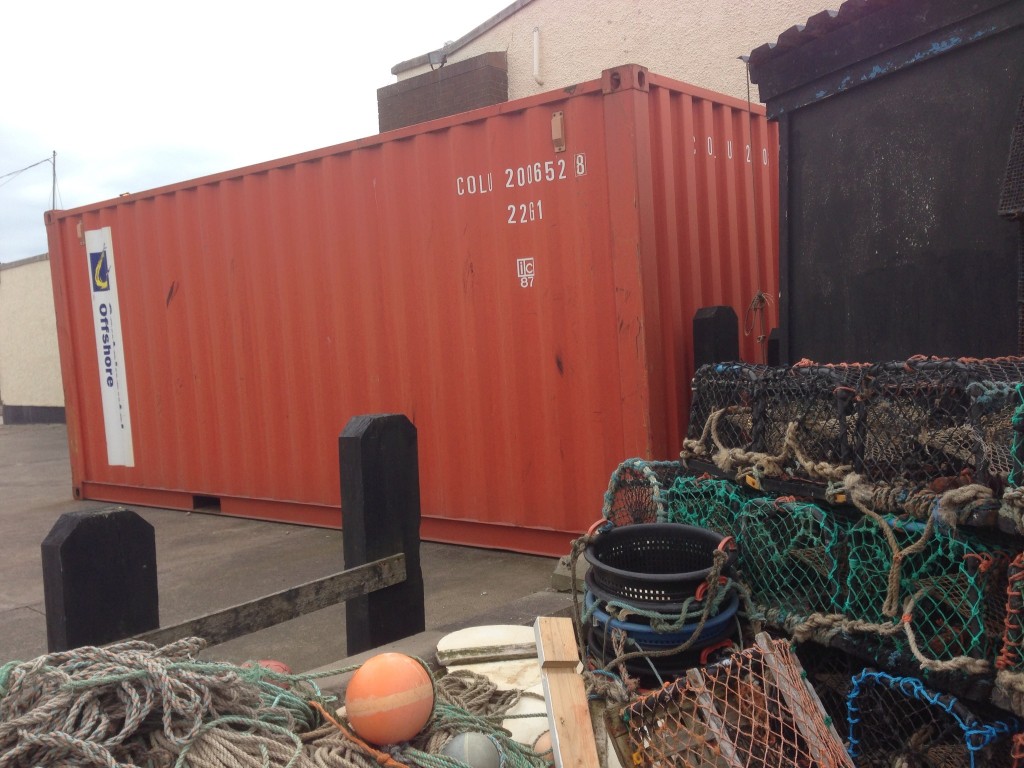
We just spent a few days in Scotland and spotted this shipping container being used for storage at the harbour in Stonehaven, Aberdeenshire.

Storage container in Stonehaven

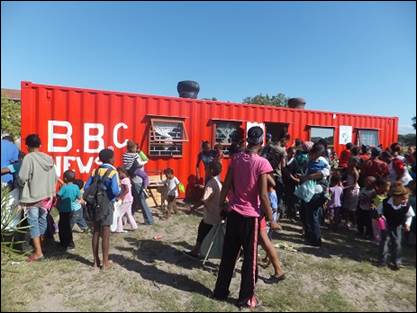
Meanwhile, news of the BBC News container: it’s now in its 3rd year of post-shipping existence as a soup kitchen in Kleinvei, South Africa. According to Tim Smith of Breadline Africa: “The Children’s World Kitchen project has benefited enormously when they received this container.  It is three years since this container was received and began serving the need of the community.”

The post-shipping BBC Box in the Cape Flats

My containers correspondent, Captain Thomas Marnane, followed up our previous discussion about the importance of standardisation in shipping with some observations on the environmental benefits of containers – not a standard angle on the globalisation of trade, it must be said. In an email he wrote:

“The conservation of resources by reducing container weight and saving fuel (hauling on land and at sea), increasing cargo weight available, reducing losses, etc. is an example of what I call “closet environmentalism”.  It is not all altruistic.  That is that, in general, I believe environmental improvements and resource conservation is most brought about by individuals and businesses who have  incentives to improve by using and wasting fewer resources to provide a  product or service and  improve either quality of life and/or the bottom line, and for the most part they do it without fanfare or publicity.”

We should add the recycling of containers to other uses as part of his environmental tally.

This whole discussion was of course set off by the container that appeared in my local park, and [amazon_link id=”0691136408″ target=”_blank” ]The Box[/amazon_link] by Marc Levinson.

[amazon_image id=”0691136408″ link=”true” target=”_blank” size=”medium” ]The Box: How the Shipping Container Made the World Smaller and the World Economy Bigger (New in Paper)[/amazon_image]

Institutions of capitalism

In the past few days I’ve been pondering ‘institutions’ in the sense in which economists mean them – the entire range of non-market, social norm based arrangements for the collective allocation of resources. In other words, this includes both the WTO and standards for containerisation, contract law, unions, government agencies, multinationals and so on. As Oliver Williamson puts it in his classic book [amazon_link id=”068486374X” target=”_blank” ]The Economic Institutions of Capitalism[/amazon_link], the insight is that:

“[E]conomic organization has the purpose of promoting the continuity of relationships by devising specialized governance structures, rather than by permitting relationships to fracture under the hammer of unassisted market contracting.”

[amazon_image id=”068486374X” link=”true” target=”_blank” size=”medium” ]The Economic Institutions of Capitalism[/amazon_image]

His work brought transactions costs to centre stage as an explanation for institutional forms and economic relationships – Williamson and Elinor Ostrom of course won the Nobel memorial prize for their work – in very different domains – on understanding institutions and their effectiveness.

Williamson’s book was published in 1985, so although it has a chapter on ‘the modern corporation’, this predates the dramatic – and distinct – effects information technologies and communications technologies have had on corporate structures. It has but a few pages on multinationals. Richard Baldwin, among others, has recently published fascinating papers on the changing structures of trade resulting from the new modern (post modern?) corporation, looking at supply chains and so-called ‘trade in tasks’.

It’s an area of great interest to me. One thing I’m currently working through, in preparation for a seminar at COMPAS next month, is how companies factor their labour market choices into their decisions – for they’re optimising across tasks, locations and production technologies, where the latter includes labour intensity and skill level. Thoughts gratefully received.

Embarrassment of Riches

The Financial Times this weekend had a wonderful article by Simon Schama about the re-opening of the Rijksmuseum in Amsterdam. He writes: “In an age of interchangeable international art fairs, all flogging indistinguishable contemporary art, there is something deeply stirring about a great art institution being unafraid to reassert the distinctiveness of its national culture and history, and to make it a cause for popular rejoicing rather than uncool embarrassment.”

The article sent me back to Schama’s 1987 book [amazon_link id=”0006861369″ target=”_blank” ]The Embarrassment of Riches: An Interpretation of Dutch Culture in the Golden Age[/amazon_link].

[amazon_image id=”0006861369″ link=”true” target=”_blank” size=”medium” ]The Embarrassment of Riches: An Interpretation of Dutch Culture in the Golden Age[/amazon_image]

It’s a brilliant account of the feedbacks between cultural innovation and confidence and economic strength, although Schama doesn’t express it in those terms. Still, the country had by the 17th century a troubled and war-torn recent history, nor is it without geographical disadvantages (small and potentially very wet). Its military and economic success calls for explanation.

The revamped Rijksmuseum sounds fantastic – can’t wait to visit. Here’s what the website says about Amsterdam’s age of prosperity.

Institutions matter – but not the way we think

A couple of days ago I tweeted a link to a paper estimating the effect of containerisation on world trade to be far greater than the effects of trade liberalisation and GATT. It tied in with a recent post here prompted by the appearance of a shipping container in the local park. I cited there Marc Levinson’s terrific book about containerisation, [amazon_link id=”0691136408″ target=”_blank” ]The Box[/amazon_link].

It’s always a pleasure when my ramblings here get some feedback, and as it turns out Thomas Marnane, the father-in-law of a friend of mine, had a key role in the containerisation process. He’s kindly given me permission to quote his fascinating email:

“I think the container like the transistor have probably been the largest contributors to trade and communications in the world’s history.

I was fortunate to work at Matson where most of it all started.  Malcolm McLean of Sea-Land actually created the first container to go with his land based trucks.  Matson picked it up from there and the world followed.  Matson’s historic introduction of containerization in the Pacific in 1958 launched the development of a container freight system that became a model for carriers worldwide. Matson’s S.S. Hawaiian Citizen  was the world’s first all-container vessel when it was converted in 1960. Many of Matson’s innovations of that period are still in use today: cellular container ships, intermodal containers, specialized container equipment and container handling equipment.

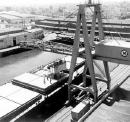
Matson’s “A-frame” gantry crane reduced ship turnaround time in port from three weeks to 18 hours and became a prototype for the industry.  …. You can see a picture of the first gantry container loading crane.  It was still sitting over in Oakland when I came to Matson.  It took up space and was an eyesore and the company wanted it gone.  I didn’t want to simply destroy it–found no bidders in the US and no museums (Smithsonian or local) that wanted it and eventually sold it to someone in Portugal and have no idea where it is now.

Matson’s A Frame Gantry Crane – where is it now?

I was given pretty free reign in my role as container equipment engineer and procurer at Matson and in partnership with Kiki Shahani, a very good friend and world class transpiration engineer, procured and made dozens of patentable design changes to the containers over the years.  Things like changing material to stainless steel on refrigerated containers, modifications to structure and corners (lifting castings), floors, airflow, side panel shapes, paint systems, auto carriers and handling, appliances (hinges, locks, connectors for refrigeration units, etc.  I say patentable because we only put patent pending on them long enough to get it to market and not have to fear that someone would steal the design, patent it and then ask for royalties.  It usually took two to three years for the industry to pick up the changes through the manufacturers and incorporate them in their own equipment and by then, hopefully, we had done something better to regain a competitive edge.

The design changes were primarily to reduce damage and weight and in the case of the refrigerated containers increase temperature reliability.  We were able through the growing capability of the computer to do finite element analysis and testing and determine where we needed  more or less strength.  The result over several years was that we achieved a reduction of about 20% in container weight and 50% in maintenance and repair.  For a forty foot long dry cargo container at 8375 lbs this is a savings of 1675lbs (.2x8375lbs=1675lbs).  Multiply the 1675 times any number of containers you want and you can see that the increase in load you can add to the container and thus reduction in number of containers needed and the reduced weight that ships, trucks, trains, etc have to carry is significant (cost savings, fuel savings in transporting, product damage, etc).  All of this was part of my recent recognition by the University of Rhode Island for my work in resource conservation.    

And just think, just like when I was a kid and loved to play with blocks, when I got to be a big boy I got to play with containers which are just really big blocks.  What more could a guy want.

As you can see I still have a love affair with containers and cranes (they let me design and build cranes also with help from one great electrical engineer, Al Siver, one great mechanical engineer, Ed Stephens and a world class crane designer from Liftech, Michael Jordan–I got to travel the world with those guys and still talk with them frequently).”

And in a follow up email, having looked at the summary of the Levinson book, he added:

“I note Harry Bridges on the summary in Amazon.  He is something of a legend in San Francisco (the area around the Ferry Building is called Harry Bridges Plaza) and it is still not fun to negotiate with the Longshore Union even though their numbers, as a result of containers and the handling thereof, are down by 80-90%.  

Matson also had the first semi-automated system for container handling at Terminal Island, CA.  It was finally abandoned because it was technically difficult to maintain and the equipment got out of date and was a big expense to replace (the business is highly capital intensive now vice labor).  Some European terminals are automated (as I recall Rotterdam, Hamburg, Amsterdam and one UK Port  that I cannot remember, perhaps Southampton–it has been awhile since I visited–were the leaders) and Rotterdam was the best.  I got to visit them all and have exchange visits, even got the Hamburg guys to get in my hot tub!!.  In the US American President Lines paved the way for intermodal (sea, truck, rail) shipping across the U.S and got us to “double stack” trains by working out routes that had overpasses, tunnels etc. in place or modified to handle the heights.  I got to play with trains too when we went to moving our cargo from Seattle to Portland by train instead of having a ship come into Portland every week (the Willamette River is long and slow). We moved the cargo down from Seattle to Portland by a weekly double stack train which had to have cars modified to fit the route (some places “humping” of cars through their connections was a problem, etc.).

…. Don’t hold me too tight to the reduced container weights because it has been a while but it was at a minimum a 15% reduction and we worked on it ever year for every type of container and chassis when we placed our new container orders.  Refrigerated containers got heavier with the stainless steel but the damage was reduced by more than half and the combination of less damage and subsequent less product loss was substantial. Prototype testing in Korea with Hyundai was also a lot of fun–we tried to break new designs of containers with some interesting test gear. That and leading in automating our refrigeration equipment really kept us in the game  We ended up buying most containers in China–they become a commodity … as their price came down,  and some of the weight reduction was the result of good thought by Chinese container engineers.  Surprisingly every person in charge of container engineering in the companies we purchased from were women and they could work the drawings from behind their eyeballs vice on paper because they know their business so well.”

The close-up account is fascinating. It has also led me to reflect on what economists mean when we say – as we do all the time these days – that ‘institutions matter’ for growth. Probably most of us have institutions like trade rules and agreements in mind, but it may well be that the setting of standards and engineering principles – as in containerisation – matter much more.