
Politics, populism and people

There’s nothing like reading the newspapers at the weekend to put you off politics – not that weekday politics are much better. Even people like me who are positively interested in policies, albeit not party politics, sometimes despair about government by populist headline and short-term polling. Perhaps I should say ‘especially’ rather than ‘even’. The UK government is funding four evidence-based research centres, known as ‘what works’ centres. I find it hard to imagine how politicians will use the research if it happens not to fit in with the “narrative” of the day, shaped by prior beliefs or by prejudice and ideology. It isn’t just me. Polls, and turnout in elections, show that pretty much everybody is repulsed by the political system. For example, an Ipsos MORI poll from January 2013 found that fewer than one in five Britons trusts politicians, while net satisfaction with the way the UK (Westminster) parliament works has been trending broadly down since the 1990s, with more dissatisfied than satisfied.

Anthony Painter’s new book, [amazon_link id=”1780766610″ target=”_blank” ]Left without a future?[/amazon_link], diagnoses this structural problem very astutely. He writes of politics ‘without humility’, “A spectacle of false partisan divides, dishonest posture, lessons missed and opportunities wasted. Is it any wonder that our politicians are held in such low regard?” If politicians insist on acting out stereotyped Punch and Judy roles, people will stop taking them seriously.

[amazon_image id=”1780766610″ link=”true” target=”_blank” size=”medium” ]Left Without a Future?: Social Justice in Anxious Times[/amazon_image]

The book, written under the auspices of the progressive think tank Policy Network, analyses the socio-economic reasons for the decline of the Labour Party alongside the role played by free market or ‘neo-liberal’ ideas. Why, Painter asks, has the crash not so thoroughly discredited this dominant ideology of the 1990s and 2000s that the organised left benefited politically? As he points out, it is hardly as if people are entirely uninterested in current issues. Still, “The mainstream left is in crisis.”

Part of his explanation is that the left has concentrated on staking a claim to the moral high ground in the realm of ideas, in a rather didactic manner, without bothering with the humble, practical politics of paying attention to people and organising around their concerns and needs. Indeed, he obviously finds the moralising pretty unappealing. “It is through forming inclusive institutions that the left will be in a position to advance social justice….. The market is not a force of nature; it operates in accordance with a deliberate institutional design. It is to thinking about the institutional design of the future that the left’s energy should now be directed.”

I’m a technocrat, not a party political person, and so am not the target audience of a book aimed at the organised left of politics. However, I couldn’t agree more with the general point Painter is making here. Many politicians, as others have pointed out, have spent their entire career doing politics, moving from student politics to think tanks and advisory or lobbying roles, into constituencies and on up the ladder. They think of politics only as a battle of policy ideas, or rather as a battle to announce such ideas and get media attention for them. I’m generalising of course, but this quite common career path makes for a political world that broadly speaking has little traction with people, until one of the policy ideas is implemented from above and causes (usually) all kinds of problems.

The book starts with an account of the decline of the left, much of which carries over to the decline of the standing of party politics in general. It traces the failure of parties to respond to the vast social and cultural changes of recent decades. It describes the euphoria on the left that generally greeted Barack Obama’s election, and the subsequent disenchantment: “It was not just a change of government these people were interested in – it was a change in the whole of politics. The general consensus was that an intolerable chasm had opened up between the people and their representatives.” There are echoes here of the sympathy Matt Taibbi expresses toward the Tea Party supporters in the US, in his terrific book [amazon_link id=”0385529961″ target=”_blank” ]Griftopia[/amazon_link]; why would people not distrust their government, Taibbi asks. Painter still has some faith in Obama, seeing him as a politician who is after long-term change, not day-to-day headline victories.

Left Without A Future? goes on to explore the way society has changed, with ‘bubbles’, ‘networks’ and ‘tribes’ replacing class identification. The left’s old ‘solidarity’ approach does not speak to people now. What’s more, the character of the economy has changed, but business and politics do not take account of how value is created in a services and intangibles economy, nor of the erosion – to the extent it ever existed – of a clear division between the market and the state. Cultural identities have changed as much as economic realities. There is a widespread sense of anomie. Meanwhile, “each party is holding together an unstable coalition of quite incompatible views.” One chapter looks specifically at Scottish nationalism, and – in one of the more optimistic passages – sees this debate as a potentially constructive one that could lead to a more balanced and culturally confident UK.

What to do about the state of politics and the left? Painter writes: “Those who seek sustainable change through collective action need to understand the context in which they operate. They have to build enduring coalitions of support.” The coalition-building needs to recognise the changed economic, social and cultural identities of the day, rather than cleave to the class-interest identities of the 1960s and 70s. He rejects the various strands of political thinking he describes as ‘new moralism’, including thinkers on the right such as Jesse Norman and Philip Blond, as well as Maurice Glasman with his emphasis on community on the left.

Painter argues that although attractive, the practical impact of a discourse about re-moralising is likely to be limited. What’s more, he writes, “The moral conversation is a hubbub that is becoming deafening. Britain is socially divided; values are plural, needs diverse and attitudes varied. … The problem is not the absence of moral certainty; it is the presence of clashing moral certainties. … A top-down moral politics in a pluralistic nation is bound to result in anger and resentment.”

He is more attracted by the pragmatic justice of Amartya Sen. The book ends with an argument for the specificities of addressing and disrupting concentrations of overweening power, of seeking improvements in people’s lives from day to day, and above all of working to build new types of institution. Restructure education, look at the way business operates, concentrate on local institution-building. Painter cites  approvingly Tamara Lothian and Roberto Unger in their Crisis, Slump, Superstition and Recovery, where they make the case for small-scale institutional experimentation. He calls for a combination of top-down leadership to give people a hopeful vision and bottom-up civic activism.

This could sound a bit underwhelming – certainly in the context of a political culture geared towards big policy announcements that are supposed to fix complicated and intractable problems. However, I found the emphasis here on humility and pragmatism refreshing, although needless to say not agreeing with all the specific suggestions the book makes. Although the book is billed as a contribution to rescuing the mainstream left from irrelevance, the points it makes about the said irrelevance apply to all the main parties. Pretty much every day I come across examples of people saying that politics is – well, irrelevant at best, and sometimes much stronger adjectives are used. They are not making a party political point, but a systemic one. Left Without A Future? speaks to that wider sentiment. And if our ‘actually existing’ politics does not give itself a future, a different kind of politics will fill the vacuum.
Supply and demand for authors

Most writers know that their chosen path is not going to make them a fortune. The exceptions are few – only a few are as successful as J.K.Rowling (a.k.a. Robert Galbraith, apparently after J.K.Galbraith, in her recent PR stunt with [amazon_link id=”1408703998″ target=”_blank” ]The Cuckoo’s Calling[/amazon_link]) or [amazon_link id=”0593072499″ target=”_blank” ]Dan Brown[/amazon_link] or, in our world, [amazon_link id=”1844801330″ target=”_blank” ]Greg Mankiw[/amazon_link] or [amazon_link id=”0141019018″ target=”_blank” ]Steven Levitt[/amazon_link].

[amazon_image id=”0141019018″ link=”true” target=”_blank” size=”medium” ]Freakonomics: A Rogue Economist Explores the Hidden Side of Everything[/amazon_image]

So it was with great sympathy that I read a lament by Guy Walters in the Literary Review about the expectation that writers will travel the country giving talks for free, on the basis that it might just increase sales. He contrasts writers with comedians – apparently Al Murray asks for and gets 70% of takings at the door. Mr Walters calculates that the Hay Festival took £5600 from ticket sales at a talk he gave, for which they ‘paid’ him half a dozen bottles of wine.

I know nothing about the Hay Festival’s finances. But there are two problems with wanting to get paid for book talks.

One is that event costs are high. I’m currently organising the 2nd Festival of Economics with the Bristol Festival of Ideas. Participants are paid expenses and a small fee, because on principle we believe they should get paid something whenever tickets are charged for. But ticket sales alone do not cover the costs of the expenses and venue hire; we need to raise a few thousand pounds in sponsorship to break even. (Almost there, but please get in touch if you’re interested in sponsoring us!)

The second is that there are lots of authors. Lots and lots of them. The well-known ones can presumably charge a high fee, like the well-known comedians, but the lesser known ones have virtually no market power. It’s supply versus demand and then some: like so many other creative sectors, superstar economics apply here. This is a common phenomenon with experience goods, whose quality is unknown before they have been consumed. This means consumers flock to the writers/performers whose reputation is already strong enough to guarantee enjoyment, rather than taking a risk on the unknown. To them that hath, shall more be given.

I do think writers should have expenses paid by event organisers, and a fee even if token when the audience is paying. There’s never any harm in asking. But most writers have to take part in the events for enjoyment, and a scintilla of extra public recognition that might help sales, and not for cash.

Non-satiation or the paradox of choice?

This week I’ve been travelling – two days in Newcastle and lots of meetings. It included a visit to the set of The Paradise, the BBC drama based on Zola’s [amazon_link id=”2218745208″ target=”_blank” ]Au Bonheur des Dames[/amazon_link]. It’s one of the novels I haven’t read, despite being a huge Zola fan. (Does any other British reader of this blog remember the superb, terrifying BBC dramatisation of Therese Raquin with Alan Rickman in the 1980?) So of course I’ll have to get the book now.

[amazon_image id=”0199675961″ link=”true” target=”_blank” size=”medium” ]The Ladies’ Paradise (BBC tie-in) (Oxford World’s Classics)[/amazon_image]

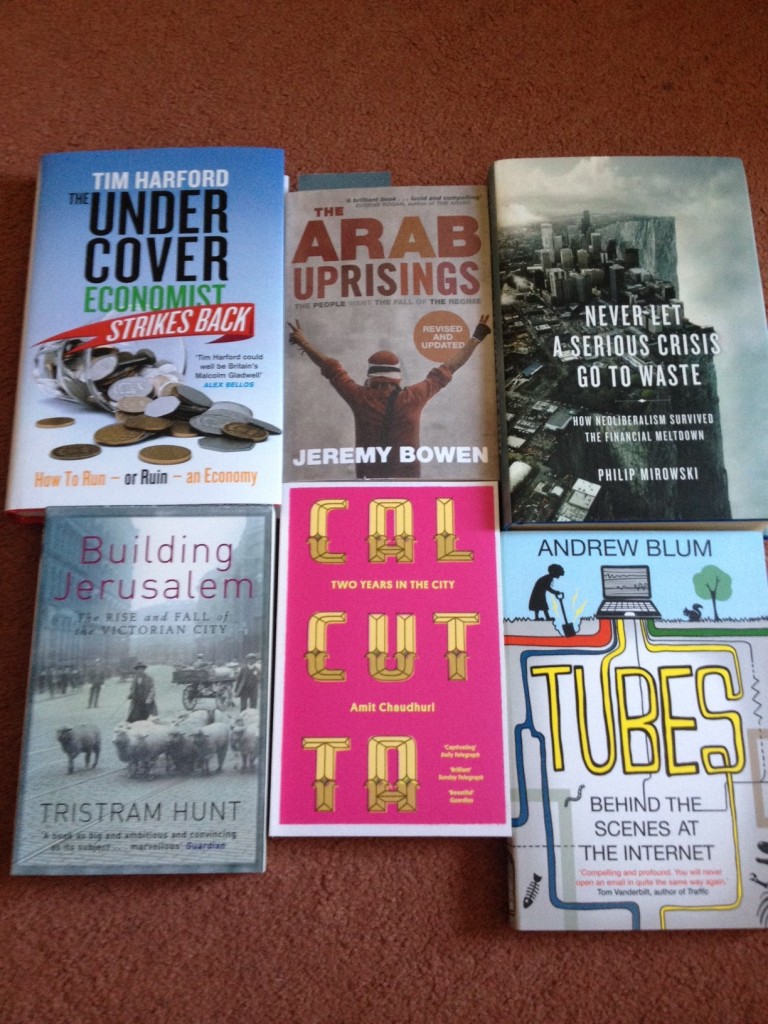
Meanwhile I bought Jeremy Bowen’s [amazon_link id=”0857208861″ target=”_blank” ]The Arab Uprisings[/amazon_link] at the station bookstore, just in case I ended up with some unexpected free time and no book (hah!).

Then got home to my recent orders and a couple of incoming review copies. Here are the recent acquisitions. Good thing summer is coming up.

Recent acquisitions

Of course, this kind of appetite for more books (and I’m with Umberto Eco that it isn’t necessary to read all the books in one’s library/anti-library) lends support to the assumption of non-satiation in consumer choice theory. More is always better. The theory refers to more of the same and one could argue that each book title should count as a separate good, in which case non-satiation would not be a valid assumption (although a couple of my colleagues like to have the same book in physical copy and on an e-reader).

But that doesn’t mean Barry Schwarz’s [amazon_link id=”0060005696″ target=”_blank” ]Paradox of Choice[/amazon_link] is valid either. His examples include types of jeans or brands of cereal and toothpaste. But not only do I not want Prof Schwarz determining what kinds of jeans I’m allowed to wear, I never hear proponents of the paradox of choice arguing that there are ‘too many’ book titles, or charities to which to donate, or types of wine. Are we to suppose that the professional classes are less likely than the lower orders to be daunted psychologically by too much variety?

Political bubbles

The Adelman biography of Albert Hirschman, [amazon_link id=”0691155674″ target=”_blank” ]Worldly Philosopher[/amazon_link], is great but too big to carry around so I’m reading it at home, and on the tube I’m reading [amazon_link id=”0691145016″ target=”_blank” ]Political Bubbles[/amazon_link] by Nolan McCarty, Keith Poole and Howard Rosenthal, & have almost finished.

[amazon_image id=”0691145016″ link=”true” target=”_blank” size=”medium” ]Political Bubbles: Financial Crises and the Failure of American Democracy[/amazon_image]

It’s long been my view that history is over-determined, looked at from today (under-determined of course, if you’re trying to predict events.) These three political scientists have another causal explanation to add to the list of explanatory factors for the Great Crash of 2008. As well as greed and fraud, toxic financial innovation, global imbalances, fiscal irresponsibility, gigantism in banking and all the other contributors, there is the political dimension.

The charge is that a combination of three political factors created the conditions for all those other contributors to financial meltdown to develop. The first is ideology, the pure belief that markets are good and government regulation bad; the second is the array of special interests hoping for an endless boom, especially in housing – the lenders, the realtors, the people getting cheap loans; the third is the American institutional framework, expressly designed to stop things happening rapidly, in the context of ultra-rapid developments in financial markets. The three interact in a pro-cyclical way, the book argues, hence the terminology of the ‘political bubble’.

Nobody in the political elite, on the executive or the legislative side, comes out of this book well. The authors even trace some of the rot as far back as the now-saintly-seeming Jimmy Carter – after all, the savings and loan debacle of the early 1980s had its root in his presidency. The book is equally scathing about the ideologically free market Republicans, Reagan and the two Bushes, and the differently ideologically free market economics team of the Bill Clinton years.

The focus is solely on the United States. This means there is more political detail than many non-American readers will either want or be fully able to interpret.

With that caveat, I found the argument persuasive. After all, there are plenty of other mature democracies that have experienced that combination of housing bubbles, Franken-finance, and political incapacity. The US financial markets have also hugely influenced global markets. It would be interesting to work through the same kind of argument in other countries. One might even add another layer of political sclerosis in the international context, adding a fourth ‘i’ for ‘international incompetence’ to the three ‘i’s making up the book’s hypothesis.

Summer reading

The papers all magically decided that this was the weekend to publish recommendations for summer reading. My holiday is still a few weeks away but it’s never too soon to start planning which books to take.

In my in-pile I’ve got some suitable paperbacks.

[amazon_link id=”0141030585″ target=”_blank” ]The Old Ways: A Journey On Foot[/amazon_link] by Robert Macfarlane

[amazon_image id=”0141030585″ link=”true” target=”_blank” size=”medium” ]The Old Ways: A Journey on Foot[/amazon_image]

[amazon_link id=”0713998687″ target=”_blank” ]Iron Curtain[/amazon_link] by Anne Applebaum

[amazon_link id=”1849904936″ target=”_blank” ]Parade’s End[/amazon_link] by Ford Madox Ford (bought after the brilliant TV drama, and not yet read)

[amazon_image id=”1849904936″ link=”true” target=”_blank” size=”medium” ]Parade’s End[/amazon_image]

[amazon_link id=”0140449086″ target=”_blank” ]The Histories[/amazon_link] by Herodotus (a 2nd hand book also in the pile for some time)

That’s nowhere near enough so I’m planning to by some of:

[amazon_link id=”075381983X” target=”_blank” ]Building Jerusalem: Rise and Fall of the Victorian City[/amazon_link] by Tristram Hunt

[amazon_image id=”075381983X” link=”true” target=”_blank” size=”medium” ]Building Jerusalem: The Rise and Fall of the Victorian City[/amazon_image]

[amazon_link id=”0670918989″ target=”_blank” ]Tubes: Behind the Scenes at the Internet[/amazon_link] by Andrew Blum

[amazon_link id=”1908526173″ target=”_blank” ]Calcutta: Two Years in the Cit[/amazon_link]y by Amit Chauduri

[amazon_image id=”1908526173″ link=”true” target=”_blank” size=”medium” ]Calcutta: Two Years in the City[/amazon_image]

[amazon_link id=”0241145368″ target=”_blank” ]The Infatuations [/amazon_link]by Javier Marias (I loved his earlier trilogy, [amazon_link id=”0099461994″ target=”_blank” ]Your Face Tomorrow[/amazon_link])

[amazon_image id=”0241145376″ link=”true” target=”_blank” size=”medium” ]The Infatuations[/amazon_image]

Any other recommendations, folks? A strong preference for paperbacks, and some detective fiction ideas needed.