What works?

Towards the end of a holiday I always try to read something a bit more work-related to get myself ready for the return to normality. This year I ended with a pair of books which, by coincidence, shed great light on each other. One was Albert Hirschman’s [amazon_link id=”067476868X” target=”_blank” ]Rhetoric of Reaction[/amazon_link], prompted by reading the wonderful biography of him by Jerry Adelman, [amazon_link id=”0691155674″ target=”_blank” ]Worldly Philosopher[/amazon_link].

[amazon_image id=”067476868X” link=”true” target=”_blank” size=”medium” ]The Rhetoric of Reaction: Perversity, Futility, Jeopardy[/amazon_image]

In it Hirschman describes three types of argument deployed by those who want to debunk ‘progressive’ or interventionist policies. He calls them the perversity thesis (interventions backfire, they turn out to have perverse effects, often the exact opposite of what was desired); the futility thesis (any attempt at change will fail because it is too hard to accomplish – plus ça change, plus c’est la même chose); and the jeopardy thesis (change is desirable but to achieve it will endanger other things that are highly valued, change is too destructive). He notes that the futility thesis does not sit comfortably with the others and tends to be made by different people. But all three are somewhat plausible as soon as you acknowledge, as an honest person must, that the world is a complex place with cause and effect hardly ever clear. So all three rhetorical strategies have great success.

Straight after this I turned to [amazon_link id=”0815793898″ target=”_blank” ]Government Failure versus Market Failure: Microeconomic Policy Research and Government Performance[/amazon_link] by Clifford Winston. This is an interesting survey of the empirical evidence on several areas of government policy in the US, including competition policy. To my surprise, the book cannot find empirical evidence that the consumer benefit of anti-trust enforcement outweighs the enforcement costs – the book’s overall conclusion is that “the welfare cost of government failure may be considerably greater than that of market failure,” and it concludes this is so even for competition policy aimed at enhancing the functioning of markets. I didn’t find this persuasive because I don’t believe comparative statics – the Harberger triangles –  capture the dynamic effects, which can be very much larger. An analogy would be with Robert Vogel’s famous conclusion that the railroads didn’t do much for the US economy if you look at the incremental GDP growth. On other areas of policy such as agricultural support, Winston is very convincing, however.

What particularly struck me though was that the book is a good example of the kind of rhetoric or framing that Hirschman described as the perversity thesis. Winston writes:

“Government failures appear to be explained by the self-correcting nature of some market failures, which makes government intervention unnecessary; by the short-sightedness, inflexibility and conflicting policies of government agencies; and by political forces that allow well-defined interest groups to influence elected and unelected officials to initiate and maintain inefficient policies that enable the interest groups to accrue economic rents.”

[amazon_image id=”0815793898″ link=”true” target=”_blank” size=”medium” ]Government Failure Vs. Market Failure: Microeconomic Policy Research and Government Performance (AEI-Brookings Joint Center for Regulatory Studies)[/amazon_image]

My final read, on the plane, was [amazon_link id=”1849904936″ target=”_blank” ]Parade’s End [/amazon_link]by Ford Madox Ford, a brilliant, epic novel on the way the First World War changed everything. The protagonist, Christopher Tietjens, is a government statistician. He makes the mistake of telling his superiors what he can prove to be true about government policies and actions – an early example of the evidence-based or “what works” approach to policy. Not surprisingly, they take a great dislike to him. An early example of what politicians will make of being told “what works” by experts?

[amazon_image id=”1849904936″ link=”true” target=”_blank” size=”medium” ]Parade’s End[/amazon_image]

Indians, Turks and Homo Economicus

There are still a few of my holiday reads I’ve not yet posted about. One was Amit Chaudhuri’s [amazon_link id=”1908526181″ target=”_blank” ]Calcutta: Two Years in the City[/amazon_link], the author’s reflections on moving back to a city he had known well as a child, his conversations with people he met in the streets and in other ways, on Bengali culture (virtually unknown to me save for a couple of Satyajit Ray films and what bits I’ve picked up from reading Amartya Sen, for example in [amazon_link id=”0141012110″ target=”_blank” ]The Argumentative Indian[/amazon_link]). There is little about the economy in it, although plenty of observation. Chaudhuri writes:

“Will someone in the social sciences write a dissertation on how the rise of individualism in Bengal (in contrast to the West) destroyed rather than energised entrepreneurship, at least on home ground; how, in India, caste and community drive capital and the free market?”

I presume somebody has but don’t know – maybe a reader can give some pointers?

[amazon_image id=”1908526181″ link=”true” target=”_blank” size=”medium” ]Calcutta: Two Years in the City[/amazon_image]

I read, too, Orhan Pamuk’s early novel [amazon_link id=”0571275958″ target=”_blank” ]Silent House[/amazon_link] – out in a new English paperback, although it was his 2nd novel, written in 1983. I’m a huge fan of his work. This one is set at a time 30 years ago of political and social tension between modern, affluent, urban young people and their poor, rural, unsuccessful counterparts – so well worth reading now. Like [amazon_link id=”0571218318″ target=”_blank” ]Snow[/amazon_link], it achieves the great imaginative accomplishment of helping the reader completely understand how some people come to hold such different, and unappealing, views.

[amazon_image id=”0571275958″ link=”true” target=”_blank” size=”medium” ]Silent House[/amazon_image]

I thought both books were great – good reads and able to give the reader a real sense of another world, where people think and behave differently. A reminder of the importance of culture to social science, and an antidote to the (sometimes useful) assumption of homo economicus.

What every traveller wants

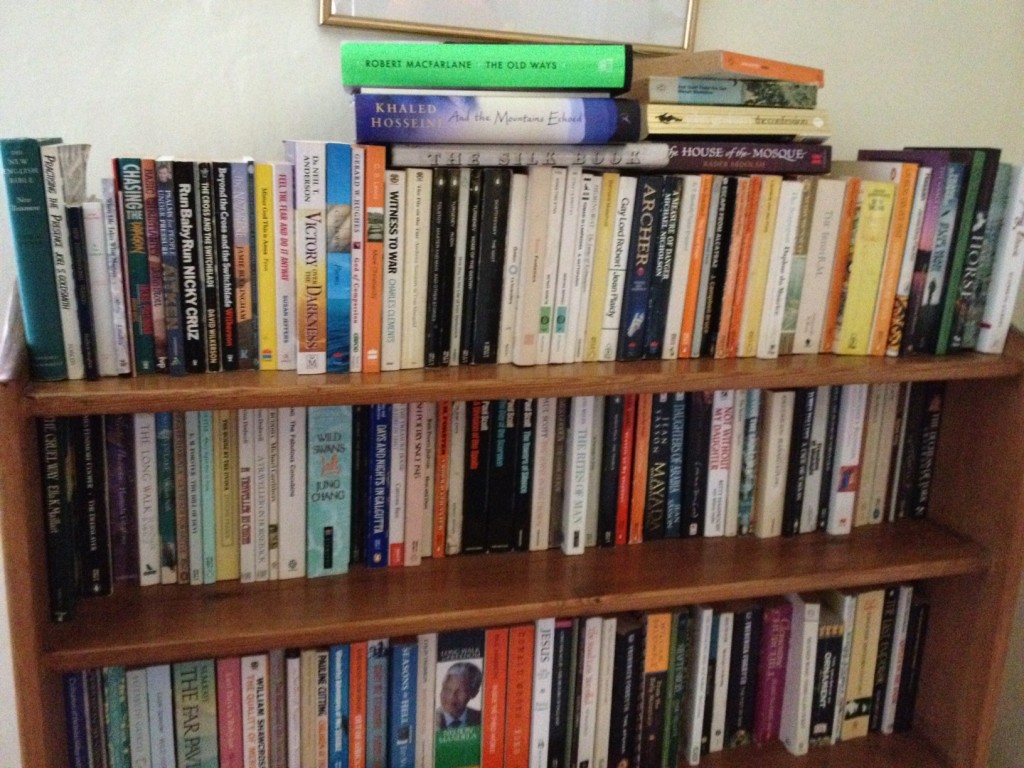
We were away at a wedding in Somerset this weekend and stayed at a wonderful bed & breakfast, The Manor House in West Compton. (The website is down – I’ll add a link later.) Apart from the lovely 15th century house in quiet countryside, kind hosts, comfortable room, beautiful paintings and furnishings, excellent full English breakfast and tea-making facilities with chocolate digestives on the side, this was on the landing outside our room:

Bookshelves

The internet of stuff

Andrew Blum’s [amazon_link id=”0670918989″ target=”_blank” ]Tubes: Behind the Scenes at the Internet[/amazon_link] was another holiday book. It was a decent enough on the terrace with a cool drink in between swims, but I was somewhat disappointed in it. The book starts with the author’s home internet connection being lost due to a squirrel chewing through a cable in his yard, and this sets off a quest to track down the physical infrastructure delivering what we all now consider to be more or less a human right, namely broadband internet access.

[amazon_image id=”0670918989″ link=”true” target=”_blank” size=”medium” ]Tubes: Behind the Scenes at the Internet[/amazon_image]

This subject fascinates me, at least since I first read about the new tunnel for fibre-optic cable being driven through the Allegheny Mountains to speed the connection between the Chicago and New York financial markets by a few nanoseconds. Also the question of where the internet servers on which ‘the cloud’ sits are located and what that implies for, say, the balance of payments, or privacy for that matter. Not to mention who owns all the cables and infrastructure, how they interconnect, where the value sits in the value chain, and all that jazz.

So Tubes starts out well and has a number of interesting sections in which the author visits various key locations such as the London Internet Exchange, or the Google and Facebook data centres in Oregon, or the seaside spots in Cornwall and Portugal joined by a new undersea cable. Still, I felt he didn’t tell me enough about these places – fantastic access without enough detail or analysis. Maybe that has something to do with the terms on which he was allowed to visit, although that’s never stated.

Interestingly, Facebook emerges as a far more open company than Google when it comes to Blum’s visits to the data centres – he isn’t even allowed in through the door at their data center – which is also obscured on Google Maps. I wonder if Facebook has changed its approach since the visit?

So I would recommend reading Tubes, which is entertaining and well-written. But I’m still looking for something more analytical about the physical reality of the internet and the intangible economy it is creating.

Walking, thinking and writing

One of my holiday reads was Robert Macfarlane’s [amazon_link id=”0141030585″ target=”_blank” ]The Old Ways: A Journey on Foot[/amazon_link], a very enjoyable collection of essays on his various walks, some by sea. Like Rebecca Solnit in her wonderful book [amazon_link id=”1844675580″ target=”_blank” ]Wanderlust: A History of Walking[/amazon_link], Macfarlane says the rhythm of walking helps him think.

[amazon_image id=”0141030585″ link=”true” target=”_blank” size=”medium” ]The Old Ways: A Journey on Foot[/amazon_image]

I agree, although often for me it’s my stately (ie. slow) jog around the park with the dog each morning. Perhaps the physical motion actually jiggles one’s brainwaves into a different state? The other mechanism I have for thinking is writing. It’s almost impossible to structure thoughts without getting words onto paper or screen, and sometimes the words seem to bypass consciousness.

The hardest thing of all is just sitting and thinking. Hence the productivity paradox: one is least likely to have good ideas by sitting at a desk trying to have good ideas, and much more likely to do so when in motion.

Not walking but running