Living vicariously

My eldest son spent his teenage years saying he was never going to end up as an economist (not that I ever put any pressure on him to choose economics). Then he read [amazon_link id=”0349119856″ target=”_blank” ]The Undercover Economist[/amazon_link] by Tim Harford, and became an economist. Next week he starts an MSc course in Economics. Living vicariously, I was looking at the course outline.

It’s 32 years since I was at the same stage in my education, and it is really startling to see how little the curriculum has changed. This is why I organised a conference in 2012 on the economics curriculum (the pre- and post-conference papers are in [amazon_link id=”1907994041″ target=”_blank” ]What’s the Use of Economics[/amazon_link]); and why Wendy Carlin of UCL is launching an initiative to develop a new, open-access undergraduate core curriculum.

Of course, until there is an alternative, most lecturers will carry on doing the same thing as before. Developing a new course by oneself is time-consuming and unrewarded, and the incentives to stick with existing textbooks and problem sets are overwhelming. I was pondering how I might home-school my son for a master’s level course, should he be in the unfortunate position of relying on mum.

For macro, I might be tempted just to give him Tim Harford’s new book, [amazon_link id=”1408704242″ target=”_blank” ]The Undercover Economist Strikes Back[/amazon_link], and the Bank of England’s suite of publications on its model and the Inflation Reports. I don’t see the point of continuing to teach the mathematical general equilibrium and DSGE models, as they are neither true nor useful. I would add, though, endogenous growth theory, via the Aghion and Howitt textbook, [amazon_link id=”0262012634″ target=”_blank” ]The Economics of Growth[/amazon_link]. For micro, Sam Bowles’ [amazon_link id=”0691126380″ target=”_blank” ]Microeconomics: Behavior, Institutions and Evolution[/amazon_link], Paul Klemper’s [amazon_link id=”0691119252″ target=”_blank” ]Auctions: Theory and Practice[/amazon_link] and one of the game theory texts – Martin Osborne and Ariel Rubinstein’s [amazon_link id=”0262650401″ target=”_blank” ]A Course in Game Theory[/amazon_link]? – supplemented by some business economics texts such as Paul Geroski’s [amazon_link id=”0198288557″ target=”_blank” ]Market Structure, Corporate Performance and Innovative Activity[/amazon_link]. For econometrics, Angrist and Pischke’s [amazon_link id=”0691120358″ target=”_blank” ]Mostly Harmless Econometrics[/amazon_link], maybe Clements and Hendry on [amazon_link id=”0521634806″ target=”_blank” ]Forecasting Economic Time Series[/amazon_link], and an actual software package.

Needless to say, this train of thought is just me living vicariously. Wouldn’t it be marvellous to be a student again? Meanwhile, my son is forewarned that I’ll be eager to look at his reading lists when he starts his actual course.

[amazon_image id=”0691119252″ link=”true” target=”_blank” size=”medium” ]Auctions: Theory and Practice (Toulouse Lectures in Economics)[/amazon_image]

Neglected mental furniture

There’s an interesting article in the new edition of The American Conservative about A.J.P. Taylor. (This journal isn’t one of my regular reads – the wonderful Arts & Letters Daily brought it to me.) The title is ‘A.J.P.Taylor is History’, the double entendre being that he shaped how we conceive of modern history, but is now forgotten. Surely not? I asked Twitter. It emerged that unless you’re of a certain age (i.e. middle aged), the answer is yes, Taylor is a neglected figure.

This is a shame. His scholarly work was important. [amazon_link id=”014013672X” target=”_blank” ]The Origins of the Second World War[/amazon_link] was of course controversial but it did put the spotlight on the fact that conditions in Europe were conducive to conflict, including the economic situation (as Keynes had forewarned in [amazon_link id=”1602390851″ target=”_blank” ]The Economic Consequences of the Peace[/amazon_link]). He was also one of the first media dons, a terrific broadcaster and populariser. These people are rarely popular among their colleagues but serve an important purpose, and act as one of the (too) few conduits between academic research and the taxpayers who fund it. Here he is on the BBC talking about Europe in 1939 and here in the BBC Archive talking about Winston Churchill.

[amazon_image id=”014013672X” link=”true” target=”_blank” size=”medium” ]The Origins of the Second World War[/amazon_image]

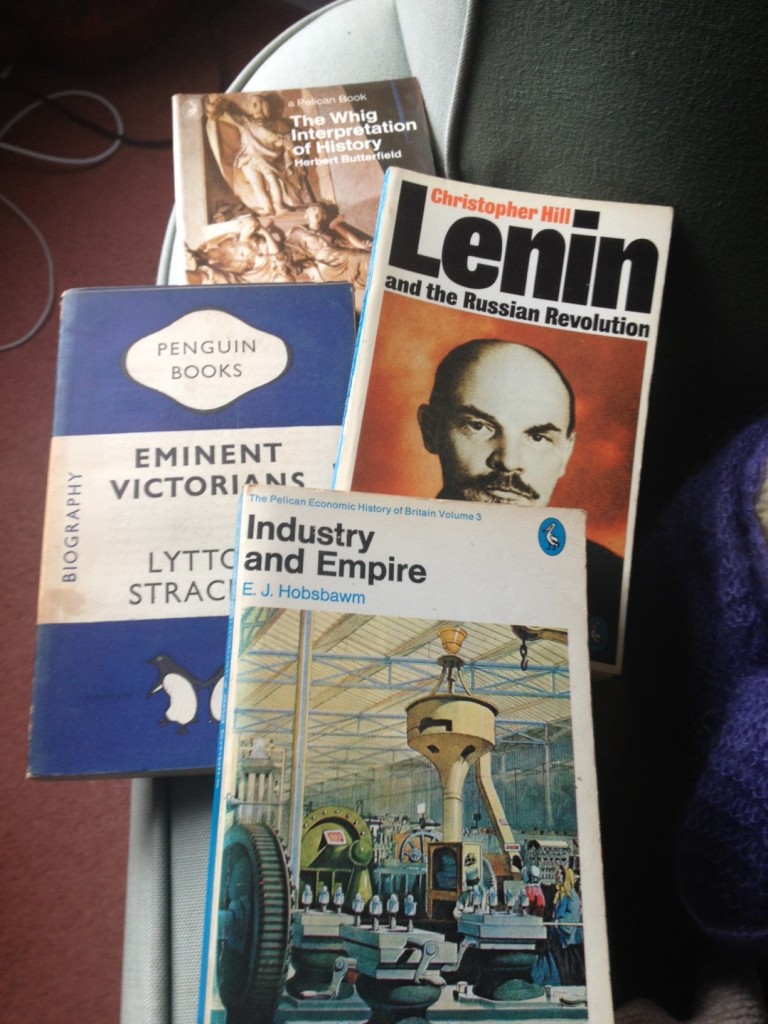
The discussion this morning about Taylor set me to thinking about the writers who formed my mental furniture in the late 1970s, in the sixth form and heading off to university. It was a kind of accident that turned me into an economist, history having been my main interest at school. I just pulled off my shelves as well Lytton Strachey’s [amazon_link id=”019955501X” target=”_blank” ]Eminent Victorians[/amazon_link], Christopher Hill’s [amazon_link id=”0140135359″ target=”_blank” ]Lenin and the Russian Revolution[/amazon_link], Herbert Butterfield’s [amazon_link id=”0393003183″ target=”_blank” ]The Whig Interpretation of History [/amazon_link]and Eric Hobsbawm’s [amazon_link id=”0140257888″ target=”_blank” ]Industry and Empire[/amazon_link], in beaten up old Penguin editions.

I don’t know what students read now, what shapes their mental landscape. Or for that matter what middle-aged folk in other disciplines or from outside the UK read in their formative years?


How much do we really want a manufacturing revival?

There’s a well-known economics joke that goes:

“Q: How many economists does it take to change a light bulb?

A: None, because if it needs changing, market forces will take care of it.”

The psychiatrist equivalent seems to be:

“A: None, but the lightbulb has to really want to change.”

These old chestnuts came to mind as I was reading Vaclav Smil’s new book, [amazon_link id=”0262019388″ target=”_blank” ]Made in the USA: The rise and retreat of American manufacturing[/amazon_link]. It’s exactly the kind of book I find very relaxing, with tons of information and empirical observation.

[amazon_image id=”0262019388″ link=”true” target=”_blank” size=”medium” ]Made in the USA: The Rise and Retreat of American Manufacturing[/amazon_image]

I’ll review it when it is officially published later this month. But, as a curtain raiser, the sections on how hard it has become to manufacture in the US (and by extension other advanced economies) are eye-opening. Low wages in Asia are not the main reason many manufacturers give for offshoring, but rather the complexity of the processes they have to go through to create a viable plant at home – training the workforce, lack of infrastructure, permits, legal obstacles or fear of legal challenge, planning permission – there’s no “can do” but rather an interlocking web of “no, sorry, can’t do”. Smil quotes one example of a planned investment that was pulled because the factory would be behind the local golf course in its priority of access to the water supply.

In another context, I was looking back at my notes on Joseph Tainter’s 1988 book, [amazon_link id=”052138673X” target=”_blank” ]The Collapse of Complex Societies[/amazon_link], a fascinating work. His argument was that sophisticated societies become too rigid in their complexity, impossible to simplify, resulting in the ultimate simplification of collapse.

Yesterday President Hollande announced a grand new industrial strategy aimed at increasing the share of manufacturing in the French economy – lower now than in the UK, never mind Germany. It isn’t clear that it addresses the kinds of obstacle Smil writes about in his book. How can we make it easier again for businesses to open major manufacturing plants, or build infrastructure, in our highly complex societies? As a start, we have to really want to do it.

[amazon_image id=”052138673X” link=”true” target=”_blank” size=”medium” ]The Collapse of Complex Societies (New Studies in Archaeology)[/amazon_image]

Shipping news

I’m delighted to find that Rose George’s new book [amazon_link id=”1846272637″ target=”_blank” ]Deep Sea and Foreign Going: Inside Shipping, the Invisible Industry that Brings You 90% of Everything,[/amazon_link] is Book of the Week on Radio 4. Good for Maersk for allowing her to join the voyage. I’m looking forward to reading the whole book.

[amazon_image id=”1846272637″ link=”true” target=”_blank” size=”medium” ]Deep Sea and Foreign Going: Inside Shipping, the Invisible Industry That Brings You 90% of Everything[/amazon_image]

Regular readers of this blog will know of my mild obsession with shipping containers. Thanks to @illicit_econ on Twitter (well worth a follow) I’ve also found this documentary film essay, The Forgotten Space, by Allan Sekula and Noel Burch. I’m not sure how to get hold of this in a UK format but it looks enticing.

Economists, doctors and quacks

The news of the death of Ronald Coase sent me to his key papers, of course (all listed here), but also to a collection of essays I hadn’t read before, [amazon_link id=”0226111032″ target=”_blank” ]Essays on Economics and Economists[/amazon_link]. He makes some very interesting points about the role of economics in public policy, expanding on the question of how limited government intervention to correct market failures ought to be. Essentially, Coase argued that this is an empirical question. The existence of significant transactions costs means market arrangements can lead to inefficient outcomes, but government interventions are often flawed too. He approves of George Stigler’s work on the political ‘market’, with the firms affected by regulations likely to be the highest ‘bidders’, therefore able to shape regulation in their own interests. (If this seems cynical, think about banking regulation.)

[amazon_image id=”0226111032″ link=”true” target=”_blank” size=”medium” ]Essays on Economics and Economists[/amazon_image]

In ‘Economists and Public Policy’, Coase turns to economists: “The problem is that economists seem willing to give advice on questions about which we know very little and on which our judgements are likely to be fallible, while what we have to say that is important and true is quite simple – so simple that little or no economics is required to understand it.” However, the simple truths are highly unwelcome. The essay goes on to discuss the political and popular resistance to economic arguments against, say, price controls after a bad harvest. “History indicates that these are simple truths which people find it easy to reject or ignore.” The essay is not entirely pessimistic – Coase believed that when the counter-productive effects of policies became too large, the policies would be reversed.

Coase is also trenchant on the character of economics. It is clear he disapproved of the ‘imperialism’ of economics, the Chicago-originated move into subject areas such as family life, previously the terrain of other social sciences. He cannot have been a fan of [amazon_link id=”0141019018″ target=”_blank” ]Freakonomics[/amazon_link]. However, he is pretty scathing, in the essay ‘Economics and Contiguous Disciplines’, about the failure of other social sciences to raise their game in their techniques and attention to evidence – he sees as particular strengths of economics the recognition of general equilibrium effects (everything is connected) and the relevance of economic incentives in other decisions, too often simply denied by other social scientists. Finally, the essay argues that economists need to study contiguous social sciences, “because it is necessary if they are to understand the working of the economic system itself.” He concluded: “We may expect the scope of economics to be permanently enlarged to include studies in other social sciences. But the purpose will be to enable us to understand better the working of the economic system.” His own work, of course, laid the foundations for institutional economics.

There are a couple of interesting essays on Marshall in the book too. Coase likes Marshall’s insistence on the need for both theory and evidence, deductive and inductive reasoning in economics. He obviously found modern economics far too much on the theoretical, deductive (or reductive) side.

I also happened to read this weekend Jamie Whyte’s pamphlet for the Institute of Economic Affairs, [amazon_link id=”0255366736″ target=”_blank” ]Quack Policy: Abusing Science in the Cause of Paternalism[/amazon_link]. There was a brief to-do online about this, with critics noting that it was hardly surprising the free-market IEA had published a pamphlet arguing against government interventions, and how could anyone argue against evidence-based policy? Whyte wrote some years ago an excellent and funny book, [amazon_link id=”0954325532″ target=”_blank” ]Bad Thoughts: A Guide to Clear Thinking[/amazon_link], about the absence of logic and sense in much public debate. The pamphlet looks at several different areas of policy and asks about the standards of evidence underpinning them. It’s obvious where it’s coming from, but it makes a number of sound points.

[amazon_image id=”0255366736″ link=”true” target=”_blank” size=”medium” ]QUACK SCIENCE & PUBLIC POLICY[/amazon_image]

The first two examples are health-related: proposals for minimum alcohol pricing and the ban on ‘passive’ smoking. Any health-related subjects are awash with political correctness and the abuse of statistics; medical people are strongly resistant to the relevance of any economic considerations at all, which one might take more seriously if they were more statistically-adept. In these two chapters Whyte argues that:

(a) a cost-benefit analysis must take account of the costs of outlawing something, and this is rarely done in health matters – NICE guidelines seemingly explicitly rule out consumer welfare considerations (p35);

(b) the incremental risks of the target behaviour are such that these costs can be very small (although he seems to me to underestimate them in the alcohol example); and

(c) the policies ought not to be economically perverse.

Actually, I think he misses the strongest case against a minimum alcohol price, which is that it increases the profits of big retailers by enforcing the kind of retail price maintenance long outlawed by competition authorities. If the government decides alcohol should be dearer, it should raise the rate of duty. This would not, however, be so pleasing to the sellers of alcohol as taxpayers would then benefit, not retailers – see Coase’s essay, above.

Whyte has a chapter on global warming that goes through the debate about how much we should weigh future against current welfare, including the likelihood that future generations will be richer, and that technological progress will occur, in trying to calculate the costs and benefits of action against global warming. (I think he’s sceptical about whether it’s occurring but that isn’t the main point here.) This is the same debate that occurred among economists like Partha Dasgupta, William Nordhaus and Nick Stern when the [amazon_link id=”0521700809″ target=”_blank” ]Stern Review[/amazon_link] was published. It’s a perfectly respectable argument to set out. Then he turns to what he describes as ‘happiness engineering’, where my sympathies are with him entirely. Government attempts to make people ‘happier’ are either obvious – ensure there are plenty of jobs, keep inflation modest – or intrusively paternalistic.

There’s a final chapter, which is too cursory, about the problem of using ‘scientific authority’ as the basis for public policy. “Experts are natural supporters of policies that draw on their expertise and thus naturally inclined to overstate the credibility and importance of their ideas,” he writes. Of course. But is not using expertise really better? Of course we would like policy to be genuinely evidence-based, and it is difficult to assess the epistemological status of proclaimed expertise. However, Coase’s pragmatism is more attractive than Whyte’s all-out scepticism, for all that Quack Policy flags up some good reasons for concern about how ‘evidence’ is used in actual policy-making.

This was a theme of another book I read recently, [amazon_link id=”0815793898″ target=”_blank” ]Government Failure versus Market Failure[/amazon_link] by Clifford Winston, which in this post I compared and contrasted with Hirschman’s writing on [amazon_link id=”067476868X” target=”_blank” ]The Rhetoric of Reaction[/amazon_link]. How you devise and implement welfare-enhancing, effective government policies in complex societies with a wide range of interests bearing on politicians – it’s what we’re all about as economists (and other social scientists).

A new book reviewed by Peter Wilby in The Guardian this weekend looks highly relevant too: [amazon_link id=”1780742665″ target=”_blank” ]The Blunders of Our Governments[/amazon_link] by Anthony King and Ivor Crewe.

[amazon_image id=”1780742665″ link=”true” target=”_blank” size=”medium” ]The Blunders of Our Governments[/amazon_image]

I’m sceptical about a lot of government interventions and also sceptical about leaving everything to the mythical market; it seems the only evidence-based possibility. We should demonstrate due humility by avoiding overclaiming either way.