Adam Smith for our times

Adam Smith’s [amazon_link id=”0143105922″ target=”_blank” ]The Theory of Moral Sentiments[/amazon_link] has had something of a revival in recent times. Emma Rothschild’s Economic Sentiments focused on it, and Nicholas Phillipson’s recent biography of Smith, Adam Smith: An Enlightened Life underlined its importance in Smith’s thinking. My own dear publisher Peter Dougherty also gave it due credit in his [amazon_link id=”0471720909″ target=”_blank” ]Who’s Afraid of Adam Smith: How the Market got its Soul[/amazon_link]. So, while still far less well-known and less widely read than [amazon_link id=”0140432086″ target=”_blank” ]The Wealth of Nations[/amazon_link], [amazon_link id=”0143105922″ target=”_blank” ]Moral Sentiments[/amazon_link] is creeping onto the intellectual radar of our times – we are rediscovering the Adam Smith we need now.

[amazon_image id=”0143105922″ link=”true” target=”_blank” size=”medium” ]The Theory of Moral Sentiments (Penguin Classics)[/amazon_image]

It gets a deserved boost from Russ Roberts’ new book, [amazon_link id=”1591846846″ target=”_blank” ]How Adam Smith Can Change Your Life[/amazon_link] (which I read in manuscript and provided a little comment for). This is a delightful book translating Smith’s 18th century prose into a 21st century guide to individual and collective living well. I choose that phrase because it isn’t just a guide to leading the Aristotelian good life, nor a book about how to run the economy better, but combines the two into insights about how wise choices can help the individual and society.

[amazon_image id=”1591846846″ link=”true” target=”_blank” size=”medium” ]How Adam Smith Can Change Your Life: An Unexpected Guide to Human Nature and Happiness[/amazon_image]

For example, in the chapter ‘How to Make the World a Better Place,’ Roberts says: “In The Theory of Moral Sentiments, Smith describes how individual choices can lead to important social outcomes. He’s talking about something more important than the price of apples. He’s describing the role each of us plays in creating a moral society.” And he goes on to explain how emergent social norms create the standards or proper, moral behaviour. “Smith argues that norms and culture are the result of the tiny and infinitely numerous and subtle ways we interact.” I particularly like this chapter. It combines Hayek and Ostrom in a rather unexpected way.

The chapters have titles such as ‘How to be Happy, ‘How Not to Fool Yourself’, ‘How to be Loved’, ‘How to Live in the Modern World.’ The last of these links The Theory of Moral Sentiments and The Wealth of Nations, explaining that they share the same world view, the same view of human nature, but apply it to different domains, the personal and the commercial.  “A modern person has to inhabit two worlds at the same time, a world that is intimate and a world that is distant, a world that is held together by love, and a world that is held together by prices and monetary incentives.”

Russ Roberts will be known to many readers of this blog for his Econtalk podcasts, a huge public service. He’s an excellent writer – I am a fan of his novels, [amazon_link id=”0262681358″ target=”_blank” ]The Invisible Heart [/amazon_link]and [amazon_link id=”0691143358″ target=”_blank” ]The Price of Everything.  If[/amazon_link] you haven’t read [amazon_link id=”0143105922″ target=”_blank” ]A Theory of Moral Sentiments[/amazon_link], or if you have and would like an enjoyable reminder, [amazon_link id=”0241003199″ target=”_blank” ]How Adam Smith Can Change Your Life[/amazon_link] is a pleasure to read.

What do economists know?

Emran Mian, who runs the Social Market Foundation (and has written a brilliant novel, [amazon_link id=”1846556260″ target=”_blank” ]The Banker’s Daughter[/amazon_link]), has a terrific essay – Prediction and the Flagpole –  in 3am Magazine about the problem of knowledge in economics – what do we actually know about how the economy works, about causality? As he points out, either the mechanisms are highly contested among economists, or ignored by them. We don’t know very much at all.

There should be no shame in this, because we don’t know much about anything. This is why epistemology is so hard. However, as the article also says, “We live in a peculiarly economics-friendly public sphere.” Yet many economists over-claim their knowledge, especially when it comes to making predictions. Personally, I think economic forecasting is largely a hopeless task except for the limited task of using time series methods to predict a short period ahead. (I was a forecaster for several years, a long time ago, so I know whereof I speak.) Chris Dillow has recently blogged about the nonsense often associated with forecasts – unicorn farming is his term for it. Nate Silver’s [amazon_link id=”0141975652″ target=”_blank” ]The Signal and the Noise[/amazon_link] has a terrific chapter effectively demolishing most macroeconomic forecasts.

After the onset of the financial crisis, there were lots of calls for economists to be humbler. I don’t see a lot of humility, alas. Most f my colleagues have little interest in the philosophical questions, although of course my great hero David Hume was keen on epistemology. One terrific book about what economists can know is John Sutton’s [amazon_link id=”0262692791″ target=”_blank” ]Marshall’s Tendencies: What Can Economists Know?[/amazon_link]. I must read Mary Morgan’s [amazon_link id=”0521176190″ target=”_blank” ]The World in the Model: How Economists Work and Think[/amazon_link], and Nancy Cartwright’s recent [amazon_link id=”0199841624″ target=”_blank” ]Evidence-Based Policy[/amazon_link] – she has also written a lot about the causality question.

[amazon_image id=”0262692791″ link=”true” target=”_blank” size=”medium” ]Marshall’s Tendencies: What Can Economists Know? (Eyskens Lecture) (Gaston Eyskens Lectures)[/amazon_image]  [amazon_image id=”0521176190″ link=”true” target=”_blank” size=”medium” ]The World in the Model: How Economists Work and Think[/amazon_image]  [amazon_image id=”0199841624″ link=”true” target=”_blank” size=”medium” ]Evidence-Based Policy: A Practical Guide to Doing It Better[/amazon_image]

What to read next?

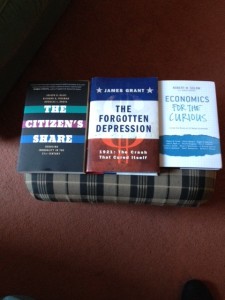
Here are the recent arrivals:

[amazon_link id=”1451686455″ target=”_blank” ]The Forgotten Depression – 1921: The Crash That Cured Itself[/amazon_link] by James Grant

[amazon_link id=”1137383585″ target=”_blank” ]Economics for the Curious: Inside the Minds of 12 Nobel Laureates[/amazon_link] by Robert Solow

[amazon_link id=”B00GGSG3VU” target=”_blank” ]The Citizen’s Share: Reducing Inequality in the 21st Century[/amazon_link] by Joseph Blasi, Richard Freeman and Douglas Kruse


New arrivals

James Grant’s looks most enticing….

If you only read two economics books….

On Tuesday Radio 4 will be broadcasting a programme, Teaching Economics After the Crash. (It goes out Tuesday December 2 just after 8pm, and I presume a podcast afterwards.) I took part, and the presenter, Aditya Chakrabortty of The Guardian asked all the participants to nominate two must-read economics books for the programme website. The whole set of selections adds up to an interesting reading list.

Mine were John McMillan’s [amazon_link id=”0393323714″ target=”_blank” ]Reinventing the Bazaar: A Natural History of Markets[/amazon_link], and Thomas Schelling’s [amazon_link id=”0393329461″ target=”_blank” ]Micromotives and Macrobehavior[/amazon_link].

[amazon_image id=”0393323714″ link=”true” target=”_blank” size=”medium” ]Reinventing the Bazaar: A Natural History of Markets[/amazon_image]   [amazon_image id=”0393329461″ link=”true” target=”_blank” size=”medium” ]Micromotives and Macrobehavior[/amazon_image]

The cast list makes the programme’s conclusions pretty clear: it won’t give a positive verdict about modern economics! Wendy Carlin, Danny Quah and I seem on the face of it to be the hardline mainstream voices, which is bizarre. You could only think that of us if you had only spoken to heterodox economists about the state of play. I’m sure it will be an interesting and thought-provoking programme – after all, The Guardian has been campaigning on this issue – but it certainly isn’t going to be a descriptive portrait of the complete state of opinion in economics.

The Coaseian Milkman

It is one of life’s joys when a new book turns up unexpectedly in the post, and last week Edge publishing kindly sent me one that on the face of it was a bit of a random choice. It’s [amazon_link id=”1770530606″ target=”_blank” ]The Milkman[/amazon_link] by Michael Martineck. Mysterious because it’s a science fiction novel set in a future dystopian America – specifically the Buffalo, New York area. Still, I’ve been travelling a lot and was glad of some light relief, and The Milkman turned out to be a page-turning read.

[amazon_image id=”1770530606″ link=”true” target=”_blank” size=”medium” ]The Milkman: A Free World Novel[/amazon_image]

Besides, the publisher’s decision to send me the book became less mysterious as the pages turned. Not only does it feature an economist as one of the good guys (yessss!) but it has a highly topical set of economic issues at its core. The book asks what happens when the marketisation of public goods, and the globalisation of the world economy, is taken to its extreme? This dystopian world is run by three global mega-corps which have eliminated governments as highly inefficient. There is no guilt or innocence: simply a question of whether each person’s (sorry, asset’s) net present value to the corporation that owns him/her is positive or not. What is their future contribution to profit, how much will they cost to keep healthy, when will their value as a deterrent to other awkward customers exceed their value in their workplace? This is also a constantly online world – people are tied, and tracked, by smart watches. Public space, and public goods, have vanished. All the externalities have been internalised under the corporate umbrella.

So I won’t pretend it’s the most literary novel I’ve ever read, but I really enjoyed it. What’s not to love about a storyline that takes Ronald Coase seriously?