
The devil take the debt

Adair Turner’s [amazon_link id=”0691169640″ target=”_blank” ]Between Debt and the Devil: Money, Credit and Fixing Global Finance[/amazon_link] – out this month – joins a select group of books that provide as clear an explanation of the financial crisis as one could hope for. It complements John Kay’s [amazon_link id=”1781254435″ target=”_blank” ]Other People’s Money[/amazon_link], with its emphasis on globalisation, financialisation and the switch from relationship to transactional finance. [amazon_link id=”0691169640″ target=”_blank” ]Between Debt and the Devil[/amazon_link] emphasises above all the inherent instability of banks’ ability to create credit, when not restrained by policy, especially given the scarce supply of that all-important asset, real estate. The growth of the shadow banking sector amplified this pre-existing source of volatility.

[amazon_image id=”0691169640″ link=”true” target=”_blank” size=”medium” ]Between Debt and the Devil: Money, Credit, and Fixing Global Finance[/amazon_image]

The book starts by pointing out that it was always foolish to think financial markets would satisfy the criteria for efficient (and stable) outcomes. The pre-crisis orthodoxy of liberalisation ignored the pervasive information asymmetries and non-rational choices in finance. [amazon_link id=”0071592997″ target=”_blank” ]Minsky[/amazon_link] features prominently here. As Turner points out, it isn’t as if there was any shortage of evidence from history that financial crises occur reasonably frequently. He adds the distinctive feature of the recent crisis, the increased inequality of incomes driving demand for easy credit, which banks were only too happy to meet. (Echoes of of Raghuram Rajan’s [amazon_link id=”B005CQAJD0″ target=”_blank” ]Fault Lines[/amazon_link].)

The third part of the book covers the global dimensions of the crisis, in particular the China-US flows, and the role of the Euro. The financial flows not intended for direct investment were both immense and destabilizing, he writes. Among the high income countries, gross cross-border flows increased from less than 10 times GDP in the 1970s to 37 times GDP in the 2000s, with even larger proportionate increases for middle income countries. There is no evidence at all, he argues, that financial flows on this scale play any socially useful role at all.

And in this context of unsustainable credit growth at home and destabilizing flows across borders, only a minority of banks proved able to manage their balance sheet risks. To make matters worse, those that were good at risk management looked after themselves by offloading their bad risks onto other financial institutions, less well able to manage them. So the outcome for the system as a whole was even worse.

Given the difficulty of tackling the three drivers of the crisis – a limited supply of land and real estate, income inequality and global imbalances – what does Turner, a former head of the FSA, recommend? His answers are interventionist, suggesting a total rejection of the idea that finance can be left to ‘the market’. “To achieve a less credit-intensive and more stable economy, we must … deliberately manage and constrain lending against real estate assets,” he writes. He also advocates central bank monitoring of credit growth, constraining it when necessary; taxation of land values; taxation of debt to bring its treatment in line with taxation of equity; and raising bank equity ratios and minimum liquidity requirements (a step advocated by every, but every, economist who has given a moment’s thought to the crisis – shocking that the banks have lobbied their way out of this minimal step towards systemic stability).

Indeed, the book’s final chapter has some sympathy for even stronger measures: outlawing private money and credit creation; taxing credit creation funded by debt; and encouraging equity and hybrid instruments in place of debt.

However, the book concludes with a caution: “We face a choice of imperfections, and some of the imperfections are unfixable.” Financial markets are imperfect; so are policy-makers. Simple rules will never deliver stability, Turner argues. Far tougher constraints on the financial sector are needed. But policymakers will always have to make judgments as conditions change, and will get it wrong sometimes. Still, he suggests, not as wrong as in the mid-2000s.

Turner is at the tougher end of the spectrum in terms of his recommendations for constraints on the financial sector. But his calls for reforms join an honourable roll call of economists – as well as [amazon_link id=”B00UJD8AS2″ target=”_blank” ]Kay[/amazon_link] and [amazon_link id=”B005CQAJD0″ target=”_blank” ]Rajan[/amazon_link], [amazon_link id=”B00LLPSU4Q” target=”_blank” ]Admati and Hellwig[/amazon_link], [amazon_link id=”022627165X” target=”_blank” ]Mian and Sufi[/amazon_link], for example. As [amazon_link id=”0691169640″ target=”_blank” ]Between Debt and the Devil[/amazon_link] points out, millions of people are still suffering from the effects of the financial crisis. Yet the policy response has been minimal, and there is nothing to stop the whole thing from happening all over again. At least if it does, nobody will be able to blame the economists this time for not having sounded the warning.
Winner of the Enlightened Economist Prize 2015

It has been a tough year to decide which of the titles on the longlist would win. The rules are that I make up the criteria and decide for myself – it’s a combination of readability,  telling me things I didn’t already know, and likely shelf longevity. And I have to have read the book in the past 12 months; publication date is not relevant.

The shortlist included [amazon_link id=”0262525968″ target=”_blank” ]Cybernetic Revolutionaries[/amazon_link] by Eden Medina, [amazon_link id=”0241003555″ target=”_blank” ]Why Information Grows[/amazon_link] by Cesar Hidalgo and [amazon_link id=”1781254435″ target=”_blank” ]Other People’s Money[/amazon_link] by John Kay.

[amazon_image id=”0262525968″ link=”true” target=”_blank” size=”medium” ]Cybernetic Revolutionaries: Technology and Politics in Allende’s Chile[/amazon_image] [amazon_image id=”0465048994″ link=”true” target=”_blank” size=”medium” ]Why Information Grows: The Evolution of Order, from Atoms to Economies[/amazon_image] [amazon_image id=”1781254435″ link=”true” target=”_blank” size=”medium” ]Other People’s Money: Masters of the Universe or Servants of the People?[/amazon_image]

But the winner is: [amazon_link id=”0691152845″ target=”_blank” ]Mastering Metrics[/amazon_link] by Joshua Angrist and Jorn-Steffen Pischke. It might seem surprising that I chose an econometrics text, but seriously if you have any interest at all in understanding how to treat evidence carefully and reason about causation, this is a very accessible explanation. It is also straightforward to read and understand – the technical bits are in an appendix to each chapter and easily skipped. I certainly think every economist and student of economics ought to read this book.

[amazon_image id=”B00SLVGQD0″ link=”true” target=”_blank” size=”medium” ]Mastering ‘Metrics: The Path from Cause to Effect: Written by Joshua D. Angrist, 2015 Edition, Publisher: Princeton University Press [Paperback][/amazon_image]

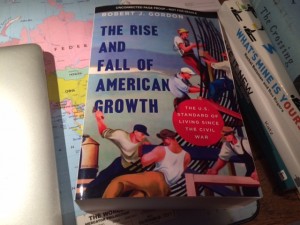
American growth

Back from a trip to New York to find this proof copy awaiting me – excellent!

Forthcoming in January from Robert Gordon

Forthcoming in January from Robert Gordon

On the flight I read [amazon_link id=”1408831635″ target=”_blank” ]The Valley[/amazon_link] by Richard Benson, a wonderfully written and evocative slice of Northern working class live over the past century. It’s an account of his family, set in the south Yorkshire coalfields. It does not romanticise that context at all – people who are from a working class family never make that mistake – but the book is all the more powerful for it. Highly recommended and absorbing enough to make the 6 hour flight pass quickly.

[amazon_image id=”1408831635″ link=”true” target=”_blank” size=”medium” ]The Valley: A Hundred Years in the Life of a Yorkshire Family[/amazon_image]

Tomorrow – drum roll – I’m going to announce the winner of this year’s Enlightened Economist Prize.

Finance made funny

I’m in New York to do a talk at NYU on Tuesday. My plane reading was [amazon_link id=”0241146666″ target=”_blank” ]The Mark and the Void[/amazon_link] by Paul Murray, author of the hilarious and tragic [amazon_link id=”0141009950″ target=”_blank” ]Skippy Dies.[/amazon_link] His new novel is set in Dublin’s financial centre at some stage after the financial crisis has struck and before it has ended (not that it has, really). It is extremely funny – I particularly liked the character of Jurgen, the protagonist’s immediate boss. It also seems to me a pretty accurate representation of the rotteness of the system and the helplessness of many perfectly decent people (if eccentric, at least in this tale) trapped inside it. Actually, for readers who haven’t ploughed through the many, many booksabout different aspects of the crisis, [amazon_link id=”0241146666″ target=”_blank” ]The Mark and the Void[/amazon_link] would be a decent introduction. But I recommend it for the out-loud laughs as well. (And apologies to the lady next to me on the plane who must have thought she had a nutter next to her.)

[amazon_image id=”0241146666″ link=”true” target=”_blank” size=”medium” ]The Mark and the Void[/amazon_image]

Thinking, learning and doing

James Bessen’s book [amazon_link id=”0300195664″ target=”_blank” ]Learning By Doing: The Real Connection between Innovation, Wages and Wealth[/amazon_link] is excellent. It strikes a balance between meaty analysis and description of historical episodes of technical change, and is at the same time very accessible.

[amazon_image id=”0300195664″ link=”true” target=”_blank” size=”medium” ]Learning by Doing: The Real Connection Between Innovation, Wages, and Wealth[/amazon_image]

The book argues that it is important to distinguish between ideas, which can be codified and transmitted and know-how attached to workers, which takes experience to accumulate. This is familiar – Paul Romer recently blogged about the role played by this distinction in his famous model. But Bessen adds that the distinction makes it important to consider the incentives for workers to invest in new skills so that new technologies can be implemented – and the part played by these incentives is usually overlooked and yet crucial for forming views about the “future of work” when there are ubiquitous robots.

He uses the historical examples to demonstrate that in the early stages of implementation of a technology, returns to workers with generally high skills will rise. They are able to make the adjustments and minor additional innovations that get the big innovation to work. During that period, the wages of ordinary workers stagnate – as in the famous Engels’ Pause (pdf). However, when the technology is thoroughly bedded in and the technical knowledge needed to work with it is standardised, ordinary workers have the incentive to invest in in gaining skills and experience. A thick labour market develops. Workers are able to threaten credibly to switch jobs. Their real wages rise and the high-level skill premium narrows.

“The specific skills associated with a major new technology are not standardized at first, which limits the market. Initially, these skills are always limited to specific employers.'”

He emphasises the need for the necessary technical knowledge to be standardised too – the example he uses is the periodic table’s invention, standardising the chemical knowledge workers in the growing industry needed, and making it easier to teach.

Bessen then uses some new examples to demonstrate that with digital technologies, this standardisation of technology, tasks and skills has not yet happened. His example is digital publishing, where the specifics of the technology are still changing, and so do the specific technical knowledge and experience needed.

In addition to the development of a standardised know-how labour market on demand and supply sides, Bessen points out that new technologies can also raise demand and employment in existing work. His example here is the continuing increase in the number of bank tellers (still going on) even as the number of ATMs grew rapidly, with the humans’ tasks changing to focus on customer relations, and the number of bank branches and transactions increasing. This is not the case with all technologies – the job market for people making oil lanterns is tiny – but the book suggests it happens more often than one would think.

The book ends with policy reflections, of which the most interesting concerns education. The reasoning about standardised knowledge, and the importance of experience, as a technology matures points to the need for skills-focused education rather than piling as many young people as possible through conventional academic tertiary education. Bessen argues that demands to make vocational jobs such as nursing or medical assistants require a university degree represent a form of job protectionism. He also – along with many other scholars – points to the dysfunctional nature of the patent/copyright system as it operates now, especially in the US.

This is a very US-focused book, but none the less interesting for that. This review has skimmed over the top of the argument; I’d strongly recommend the book to anyone interested in the automation/inequality/employment issues. It is a broadly optimistic perspective but does underline the length of the transition and the likely impact on individuals. All the more reason to pay attention to the policy implications.