What next?

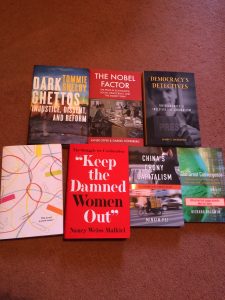
All of a sudden a wave of enticing-looking books has arrived. I’ve read the proofs of Tim Harford’s new one, Messy – not allowed to review that until closer to publication date in early November, but it’s terrific of course. I need to hold off on Richard Baldwin’s The Great Convergence, which I’m desperate to read, because it also isn’t published until November. But all of these others look tempting too. Which to pack in my bag today?

img_3585

Humans need not apply

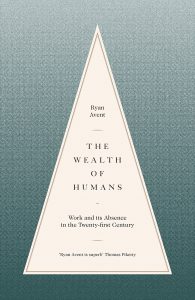
As one would of course expect from the economics correspondent of The Economist, Ryan Avent has written a very clear account of the way digital technologies, and the globalisation driven in part by technology, is changing the ways people can earn a living. The Wealth of Humans: Work and its Absence in the 21st Century brings together the debate about robots destroying jobs, arguments about the ‘death of distance’ and literature on the re-emergence of cities as economic hubs, the issue of inequality, and the more recent discussion of whether or not the world is in for an era of ‘secular stagnation’. The focus is on three related trends: automation, globalization, and the enhanced productivity of a highly skilled minority of people.

a1gvwmfxml

It ends up being a rather pessimistic synthesis. The starting point is unarguable: “Society must go through a period of wrenching political change before it can agree on a broadly acceptable social system for sharing the fruits of this new technological world.” A few years ago this would have seemed hyperbole, but no more. And yet the rest of the book tends to suggest that this political change cannot happen. Essentially, Avent does not believe enough people can become educated or skilled enough to share the benefits of automation and globalisation with those happy few whose cognitive skills have made their incomes increase. He does not think as many as 50% can complete tertiary education. “The proportion of highly educated workers to less educated workers is no longer going to grow in the growth-boosting, inequality-dampening way it once did.”

Part of this, I’d take issue with. I don’t agree that skill upgrading has ‘run out of steam’. The character of tertiary education clearly needs to change; we are in a stage like the persistence of classical education in the late 19th century. The educational establishment is slow to change – but it will, or it will be disrupted. But I’m much more persuaded by James Bessen’s argument (in Learning by Doing) that in the later stages of the technological transformation of production, the necessary skills are steadily standardised and thus able to be codified and taught. And, while addressing the ‘lump of labour’ fallacy, Avent nevertheless argues that, “The problem is the sheer abundance of labour.” Yet he also sees technology replacing ‘expensive’ labour. Surely labour=people=knowledge, pretty key in an endogenous growth, knowledge-based economy. It seems more likely that ‘work’ will be redefined, with a role for appropriately skilled humans, as it has been so many times before.

There are some very nice details indeed in the book. I didn’t know that Robert Gordon used to ask audiences whether they would rather give up post-2000 technology or indoor plumbing – the answer used to be the former, until smartphones came along. And indeed in the developing world, people would clearly rather have their phones and the internet. (An aside: indoor plumbing is a great example of why technology is social more than it’s technological. It’s a simple and well-known technology, yet one many countries are unable to make work for them.) Arvind Subramanian’s term ‘fluff not stuff’ for weightlessness (cf The Weightless World) was new to me, although perhaps a little too derogatory-sounding for the source of most of the value-added in developed economies.

Avent concludes that the reason to be pessimistic is that there is ‘no-one in control’, able to pilot society wisely through the upheaval. Looking back over the past 200 years, someone thinking they are ‘in control’ seems a pretty bad idea to me. But, to get back to the starting point, the politics, I’d agree that this is the territory for pessimism. Where leadership to generate a sense of progress and confidence would be desirable (because expectations matter no end for the economy), we have politicians reacting to people’s fears. It’s understandable, but it isn’t what we need.

Public policy reading

Frederico Mollet on Twitter set me a good challenge: some general reading for someone about to start a masters in public policy. Here is a list of suggestions, ten books*, accessibly written, with a bias towards economics and the rationale for economic policy. As ever, more ideas will be welcome.  I’m particularly keen to hear recommendations of this kind of book by female authors – this is a shockingly male list.

The first three are my all-time favourites and I think everybody ought to read them.

Seeing Like A State James Scott

Reinventing the Bazaar John McMillan

Micromotives and Macrobehaviour Thomas Schelling

Who Gets What and Why Alvin Roth

What Money Can’t Buy: The Moral Limits of Markets Michael Sandel

Economics Rules Dani Rodrik

Madmen, Intellectuals and Economic Scribblers: The Economic Engine of Political Change Edward Lopez and Wayne Leighton

Poor Economics Esther Duflo and Abhijit Banerjee

The Idea of Justice Amartya Sen

Other People’s Money John Kay

Economic fables Ariel Rubinstein

The Blunders of Our Governments Anthony King and Ivor Crewe (UK examples only, pretty funny)

PS * approximately 10 as I kept having ideas

41wndayie2l51ngtzgbdzl41calcwsg6l

1989 and all that

One of the most brilliant history books I’ve ever read is the late Tony Judt’s Postwar: A History of Europe since 1945. It was revelatory, not just because he was a brilliant writer, but also because of that framing of modern history on this side of the Atlantic as a story of all of Europe. The Iron Curtain turned out to have been an internalised barrier too. So Judt was able to reveal the epochal importance of German reunification and membership of the EU for other central and Eastern European countries. For many of us ‘Remainers’, the failure of the official campaign in the UK’s disastrous EU referendum to remind voters about how hard won modern Europe has been was inexplicable.

I’ve just finished Europe Since 1989: A History by Philipp Ther (a translation from the German original). While not on the same scale, Ther acknowledges his debt to the way Judt framed the continent as a whole. Having said that, this is a book focusing largely on the experience of the former Soviet bloc, and exploring the reasons for the different outcomes for different countries. One message is how much earlier history influences the present, for example in the differing cultural and social attitudes to entrepreneurship, or conformism. Another is the extent to which east Germany (and Berlin until relatively recently) suffered from what Ther describes as “the most radical shock therapy in postcommunist Europe.”

I found the detail interesting – Ther is obviously familiar in great depth with many of the former planned economies. I had one big frustration, which is that the entire post-1989 history is interpreted through the prism of ‘neoliberalism’. I agree with my colleague Colin Talbot that this is largely used as a generic term of abuse, one often aimed at economists in general. Ironic, really, when applied in the context of the dramatic economic collapse of the non-market economies. Ther isn’t as bad as many users of the term, in that he does appreciate that there was a specific ideological project – spearheaded by Reagan and Thatcher, supported by a group of economists. However, while talking freely about ‘neoliberal hegemony’, he also writes: “The political practice of reform in eastern Europe always diverged from pure theory,” and “Brussels’ agenda was not strictly neoliberal,” (writing about transfers of funds to the former communist countries amounting to many times the amount of Marshall Aid). He continues: “Overall, European integration and its attendant programms were a tremendous success.”

So one ends up with the impression that the first neoliberal wave was Jeff Sachs with his ‘shock therapy’ theory, and the second was Vaclav Klaus. It’s a bit thin, although of course the ‘shock therapies’ were simplistic and indeed quickly disowned by many economists. So although at least this book doesn’t claim all of economics, the mere idea of economic reform in a disintegrated planned economy, is neoliberal, it’s an analytical frame that hinders rather than helping understanding of post-1989 Europe.

51do2il7nrl

Post-truth rhetoric

Mark Thompson’s new book [amazon_link id=”1847923127″ target=”_blank” ]Enough Said: What’s Gone Wrong with the Language of Politics?[/amazon_link] might seem a bit off-topic for a blog covering economics books. But the EU referendum campaign put debate about economics on the frontline. According to opinion polling, nearly 90% of professional economists in the UK agreed a Leave vote would prove harmful to the economy (by the way, not all in the two months after the vote – it’s an assessment of longer term trade and investment prospects). Economists were also among those pointing out that the claim of £350m a week extra for the NHS could not be a true claim because the UK’s net payment to the EU is nothing like so big (so did the UK Statistics Authority; and indeed, the claim has now been dropped by the Leavers – nowhere to be seen on their website). As a consequence, Brexit campaigners dismissed ‘experts’ and indeed Michael Gove, a senior politician, compared 300 who signed an open letter to the newspapers (including me) to Nazi scientists. (He did later apologize.)

[amazon_image id=”B019CGXR6G” link=”true” target=”_blank” size=”medium” ]Enough Said: What’s gone wrong with the language of politics?[/amazon_image]

Of course, it isn’t just Brexit. Step forward Donald Trump. Populist politics everywhere are ‘post truth’. Mark Thompson’s book is about the language of this phenomenon. He looks at issues such as climate change, the MMR vaccine; at the arrival of spin techniques; at distrust in politics. He analyses the highly effective rhetorical techniques used by the post-truthers, and the role of the media in amplifying the phenomenon. It isn’t just social media and polemical online news entities, although they play a large part. Thompson also points the finger of blame at traditional quality news organisations – including the BBC, of which he used to be Director General – for falling for the idea of ‘false balance’. In other words, that every pro-Remain economist must be balanced by one of the eight pro-Leave economists. I’m not sure he would have taken a different tack, were he still in the job earlier this year: the relentless right wing attacks on the BBC’s funds, on its supposed ‘bias’, on its independence have undermined its editorial confidence. However, I do agree with him about its referendum coverage, as do Ivor Gaber of the Political Studies Association and the Electoral Reform Society, which considered coverage by the public service broadcasters too combative, like a Punch and Judy show rather than a serious deliberation.

Experts get part of the blame too, for a failure to communicate. Technocrats deploy a ‘weirdly affectless and dehumanised style,’ he writes. I hope not me, but certainly agree economists need to try harder to communicate. This faultline between technocracy and popular democracy has been a long time in the making, though: Daniel Bell warned about it in [amazon_link id=”B00I61SKOI” target=”_blank” ]The Coming of Post Industrial Society[/amazon_link]. Unfortunately it’s clear that politicians and media (of all kinds) are locked into a vicious circle of neither side being able to discuss real trade-offs or hard choices. So that only really leaves the experts. And Thompson points out that expert language needs to change. It cannot stick with reasoned argument , but needs to add the appeal to emotion and the badge of good character (to complete the triad of traditional rhetorical tools). “Technocracy is itself a product of the rationalist enterprise, so we shouldn’t be surprised when today’s policy experts contrast their world of evidence-based and hyper-rational discussion with the irrational language world of retail politics.” Not surprised, but clearly we need to extend our repetoire to persuade others.

Not surprisingly, though, Thompson’s book is weaker on solutions than on diagnosis. After all, the degradation of public discourse, the post-truth world, is a difficult and entrenched problem a long time in the making. But for the analysis – and the insights from a distinguished and experienced journalist and news executive – the book is well worth a read.