Truth is possible – and important

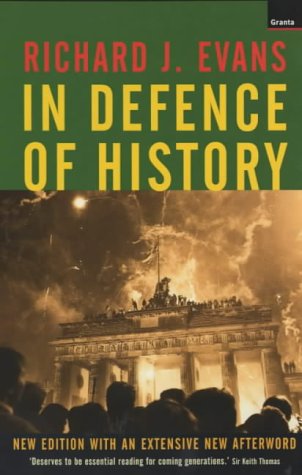
For reasons too lengthy to go into, I just read In Defence of History by Richard Evans (first published 1997). It’s a spirited counter-attack on the post-modernist/structuralist attack on history, particularly its most extreme versions. Consider for example Barthes’ claim that history is, “A parade of signifiers masquerading as a collection of facts.” Evans argues that postmodernist historians make the false claim that ‘traditional’ historians naively take historical documents at face value, whereas they are well aware that the degree of transparency of historical texts varies: to pit naive belief in the documents against knowing relativism about texts is to create a false duality.

Richard Evans has been back in the news as he acted as an expert witness for the High Court in the trial portrayed in the new film Denial. As he has noted on Twitter (@RichardEvans36), this account of the court battle between disgraced Holocaust-denier David Irving and the historian Deborah Lipstadt is extraordinarily timely. His book seems newly timely as well in the post-truth, alt_facts era; history is shaped by the present but not only by the present, and the search for truth is meaningful. As he tweeted again earlier this month:

evanstweet419CFH0TBGL


What *is* consumption?

In between visits by my students to office hours today I picked up again Thomas Schelling’s Choice & Consequence and re-read the final essay, ‘The Mind as a Consuming Organ’. Recently I wrote something about this for the FT. It’s such a rich essay – well, I’d be overjoyed to have written any of the essays in the book.

The bit that resonated today was this reflection on consumption:

“Take the rational consumer in economic theory: what is he consuming?

“What do I consume when I purchase The Wizard of Oz? Physically I buy a book or a reel of videotape. But that is a raw material. I ‘consume’ two hours of entertainment. But should I say that, like Dorothy, I consumed a trip to Oz … the adventure, with the risk and poignancy and exceitement and surprise?…

“There is no question but that part of what I get from a two hour movie or two hours with a book is ‘two hours’ worth’ of something…. But do we consume the contents of the story or just the time?”

These were profound questions in the early 1980s, but more so now a high proportion of rich consumers’ expenditure goes on experience goods. The underlying question is what is being maximised when an economic agent maximises their utility – and what are the implications for welfare economics of preference formation over emotions or mental processes. I don’t know the answers, but standard economics will struggle more with ill-defined and relative or fluid preferences than with any number of financial crises.

Imagination and economics

Martin Wolf has always been super-gloomy. In 2016 he really came into his own, as the year delivered him so much to be gloomy about. His latest column in the Financial Times is a great example, ending with a prediction that authoritarian nationalism is centre stage and will change everything about the world order.

The column alludes to Benedict Anderson’s Imagined Communities, so I went back to the book today. I’d underlined this definition of ‘official nationalism’: “An anticipatory strategy adopted by dominant groups which are threatened with exclusion from an emerging nationally-imagined community.” Not so much the left-behinds as the ‘once-aheads, really don’t like their loss of status in a changed nation’.

As Wolf puts it: “[T]he politics of nationalist resentment are not just an upsurge from below. They are a tactic of power-seekers.” He argues that economics is bound to find itself in opposition to official nationalism: “Perhaps the greatest contribution of economics is the idea that societies will gain more from seeking to trade with one another than trying to conquer one another. … The wise relationship between states, therefore, is one of co-operation, not war, and trade, not isolation. This brilliant idea happens to be correct. But it is also counter-intuitive, even disturbing. It means that one might gain more from foreigners than fellow citizens.”

So brace yourselves, fellow economists. The Govian war on experts will continue.

51G0nDJdXSL

War and inequality

I’ve been distracted for a few days, first by the ASSA conference in Chicago – of which more in the next post – and then by my eldest son’s wedding. But I’m now eager to read a book that has just arrived at Enlightenment Towers, Walter Scheidel’s The Great Leveler: violence and the history of inequality from the Stone Age to the twenty-first century. “Are mass violence and catastrophes the only forces that can seriously decrease economic inequality?” the inside cover blurb starts. The following 450 pages answer: yes. I’m not expecting it to be a cheerful read.

61rqKwdV4jL

By coincidence, there’s a recent VoxEU column supporting the Great Leveler hypothesis. Looking at Europe’s rich since 1300, Guido Alfani concludes that only the Black Death and world wars have significantly reversed increasing inequality. All this new work follows Thomas Piketty’s raising the question in his tome Capital in the 21st Century. Talk about an unpalatable trade-off.

Joy of data visualizations

Recently Dave Giles linked to an old blog post on his wonderful Econometrics Beat about plotting the data before running regressions. This is a habit drummed into me at an early age but youngsters don’t seem to always do this.

Dave mentions the well-known Edward Tufte books, The Visual Display of Quantitative Information and Envisioning Information. (I think I have the entire Tufte oeuvre.)

41gisakryl 81vezjen4l


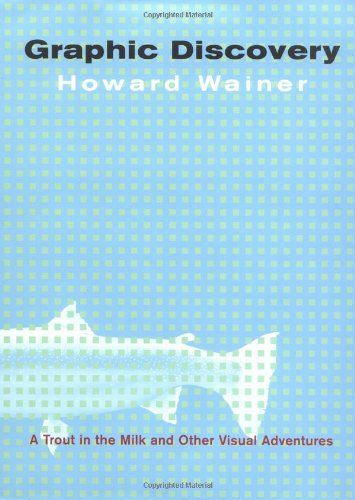
I like Howard Wainer’s books also: Graphic Discovery and Picturing the Uncertain World. I don’t have his latest, Truth or Truthiness: How to Think Like A Data Scientist, and might need to remedy that.

51j61mfzejl 51mwgf8vazl