
Still grumpy about compulsory happiness

Richard Layard has been a powerful advocate for the use of well-being or happiness as the aim of government policy for many years now. The new book he has co-authored with other happiness researchers, The Origins Of Happiness: The Science of Well-Being Over the Life Course, is a useful overview of the now-large body of empirical work exploring the links between measures of happiness (I’m going to use the book’s shorthand) and potential explanatory factors. It looks at both adult outcomes and child development. There is a substantial bibliography and excellent index. And, while not a completely easy read for the general audience – as technical jargon does slip in – it’s also very accessible.

My ‘but’ is not about the book specifically but about the advocacy of a well-being policy target in general. The applied work linking potential causal explanators to individual happiness is persuasive, and it’d be hard to argue with the kind of policy conclusions one might draw: keep employment high and stable; fund mental health care far more generously; aim to have a high trust society. Some conclusions are equally persuasive without having obvious policy implications: children need a stable and loving family more than they need a high income family; family conflict is bad for children’s well-being.

I was less familiar with the work reported in the book on education, and am not sure what to make of these sections. The empirical claim is that additional years of education contribute relatively modestly to individual happiness, and this is almost outweighed by the negative effect of comparing oneself to others: “Extra education brings considerable benefits (direct and mediated [via higher income]) to the individual. But these are substantially offset by the negative effect of one person’s education on others in the peer group.” In contrast to the received wisdom, in other words, education has negative rather than positive externalities. Maybe, this chapter concludes, it’s ok to continue with higher education because there will perhaps be some civic benefits. The unwritten coda is that the authors might like to see the education arms race halted – just as they want to policies to end the income arms race, for their conclusion is that people in the main care about their relative status, and the only way to stop this making them unhappy is to stop them trying.

Less jawdropping is a chapter on the influence of schools on children’s well-being. Its conclusion is that there is great variation between schools, and a good school has a far better impact on children’s well-being, attainment and behaviour than a similar amount of money spent by the individual family. The result doesn’t seem to be due to individual teachers, so the cause lies in the institutional context. This seems interesting and well worth further exploration, especially given the wide variation between schools.

The book’s main message is the same as the original Easterlin paper: rising incomes do not translate into rising happiness, and we could all be happier if we stop pouring our energies into positional outcomes such as income, where we compare ourselves with other people. Anyway, the argument goes, the psychological mechanism of adaptation or habituation moderates the benefit of rising incomes. Therefore policymakers should aim to increase happiness, not incomes. This seems illogical to me: if we are all going to return to a happiness set-point after a period, why bother with policies trying to increase happiness? (And never mind the point that happiness data by construction range from 0 to 10, with the great majority of people in the top half of that range; while income measured by real GDP is an analytical construct that can in theory rise without limit. Am I missing something here? It rarely gets mentioned in the discussions of the happiness lit.)

In sum, I’m in full agreement with the authors about policies to improve some of the factors that clearly affect people’s well-being. But I still don’t want well-meaning economists and psychologists (all with PhDs) trying to make people happy, utilitarian engineers of souls – still less politicians.

[amazon_link asins=’0691177899′ template=’ProductAd’ store=’enlighteconom-21′ marketplace=’UK’ link_id=’9e36ccf8-0f4d-11e8-b8cc-d7f8464ed58d’]

I also just read Animals Strike Curious Poses by Elena Passarello and was hugely disappointed. It had rave reviews, and is about the relationship between humans and animals. Although she obviously knows a lot – and some sections of the book were very interesting – it’s massively over-written and veering into the kind of creative writing task you set school children: “Write about how it feels to be a woolly mammoth being hunted.”

[amazon_link asins=’1787330303′ template=’ProductAd’ store=’enlighteconom-21′ marketplace=’UK’ link_id=’a730ed0f-0f4d-11e8-8f0a-e7fe3e6ac4a5′]
 

Civilisation: primeval slime to Mars

I finished Daniel Dennett’s From Bacteria to Bach and Back, and personally have no problem with his view that human consciousness is an evolved characteristic built over time from the ground up, and that human culture evolves too, starting with language and continues through memes. In other words, it’s all cranes, not skyhooks. Some people are obviously troubled by this argument. I lack the technical knowledge to evaluate all the detail here. It fundamentally seems far more plausible to me than the alternative.

As a matter of logic, this requires me – and Dennett – to take seriously the argument that computers/AI could evolve minds and consciousness. He puts some weight on the importance of embodiment – but that might be possible although we’re not there yet. Computer vision would be different from ours, but then so is flies’ vision or cephalopods’.

More of an issue, it seems to me, is that computers/AI are very energy-hungry compared to our brains: at the moment, Dennett writes, computer intelligence is parasitical, depending on humans to feed them a lot of energy and otherwise maintain them. What’s more, computers don’t have to struggle or compete: “Down in the hardware, the electric power is doled out evenhandedly and abundantly; no circuit risks starving. At the software level, a benevolent scheduler doles out machine cycles to whatever process has the highest priority, and although there may be a bidding mechanism … this is an orderly queue, not a struggle for life.”

So for now, I’ll stick to thinking Singularity-talk is mystical hype; but will try to keep an open mind on this question.

I’ve always had a soft spot for memes. Dennett uses words as the paradigmitic examples. It reminded me of a jokey line I read once about libraries being the dominant life form on Earth because they are so good at finding new hosts who will start to accumulate books.

There’s a nice section on the importance of social trust at the end of Bacteria/Bach, citing Paul Seabright’s wonderful Company of Strangers. Trust is the invisible glue of human societies, Dennett writes, and much too recent to be a hard-wired natural instinct. “We have bootstrapped ourselves into the heady altitudes of modern civilisation, and our natural emotions and other instinctual responses do not always serve our new circumstances. Civilisation is a work in progress and we abandon our attempt to understand it at our peril.”

Looking at the news these days, that isn’t a very optimistic note on which to end. And yet yesterday brought the amazing launch of Space X’s Falcon Heavy. Astonishing. Perhaps we’ll end up on Mars while the computers colonise Earth.

[amazon_link asins=’014197804X’ template=’ProductAd’ store=’enlighteconom-21′ marketplace=’UK’ link_id=’b39737f3-0c32-11e8-ad96-a76f5f94eca4′]  [amazon_link asins=’0691146462′ template=’ProductAd’ store=’enlighteconom-21′ marketplace=’UK’ link_id=’bd13ce93-0c32-11e8-83e6-1bec8223b6a1′]

Learning about (machine) learning

Last week I trotted off for my first Davos experience with four books in my bag and managed to read only one – no doubt old hands could have warned me what a full-on (and rather weird) experience it is. The one (and that read mainly on the journeys) was The Master Algorithm by Pedro Domingos. I was impressed when I heard him speak last year & have been meaning to read it ever since.

The book is a very useful overview of how machine learning algorithms work, and if you’ve been wondering, I highly recommend it. On the whole it stays non-technical, although with lapses – and I could have done without the lame jokes, no doubt inserted for accessibility. The book also has an argument to make: that there is an ultimate ‘master algorithm’, a sort of Grand Unified Theory of learning. This was a bit of a distraction, especially as there’s an early chapter doing the advocacy before the later chapters explaining what Domingos hopes will eventually be unified.

However, the flaws are minor. I learned a lot about both the history of the field and its recent practice, along with some insights as to how quickly it’s progressing in different domains and therefore what we might expect to be possible soon. Successive chapters set out the currently competing algorithmic approaches (the book identifies five), explains their history within the discipline and how they relate to each other, how they work and what they are used for. There is an early section on the importance of data.

As a by the by, I agree wholeheartedly with this observation: “To make progress, every field of science needs to have data commensurate with the complexity of the phenomena it studies.” This in my view is why macroeconomics is in such a weak state compared to applied microeconomics: the latter has large data sets, and ever more of them, but macro data is sparse. It doesn’t need more theories but more data. Nate Silver made a simliar point in his book The Signal and the Noise – he pointed out that weather forecasts improved by gathering much more data, in contrast to macro forecasting.

Another interesting point Domingos makes en passant is how much more energy machines need than do brains: “Your brain uses only as much power as a small lightbulb.” As the bitcoin environmental disaster makes plain, energy consumption may be the achilles heel of the next phase of the digital revolution.

I don’t know whether or not one day all the algorithmic approaches will be combined into one master algorithm – I couldn’t work out why unification was a better option than horses for courses. But never mind. This is a terrific book to learn about machine learning.

[amazon_link asins=’0141979240′ template=’ProductAd’ store=’enlighteconom-21′ marketplace=’UK’ link_id=’9a717446-0355-11e8-b4b1-ab0c19ae6d50′]

Growth, no growth, degrowth

I just read the 2nd edition of Tim Jackson’s now-classic Prosperity Without Growth, which has been out for a few months, and it’s a book I’d recommend to anyone but especially economics students. Although most students do now learn about environmental constraints and trade-offs, we do socialize them quickly into thinking about economic growth as the objective of policy. It is all too clear that the failure to take account of externalities and the depletion of natural capital assets means we’ve paid a high price for past growth. Measuring these better to ensure they’re incorporated in the choices society makes is part of my own research.

Havings said this, and commending the book, I have one central problem with its argument, as with some others making similar arguments. And that turns on the understanding of what (GDP) growth consists in. Even those who acknowledge the importance of services in the economy – as Tim Jackson does – then consistently talk about growth as consumer demand for material products, for stuff: “How is it that with so much stuff already we still hunger for more? Would it not be better to halt the relentless pursuit of growth in the advanced economies and concentrate instead on sharing out the available resources more equitably?” So stuff and growth are conflated.

As I’ve been pointing out for 20 years, growth in the advanced economies is increasingly non-material – accepting that we import stuff embodied in goods, which must be accounted for. The archetype of modern growth is a new idea – that an aspirin can avert cardio-vascular problems as well as cure headaches; that apps on one device can replace multiple material objects.

This is why indicators like the Genuine Progress Indicator, that flatline from the 1970s on while GDP rises, are so unpersuasive. I disagree with Tim when he writes: “[T]he continued pursuit of economic growth doesn’t appear to advance and may impede human happiness.” So although I agree completely that the usefulness of GDP as a welfare measure is declining, I don’t think we know how to weigh against each other the environmental minuses and innovation pluses. This is why I’m obsessed with how we conceptualise and measure society’s economic welfare, including measuring assets to give us a handle on sustainability; but many of the innovations do advance human well-being. I remember the 1970s, and though the music was better, many aspects of life were far less satisfying. Patti Smith and Siouxsie & the Banshees aren’t enough to make me want to turn the clock back.

This is an important, possibly existential debate, so I hope the book is being widely read. I also appreciate its (only slightly lukewarm) defence of economics: contrary to the impression some environmetalists seem to give, many economists care passionately about our environment and sustainability, & we think our intellectual tools can make a useful contribution.

[amazon_link asins=’1138935417′ template=’ProductAd’ store=’enlighteconom-21′ marketplace=’UK’ link_id=’296b0ae2-fea1-11e7-b656-83c781ce09d8′]

Exact Thinking in Demented Times

I bought Exact Thinking in Demented Times by Karl Sigmund for the genius title, and absolutely loved the book. The subtitle explains what it’s about: The Vienna Circle and the Epic Quest for the Foundations of Science. Karl Sigmund, the flyleaf tells me, is a maths professor at the University of Vienna and one of the pioneers of evolutionary game theory. He also co-curated an exhibition on the Vienna Circle, the inter-war group of philosophers, mathematicians and physicists who between them revolutionised the world’s understanding of – well, the world. Against idealism and metaphysics, seeking the unity of science, their logical positivism transformed Anglo-American philosophy, not least because so many of the Circle’s members had to flee Austria in the 1930s.

Who would have thought this could make a rip-roaring read? The book explains the philosophy and maths in just enough detail – there were a few bits about the maths I decided not to re-read – and weaves the ideas with the personalities, friendships and jealousies. It adds up to a wonderful intellectual history of a place and time. Jenny Uglow’s equally wonderful The Lunar Men would be a good comparator.

I’m not a big fan of logical positivism, or so I thought. Exact/Demented sent me back to my undergraduate copy of A J Ayer’s Language, Truth and Logic, which introduced the ideas to the British public (well, bits of it). I wrote the date inside, and I must have bought it enthusiastically in my first week at Oxford. Looking again reminded me how frustrating I found what seemed like meaningless quibbles about words – “easily understood by the layman”, the back cover claims. Hah! However, Exact/Demented gives a much richer account of the strands of thought in the Vienna Circle and makes it clear that the linguistic rabbit hole was but one element of the underlying empiricism. The account also completely reinforces my belief that Wittgenstein’s work is objectively meaningless and what’s more he was a complete pillock. (Although when I tweeted something from Douglas Hoftstadter’s intro to the book to the same effect, it turned out there are a few pro-Wittgenstein trolls on Twitter, so I’ll get into trouble with them again.)

Other obvious characters feature in the story, such as Kurt Godel, Rudolf Carnap and the positivism critic Karl Popper, as well as Einstein, and lesser known (to me) people, including the Circle’s leading light Moritz Schlick, and some economists orbiting around (Oskar Morgenstern, John von Neumann). The story is bookended by two murders of philosophers, and two tragic world wars. The Vienna Circle survivors ended up split between universities in the US and UK – on one occasion Bertrand Russell, Albert Einstein, Kurt Godel and Wolfgang Pauli all ended up socialising in Princeton, discussing time travel. What an occasion.

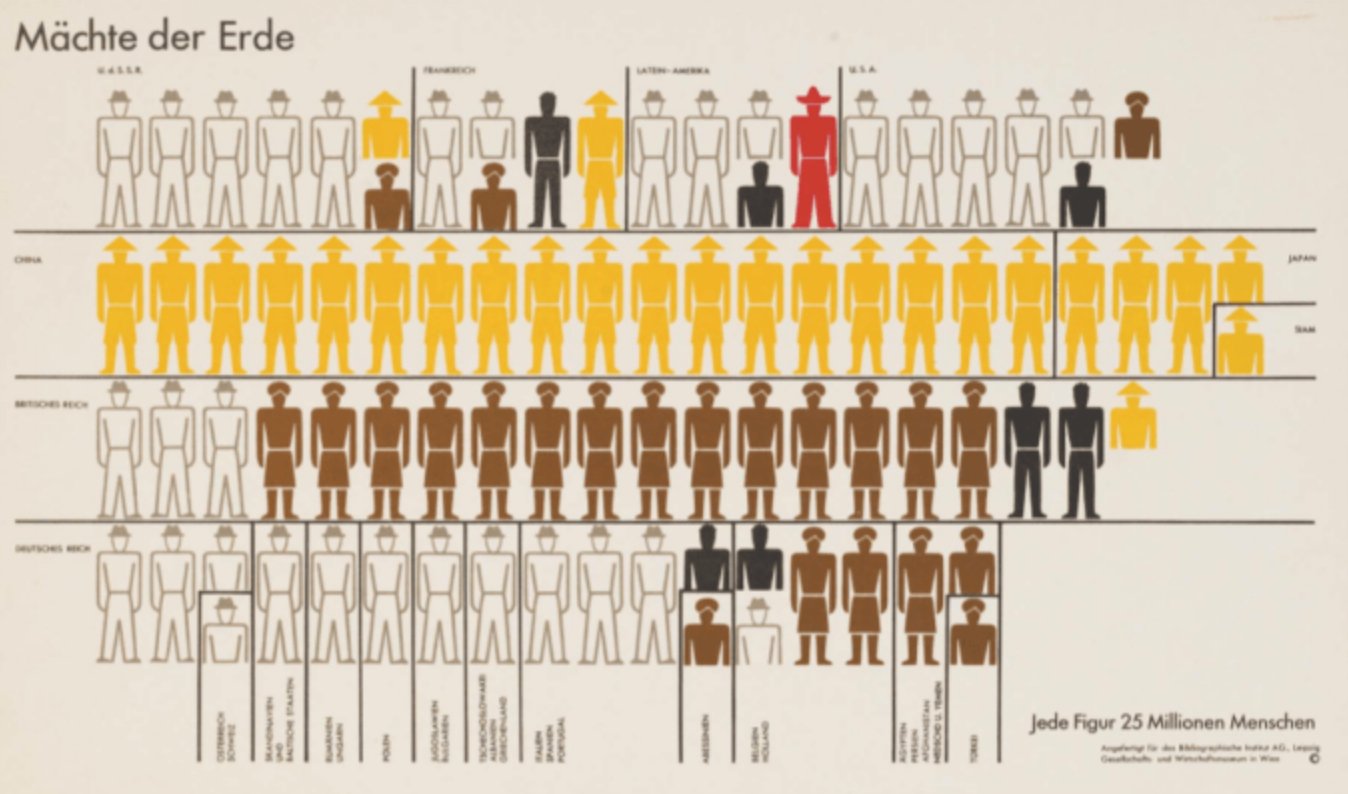
Given my own research interest at the moment, I was particularly pleased to learn about Otto Neurath’s innovative data visualization method, through his Institute for Pictorial Statistics, designed to present socio-economic statistics in a form most people could understand. The signature style was the use of rows of little human figures, which ended up being called ‘Isotype’. Who knew infographics were invented in the 1930s?

Poignantly, in 1939 Otto Neurath published a bestseller called Modern Man in the Making. “It employed a tight mesh of texts and pictures to describe the dawning world of globalized exchange, international migration and limitless progress.” How his readers must have been wishing that were true.

And this is the other attraction of this wonderful book. Its subtext throughout is both the need for and the threat to Exact Thinking in Demented Times, a message relevant today.

[amazon_link asins=’0465096956′ template=’ProductAd’ store=’enlighteconom-21′ marketplace=’UK’ link_id=’36b4c5e3-f931-11e7-9b5d-2fc3a9a6874f’]