Humans in the machine

There’s some very interesting insight into the human workforce making the digital platforms work in Ghost Work: How to Stop Silicon Valley from Building a New Global Underclass by Mary Gray and Siddarth Suri. The book as a whole doesn’t quite cohere, though, nor deliver on the promise of the subtitle. The bulk of the book draws on interviews and surveys of people who work via platforms like Amazon’s famous Mechanical Turk, but also the internal Microsoft equivalent, UHRS, and a smaller social enterprise version, Amara.

This is all extremely interesting, about how people work – in the US and Bangalore – their tactics for making money, dealing with stress, how many hours they have to work and when, how much or little agency they have, and so on. Not least, it reminds or informs readers that a lot of AI is based on the labelling done by humans to create training data sets. However, not all the ghost work described is of this kind and some, indeed, has little to do with Silicon Valley except that a digital platform mediates the employer and the seeker of work. As the authors note, this latter type is a continuation of the history of automation, the role of new pools of cheap labour in industrial capitalism, and the division of labour markets into privileged insiders and contingent – badly paid, insecure – outsiders. The new global underclass is just one step up from the old global underclass; at least they have a smartphone or computer and internet access.81uywR4bPoL._AC_UY218_ML3_The survey results confirm that some of the digital ghost workers value the flexibility they get reasonably highly – although with quite a high variance in the distribution. Not surprisingly, those with least pressing need for income most value the flexibility. Some of the women workers in India also valued the connection to the labour market when they were unable to work outside of their home because of childcare or family expectations. Similarly, with the Amara platform, “Workers can make ghost work a navigable path out of challenging circumstances, meeting a basic need for autonomy and independence that is necessary for pursuing other interests, bigger than money.”
The book’s recommendations boil down to recommending that platforms should introduce double bottom line accounting – in other words, find a social conscience alongside their desire for profit. Without a discussion of their (lack of) incentives to do so, this is a bit thin. Still, the book is well worth reading for fascinating anthropological insights from the field work, and for the reminder about the humans in the machine.
 

Varieties of neoliberalism

I’ve polished off Angus Burgin’s The Great Persuasion, recommended to me by a colleague after Daniel Stedman-Jones’s Masters of the Universe cropped up in conversation. I read the latter when it came out in 2012. It made a strong impression on me with its account of the way the creation of the climate of ideas conducive to Thatcherism and Reaganism came about as a conscious long-term project on the part of a number of free market think tanks on both sides of the Atlantic, as well as some leading economists.

Of these, Milton Friedman, features as the key figure in The Great Persuasion. This is an account of the same political project, told through the evolution of the Mont Pelerin society specifically. At its 1947 formation, it was both firmly interdisciplinary, fostering a debate about society’s moral values as well as its economic organisation, and also resigned to the interventionist climate of the times. The Victorian laissez faire version of liberal markets was firmly rejected. The aim was to ensure there remained space for market forces in the context of the Keynesian, planification spirit of the times.

However, as the postwar decades went by, and founding figures moved on (with some acrimony in some cases), Milton Friedman’s vision came to predominate. The society turned into an economics-only shop. Conservative foundations funded ever-more free market research. The restrained neoliberalism of the 1950s – so named as a contrast to laissez faire liberalism –  gave way to the harsher, ‘neoliberal’ version of the 1980s on.

Two things particularly struck me in reading the book. One was the importance of patient funders, not demanding short term political ‘impact’, but instead understanding that the wider intellectual climate needed to change and they would be in for the long haul. The other was the conviction of both Hayek and Friedman that ideas can move mountains. Burgin writes: “Friedman maintained a relentless faith in the ability of unpopular ideas to gain recognition and over the course of decades to effect political change.” I share the view that ideas are powerful but am less sure it always needs decades: people seem able to jump from one moral universe to another relatively quickly, as we have seen in other contexts.

51rxMRQiXbL._SX315_BO1,204,203,200_

Coffee table economics

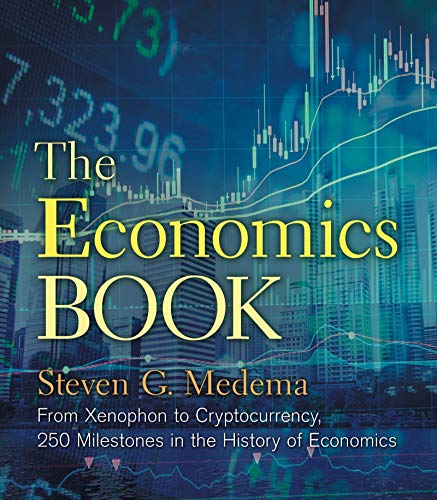
I’ve been enjoying paging through Steven Medema’s The Economics Book: from Xenophon to Cryptocurrency, 250 Milestones in the History of Economics, not least because it has lots of lovely pictures. It’s a history of economic concepts –  that starts in 700 BCE with Hesiod to cryptocurrencies in 2009. Each entry has a beautiful illustration, no mean feat when it comes to illustrating Dynamic Stochastic General Equilibrium (a photo of the ECB), National Income Accounting (women washing dishes at home and hence not contributing to GDP), or Utilitarianism (Jeremy Bentham’s catalogue of the different sources of pleasure and pain). The pictures make it exactly the kind of book you’d be happy to have on the coffee table but it’s more than that: the selection of concepts and the capsule explanations do make it a useful starting point for people who’ve maybe read the terms or think they ought to know something about economics but have no idea where to start. They can start here without embarrassment (Hicks-Allen consumer theory, the School of Salamanca, the Shapley value….) and follow up elsewhere. It’s also a bargain – get the hardback, not the Kindle version.

51yUYd8eOnL


Automation, the future of work and giraffes

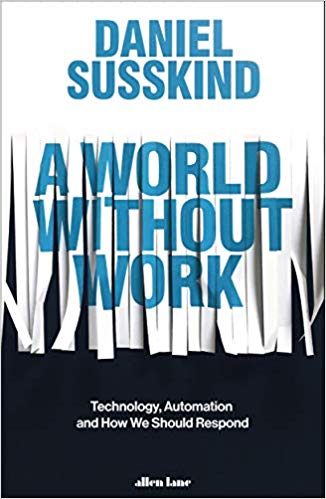
Daniel Susskind’s A World Without Work: Technology, Automation and How We Should Respond is a very nice overview of the issues related to technological unemployment – will it happen, how will it affect people, and what policy responses might make sense. As the book notes, it is impossible to predict the number/proportion of jobs that might be affected, or how quickly, with detailed studies coming up with numbers ranging from about a tenth to about a half. But that there will be disruption, and that past policies have not dealt well with the consequences, is far less uncertain. Even if you believe that the economy will in time adjust the types and amount of work available – and so in that sense this time is *not* different from the past – the transition could be painful.

The book has three sections. The first looks at the history of technological unemployment and why we might expect AI to lead to a new wave. The second sets out the task-based analysis introduced by David Autor and others to sketch how the character of people’s work can change significantly. While dismissing the lump of labour fallacy, it argues that one of the main symptoms will be increased inequality. It predicts, gloomily, that this will get worse and that some people will be left with no capital and redundant human capital,, “leaving them with nothing at all.” I’m not sure that will be politically viable, judging from current events, but the logic is straightforward.

The final section turns to potential policy responses: improved education – heaven knows, we need that; ‘Big State’ – “a new institution to take the labour market’s place” – in effect more tax and a UBI; and tackling Big Tech through competition policy – yep, I’m definitely up for that. Finally, Susskind argues that part of the role for the Big State is to ensure we all have meaning in our working lives, replacing the job as the source of people’s identity, though I wasn’t sure how this should happen.

It’s a clearly-written book, covering concisely ground that will be familiar to economists working on this territory, and providing a useful overview for those not familiar with the debate. Although I’m not a fan of UBI, the other policy prescriptions seem perfectly sensible – perhaps too sensible to be inspiring.

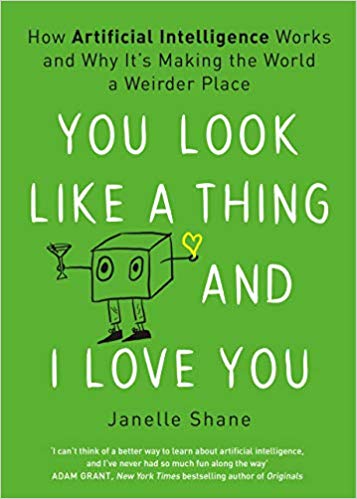
41mVd8pmXCL._SX324_BO1,204,203,200_I must say that my other recent read has made me even more sceptical about the scope for AI to take over from humans. Recently I noted there has been a wave of terrific books on AI. Add to the list Janelle Shane’s You Look Like A Thing and I Love You. You’d be absolutely mad not to read this bok. It had me in hysterics, while making it super-clear what’s hype and what’s realistic about current and near-future AI. And explaining why image recognition AI is so prone to seeing giraffes – many giraffes – where there are none. An absolute must-read.

411Akr2eXqL._SX355_BO1,204,203,200_

Calculating the economy

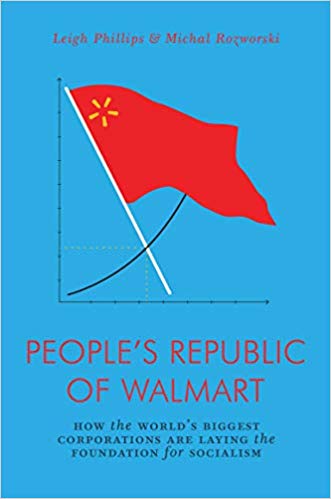
One of the books I’ve read on this trip to the AEA/ASSA meetings in San Diego is The People’s Republic of Walmart by Leigh Phillips and Michael Rosworski. This is a very entertaining projection of the socialist calculation debate onto modern capitalism.

41JGcj2r26L._SX329_BO1,204,203,200_The starting point is the Simon/Coase realisation that big firms are internally planned economies – if it works for Walmart, why wouldn’t it work at larger scale? The authors’ hypothesis is that economic planning might work better now that we have so much more powerful computers and better data.

I’d recommend the book as an introduction to the socialist calculation debate for those unfamiliar with it (ideal for students). It cites some of my favourite books including Francis Spufford’s Red Plenty and Eden Medina’s Cybernetic Revolutionaries. Some chilling lines – about Stalin’s purges, for instance: “Anyone with any expertise was placed under suspicion.” It’s a great read.

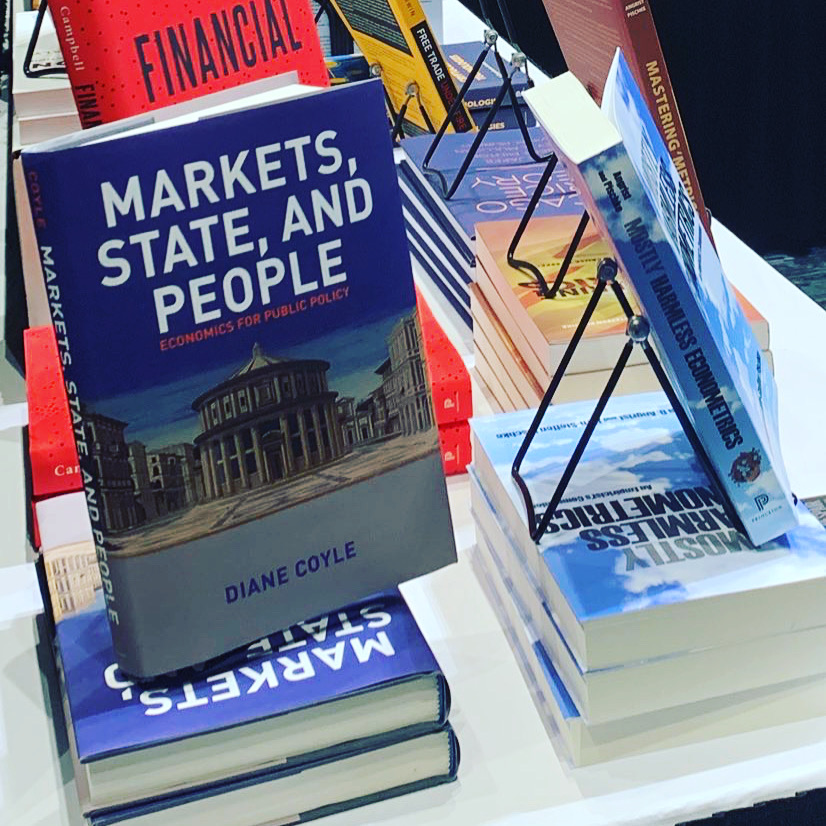
Am I persuaded? Not entirely. Technology clearly will change organisational configurations, but it has just as much been decentralisation of firms and extended supply chains as it has been giant Walmart-type firms. I’m also sceptical that the data available is actually the information needed to plan an economy, or that it’s easy to access and join up. Still, it’s the right question, and a reminder that the boundary between market, state and other forms of organistaion is not set in stone but needs constant negotiation – in fact, I know a great book about this about to be published: Markets, State and People.

0FBA95F6-E1DB-4017-A90A-89A2D3C43EB7As seen at ASSA2020 in San Diego