Positive pragmatism

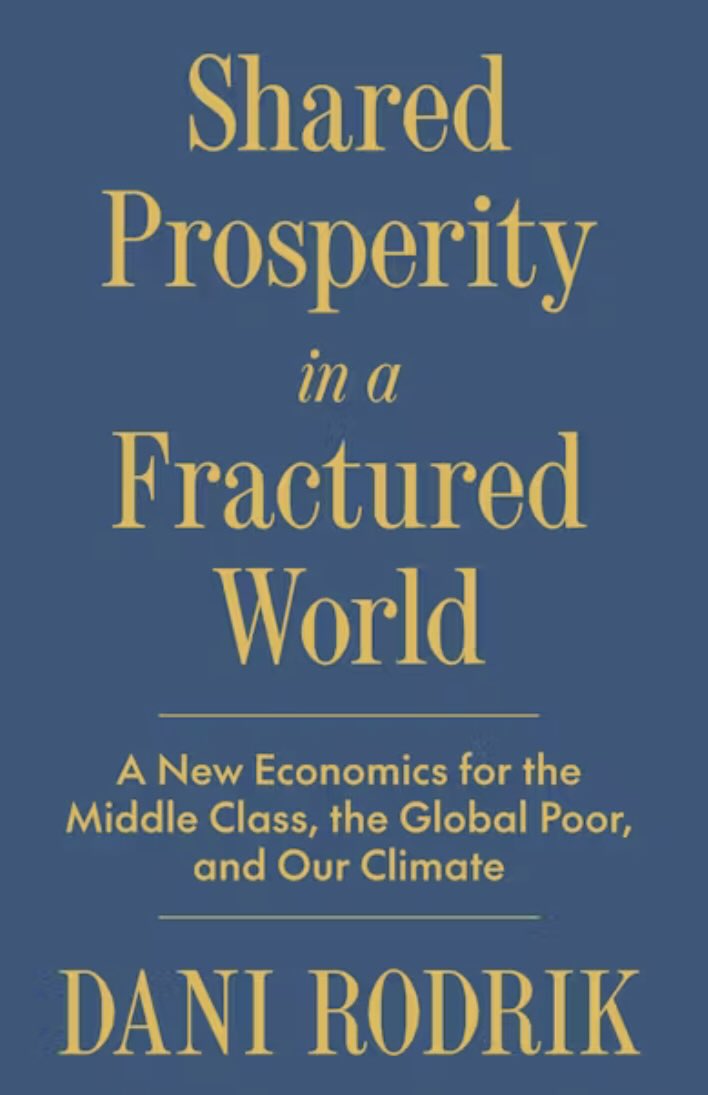
The great Dani Rodrik is giving the S T Lee public lecture in Cambridge on 15th January 2026 (free but please book a ticket if you want to attend). The subject will be his new book, Shared Prosperity in a Fractured World.

The book is an excellent synthesis of Dani’s work in recent years, structured around making the case that trade-offs between the policy objectives of eradicating poverty, tackling climate change, and preserving democracy can be alleviated or even removed. Typically, for example, measures to boost growth in low income countries might be seen as in conflict with preserving jobs for middle class voters in rich countries. The book argues that shifting the poverty-reduction focus to creating service sector jobs (not manufacturing as in the old version of globalisation) mitigates that conflict of objectives.

The book also urges pragmatism: Act at the level of the nation state as global agreements move further out of reach; Accept second-best remedies; Be willing to experiment. After diagnosing where globalization went wrong, the book has individual chapters on pragmatic policies for green transition, good middle class jobs in high income countries, and growth through the service sector in lower income countries.

These together constitute what he calls the ‘productivist paradigm’ – ‘productivism’ is a term I don’t like as it conjures up old-style industrial policies, although I don’t have a better one. I’m also decreasingly keen on the manufacturing vs services dichotomy at all as production occurs in networks or ecosystems that involve both, and high-value services are often linked to high-value manufacture.

Anyway, the productivist paradigm also involves a more active partnership between state and market as neither, alone, leads to an efficient allocation of resources. The final chapter turns back to globalization and calls for a version built around the provision of global public goods. I’m not sure I see much prospect for any activism on global governance at present.

Still, a constructive argument for an active approach to structural transformation in the interests of populations globally is very welcome. Tune in for the lecture!
Untitled


Techno-financial imperium

Underground Empire: How America Weaponized the World Economy by Henry Farrell and Abraham Newman is a rip-roaring read and simultaneously terrifying. The reader is left with the clear impression of fragility in the world financial system – bad enough in itself – that could tip over into armed conflict. Eek.

The book is about the intersection of the discovery by the US of physical choke-points in the global internet with legal choke points in the world economy and financial system, globalized as it has become. Specifically, the NSA started to find it convenient, post 9/11, to start gathering data on a massive scale on financial movements through the internet. Just seven sites in the US act as bottlenecks for internet traffic, while in other countries there are a similarly small number of such sites. This realisation became the Underground Empire of the title, the deployment of a set of technical and financial mechanisms using these choke points, allowing the US “to cut off businesses and even whole countries from access to key global networks that wove the world’s economy together.”

As the book goes on to describe, the initial post-9/11 responses merged into a haphazard but ever more extensive set of policies and legal tools that enabled the US to extert increasing leverage over extra-territorial entities – not only businesses but also governments. These have included using the power and reach of the US dollar as a reserve currency and currency of trade to “persuade” the Swift network into applying US requirements to exclude for example North Korean and Iranian entities from international payments, and more recently sanctions on US chip technology or IP being exported. The authors write: “From outside, the underground empire seems like a relentless machine of domination, the product of decades of engineering. From inside, it looks quite different, a haphazard construction lashed together from ad hoc bureaucratic decisions and repurposed legal authorities.”

And yet it is a powerful empire and has contributed to increasing geopolitical tensions, and in particular US-China rivalry – although it has also, thanks to its increasingly evident power, prompted countervailing efforts to escape imperial power. But the book concludes “There is no visible exit from the underground empire. … The roots of imperium go far too deep ever to be fully torn out.” The globalisation dream of peace through markets has turned into a nightmare of potential conflict thanks to the realisation elsewhere that markets are built on the foundations of American physical, financial and intangible infrastructure. The book concludes that it is up to the US now to turn the empire into more of a commonwealth, serving the interests of others as well as itself – something hard to see happening in the current political moment.

Screenshot 2024-09-16 at 16.45.55

State-sponsored cyber-crime

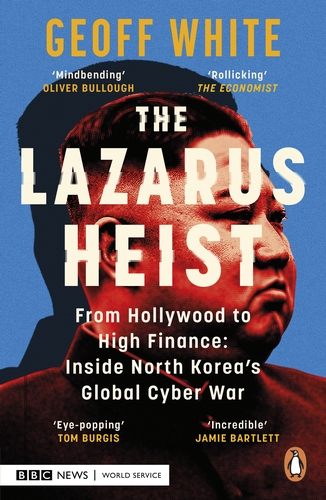
The Larazus Heist by Geoff White is a fascinating exposition of North Korea’s role in unleashing large-scale hacking and cybercrime on the world, in its efforts to bypass sanctions and bring in money to the benighted (literally) country. The subtitle spells it out: From Hollywood to High Finance: Inside North Korea’s Global Cyber War. The author is an expert cybercrime journalist, which ensures the book is a cracking read. An early chapter describes the 2014 ransomware hack of Sony Studios, which had started trailing a movie portraying Kim Jong Un in unfavourable light. But the crimes reported are mainly about the intersection between hacking and the banking system, and organised crime, because the money has to be laundered and conveyed to North Korea or at least to places the regime can spend it. So as well as an elite computer hacking corps, the book describes the process of laundering cash through Macau casinos, or Sri Lankan charities, withdrawing notes from ATMs in central India, and trucking tonnes of cash around the Philippines. And then there’s crypto, the land where grift meets large-scale crime.

Apart from the book being a terrific read, what conclusions to take away? That too few people have really internalised the advice not to open email attachments or click on links. That the mesh of banking regulation increases the burden on the honest without much hindering the criminals. That economists/finance folks pay far, far too little attention to the criminal economy (one consequence of the profession’s laziness in studying only data that can easily been found online – looking at small questions with cool econometrics where the lamp happens to be shining, rather than the big, important questions). And that everybody should be very worried about cybersecurity. I learned so much from the book about the vulnerability of everyday life to online attacks from a hostile state like North Korea – and no doubt the other obvious potential attackers. The Wannacry impact on the NHS is a sobering example.

Finally, the book is co-published between Penguin and the BBC; the World Service hosted The Lazarus Heist podcast. In this maelstrom of misinformation we live in, the BBC is more important than it has ever been.

9780241554272-jacket-large

Webs of money

A 2016 book that was an eye-opener for me was Brooke Harrington’s Capital Without Borders: Wealth Managers and the One Percent. A sociologist, she had trained as a private client wealth manager and worked among/for the global elite – the Ultra High Net Worth Individuals (UHNWIs).  The rich really are different…. and among her striking findings was their deep-seated belief they have that the money is theirs, or their family’s, and governments truly have no legitimate right to take any of it away from them in taxes.

Spiderweb Capitalism: How Global Elites Exploit Frontier Markets by Kimberly Kay Hoang is a sort of companion or follow-up volume. She is also a sociologist, but in this case conducted academic research as a clear outsider. Her focus is also different: her interest is in the ploys the UHNWIs and their delegated High Net Worth Individuals (professional lawyers and PRs etc who act for them, making pretty vast amounts of money themselves but bearing some legal risk) devise to distance themselves from “playing in the gray” – that is on the borders of legality or beyond – in emerging markets Vietnam and Myanmar. These ploys generally involve complex structures with holding companies in the Caymans, Samoa, British Virgin Islands etc, multiple Special Purpose Vehicles to make investments, professional advisers in Hong Kong or Singapore, and local fixers.

More academic (ie. slightly clunky) in style than the earlier Harrington book, it is nevertheless a fascinating read, reflecting five years of interviewing the different categories of people involved in these global money flows, and following some around on their extensive travels. Again, avoiding – or evading – tax is a regular theme. The book documents the various mechanisms involved, from the on-the-ground bribery (including attempts at mutually assured destruction deterrence such as sharing compromising social events with bribed officials) to the setting up of bank accounts and pitching investments to UHNWIs in the US. The scope of the fieldwork involved is impressive.

What to do about the spider’s web of global money flows? That’s less clear. Each individual (whether dominant or subordinate spider) is one element in a system that ultimately traps all. Although an optimistic note I took from the book is that US legislation does seem to be inhibiting some of the practices documented. In any case, it’s super-valuable to have htis kind of rigorous evidence about how the web operates, and how its inhabitants are motivated and incentivised. This is a very impressive book.

41nJtBDEPmL._AC_UY436_QL65_

Discord and David Hume

October has been whizzing past, with travel to conferences (hooray), the start of term, and a new grandson. I’ve been reading a lot of non-economics books on trains and planes, including Ai Weiwei’s compelling memoir 1000 Days of Joys and Sorrows, Red Dust by Ma Jian, and also a chunky hardback, Orhan Pamuk’s latest novel, Nights of Plague.

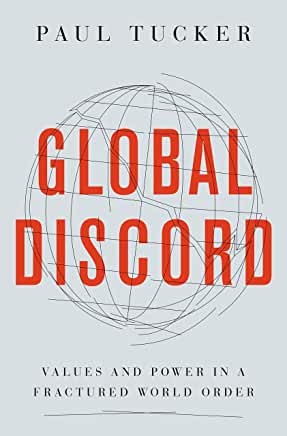
Another chunky hardback has been Paul Tucker’s latest, wide-ranging and erudite, book, Global Discord: Values and Power in a Fractured World Order. I must admit it took me some time to get into it, perhaps due to my general October distraction, but I’m with the programme: his aim is to bring a mash-up of David Hume and Bernard Williams to the current fraught state of geopolitics and global crises. The book uses the Humean dual of incentives and norms to think about international economic institutions in place of more traditional International Relations perspectives (realism, constructivism…). As long-time readers of this blog will know, I’m a big Hume fan (although confess to not having read Bernard WIlliams since my student days).

The motivating question is whether a legitimate international order can exist in a world transitioning out of the European/Atlantic order and facing complex existential challenges. Specifically, what international economic arrangements can co-exist with current geopolitics and shifts in power? The book starts with a historical overview of how the current arrangements and structures developed and why the growing power of China has challenged them. The second section looks at what form institutions for international co-operation can take and when/whether they can be stable and self-enforcing – Humean norms and conventions as a lens on international relations feature strongly here. Part three focuses on current tensions within and between China and the US – neither seeming particularly stable internally at the moment, never mind in terms of their mutual relations.

Part four is really the heart of the book: what does the Hume-Williams framework – what will be stable and self-enforcing in its norms, and what will be normatively right – imply for how democracies can legitimately delegate to international organisations, and how such organisations can legitimately constrain individual countries and governments? What are the principles for participation and delegation? How can practical problem solving encourage and sustain norms of behaviour (Hume)? What is its moral basis and hence legitimacy particularly in our still liberal(ish) democracies (Williams)?

The final part moves on to how to apply the framework in the current context, in terms of different more and less opti/pessi-mistic scenarios:lingering status quo, superpower struggle,  new Cold War, reshaped world order. Chapters consider different organisations – the IMF, WTO, BIS etc – getting in to how these might evolve. And the book ends with a vote for cautious optimism. (I find it hard to share that view as Brexit continues to destroy British democracy and prosperity, courtesy of the Conservative Party, I must say.)

The breadth of the research (and length of bibliography) across different disciplines is impressive. The book isn’t a light read, but worth while – and there are actually plenty of online events where Paul Tucker himself will give a better summary than I can here. For any day’s news headlines make it clear there could hardly be a more important set of questions to be resolved.

71nRnuSGKUL._AC_UY436_QL65_