Positive pragmatism

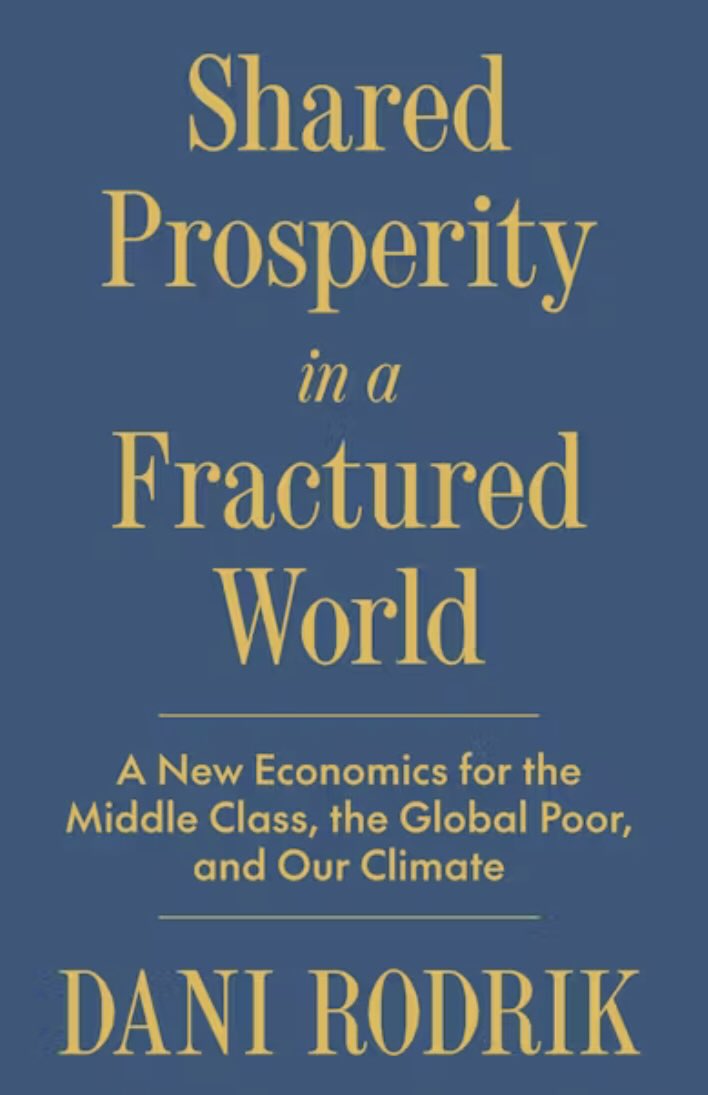
The great Dani Rodrik is giving the S T Lee public lecture in Cambridge on 15th January 2026 (free but please book a ticket if you want to attend). The subject will be his new book, Shared Prosperity in a Fractured World.

The book is an excellent synthesis of Dani’s work in recent years, structured around making the case that trade-offs between the policy objectives of eradicating poverty, tackling climate change, and preserving democracy can be alleviated or even removed. Typically, for example, measures to boost growth in low income countries might be seen as in conflict with preserving jobs for middle class voters in rich countries. The book argues that shifting the poverty-reduction focus to creating service sector jobs (not manufacturing as in the old version of globalisation) mitigates that conflict of objectives.

The book also urges pragmatism: Act at the level of the nation state as global agreements move further out of reach; Accept second-best remedies; Be willing to experiment. After diagnosing where globalization went wrong, the book has individual chapters on pragmatic policies for green transition, good middle class jobs in high income countries, and growth through the service sector in lower income countries.

These together constitute what he calls the ‘productivist paradigm’ – ‘productivism’ is a term I don’t like as it conjures up old-style industrial policies, although I don’t have a better one. I’m also decreasingly keen on the manufacturing vs services dichotomy at all as production occurs in networks or ecosystems that involve both, and high-value services are often linked to high-value manufacture.

Anyway, the productivist paradigm also involves a more active partnership between state and market as neither, alone, leads to an efficient allocation of resources. The final chapter turns back to globalization and calls for a version built around the provision of global public goods. I’m not sure I see much prospect for any activism on global governance at present.

Still, a constructive argument for an active approach to structural transformation in the interests of populations globally is very welcome. Tune in for the lecture!
Untitled


A taste of economics

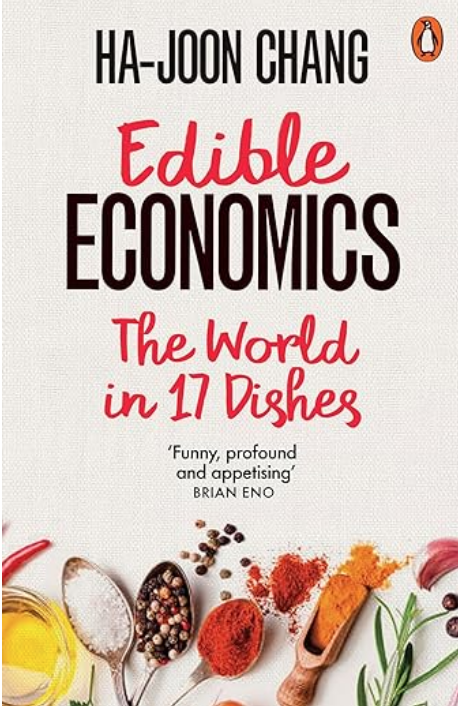
Ha-Joon Chang’s Edible Economics: The World in 17 Dishes is an entertaining read, and a nice introduction to some economic questions. Regular readers of his will not be surprised by the economic analysis – heavy on infant industry protection as the path to development for low income countries. But I did very much enjoy the food links – each chapter is an ingredient (rather than a dish), garlic, anchovy, strawberry and so on. There were nice nuggets from food history – the corporate history of Oxo and corned beef for instance, or that Koreans used to snack on fried silkworm pupae as a cheap source of protein as it was a byproduct of the silk export industry.

On the economics, the world has moved significantly towards Ha-Joon’s emphasis on active industrial policy, so he can feel vindicated in that respect. He also acknowledges here that it can go wrong, which I hadn’t spotted stated so clearly in his previous books. I’m not sure his perception of the economics profession as a monoculture with a few brave heterodox souls, set out again in the intro here, is as correct as it used to be; my perception is that it is broadening considerably and has been for a while, certainly outside the US.

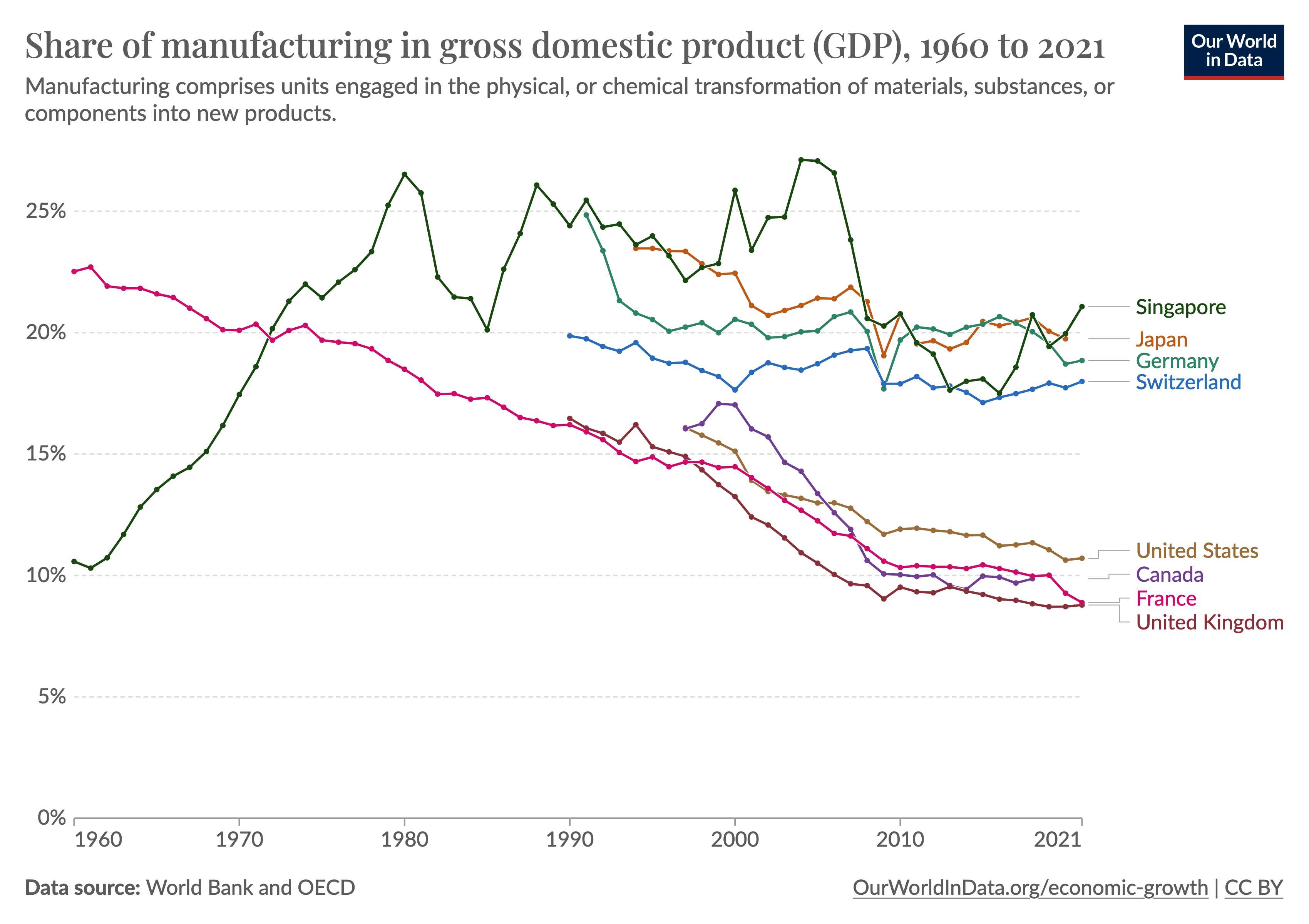
The fact in the book that really surprised me is its claim that Switzerland and Singapore are the most manufacturing-intensive economies in the world – the World Bank data suggest this is a bit of an overstatement but they do have higher manufacturing sectors relative to GDP than one might imagine and are in the Germany?Japan clud (Our World in Data figure below.) As my colleague Jostein Hauge – cited here – has written about in his book The Future of the Factory, the economy no longer divides cleanly into manufacturing vs services, as many high value services serve the manufacturing sector. I think we’d do well to get away from that as a key distinction but do believe – as Ha-Joon doesn’t seem to – that there has been an important shift in the structure of the advanced economies. Manufacturing is central as it’s one of the highest value activities, but the way in which it is central has changed.

Anyway, it’s a good debate and the book is a good read, super-accessible for non-economists. I prefer it to some of his earlier popular books because there are far fewer sideswipes at other economists, and I learned a lot about the history and culture of some of the selected foods too. All that’s missing are recipes.

manufacturing-value-added-to-gdp

Screenshot 2024-01-10 at 12.50.41

Preoccupations

I enjoyed a little book of essays by Amartya Sen, The Country of First Boys. This is a collection of reprints from articles in The Little Magazine in the early 2010s. Collections of this kind tend to be slightly repetitive because columnists have certain preoccupations they circle back to (certainly including me!). In this case, it is democracy and freedom, the importance of free speech in enabling public reasoning, identity, gender inequalities, and of course development, education and poverty. On the other hand, it is a highly accessible and enjoyable summary of some of Sen’s work.

Some points leapt out at me (reflecting my own current preoccupations). One was the example of Kerala, which has become one of the highest per capita income states in India, having been one of the poorest. Universal and good education and healthcare were a key part of its development. “Central to this understanding is the critical importance of social infrastructre in facilitating economic growth,” Sen writes (pxlix). “The role of infrastructure – physical and social – in economic performance has been a neglected subject in policymaking.” Another point was the role of ‘countervailing powers’ in ownership – a multiplicity of private owners (aka competition) but also other models – co-operatives, public ownership, independent bodies. Diversity of organisation rather than just diversity of views. This in the context of media, but – having been business model agnostic – I now think it makes for healthier competition in any market to get away from monocultures.

Anyway, a nice book for summer evenings reading in the late sunshine.

Screenshot 2023-08-15 at 07.52.01


Exporting US capitalism

When I was in the early days of my previous journalism career, writing for the Investors Chronicle, and also pregnant with child number 1, I was taken by a stockbroker (I think it was Smith New Court, bought by Merrill Lynch in 1995) on an investors’ tour of Budapest and its environs. It was early 1990, and the ‘shock therapy’ privatisation of companies in the formerly communist countries was under way. One visit vivid in my memory was the day trip to Ganz Electric on the outskirts of Budapest, where it seemed like iron ore went in at one end and everything from tractors and trains to light bulbs emerged at the other. But the toilet paper for the office suite was locked up in a cupboard to which only the Director’s formidable secretary had a key.

Ethan Kapstein’s Exporting Capitalism: Private Enterprise and US Foreign Policy brought this all back to me because one of the chapters covers that post-perestroika era. (Indeed, my previous job had involved interpreting perestroika for western European clients of an economic forecasting company and I, like many others, was coming to realise that the figures for material output of the Soviet bloc had led us to greatly over-state the prior economic growth of those countries.) Kapstein, now a Prof at Arizona State and a Director of a conflict studies center at Princeton, had previously been a banker and worked for the US Government and the OECD. He therefore had a seat on various front lines in variously troubled economies. This experience illuminates the book’s analysis. I found it a very interesting read.

The book is a history of the ups and downs of the US’s consistent focus on relying on private investment, particularly FDI, as a vector for economic development and a handmaiden to US foreign policy goals – above all, limiting the spread of Communism to developing countries. Starting with postwar Taiwan, the US has insisted on the central role of private enterprise. One explanation is ideological, the deep-seated US reverence for business and the market. Another is simple pragmatism: official aid will never be sufficient to meet the scale of the investment need in low or middle income countries. A third is an implicit theory of change: that multinational FDI builds local supply chains and has multiplier effects, setting down long-term roots for sustained development, and inoculating local people against socialist ideas and undesirable (from the American perspective) other overseas influence.

Of course, the record has been mixed, to say the least, even among the post-Communist countries. The multinationals required to do the investing have their own aims, which are not obviously aligned with long-term national development needs. Some – such as ITT in overthrowing Allende in Chile – played deeply troubling roles. With hindsight, shock therapy was too much shock and not enough therapy – the idea being to create quickly enough people with enough of a stake in the market to prevent a reversal to communism. But heterogeneous local institutional and political conditions turned out to make a big difference to outcomes.

The historical chapters in this book are fascinating. I was stopped short in one of the final chapters by the reflection that times are changing (indeed) and the US is now converging on China’s state capitalism. This seems a bizarre over-interpretation of the shift – more complex than often painted – away from globalisation. And anyway, as this chapter observes, official aid is still absolutely dwarfed by investment need. The private sector will fill the gap, or the investment won’t happen. It would be good to get away from the old chestnut that state and market are opposites, when they succeed or fail together, and for the same reasons. The history of FDI underlines the need for contextual nuance. Still, a very interesting and enjoyable read, gaining much from the author’s personal practical experience.

41twhkIKT7L._AC_UY436_QL65_

Learning to grow

I recently re-read Joseph Stiglitz and Bruce Greenwald’s (2014) Creating a Learning Society: A New Approach to Growth, Development and Social Progress (slightly amazed at how many years ago it was published, as I remember hearing Joe Stiglitz give a talk about it in Toulouse when it was just out. Seems much more recent in memory.)

It’s a masterly reframing of how to think about economic development and importantly appropriate policies in terms of quite simple models that are completely compatible with mainstream economics. The policy mix runs counter to what one could describe as conventional (mainstream) wisdom. The book advocates strategic industrial policy – because the models all involve hysteresis, so history matters and policymakers need to think about the path from here to the future; less extreme (albeit enfroced) IP rights because creating the incentive to innovate from a given pool of knowledge has to be traded off against a smaller pool of knowledge; trade/infant industry protection because learning by doing and learning from experience make production important to grow the pool of knowledge. The message about market structure – competition/concentration and static vs dynamic efficiency – is that it’s complicated. There’s no simple relationship.

41f3A04PNoL._SX331_BO1,204,203,200_

Above all, when technology is endogenous there can be no presumption that market outcomes are efficient, and policies need to think about how firms and society learn, and not just about allocative efficiency. It’s a great book for students because it demonstrates how to use models to think about complex policy options, and also that it is not bad economics to challenge market first-ism. Although pitched at developing economies, I went back to it to think about the levelling up challenge within the UK economy. Knowledge sticks to people, who stick in places, and as it accumulates places can diverge a lot over time. Given that innovation also requires adequate scale and some means of mitigating the uninsurable risks associated with it, the need for significant policy interventions seems clear to me.