
Robot wars – the prequel

[amazon_link id=”B00BIOFLWE” target=”_blank” ]America’s Assembly Line[/amazon_link] by David Nye is fascinating. It’s a history of the origins of the assembly line and mass production, with a strong focus on the motor industry, and traces the spread of mass production through other manufacturing and non-manufacturing sectors (such as housebuilding). The organisation of the line evolved over time, and varied in different places. The imperative of wartime production was an important driver. Post-war, the cybernetics revolution led to far greater automation. On the other hand, the Toyota lean production system brought in greater flexibility for workers on the line.

[amazon_image id=”B00BIOFLWE” link=”true” target=”_blank” size=”medium” ]America’s Assembly Line[/amazon_image]

The public loved the product of the assembly line, affordable mass-produced consumer goods. “In a typical American town, a working class family that couldn’t afford both a bathtub and a car was more likely to opt for a car,” Nye writes of the 1920s. (There’s a parallel with the well known factoid about the greater prevalence of mobile phones than toilets in Indian households now – any kind of means of communication seems peculiarly compelling.) Access to assembly line products, alongside the growth of a suburban middle class, spread far faster in the US than in Europe.

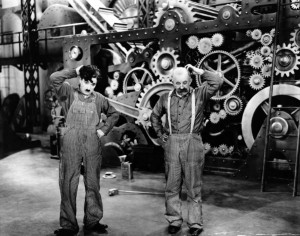
The relationship between machines and workers is an important theme in the book. Although Henry Ford famously paid $5 a day, double the going rate, many workers left before they qualified for it, so hard was the work. The unions had to fight hard to get recognition in the industry. The factories were notorious for robbing workers of any autonomy, and for speeding up the line to extract greater effort. Although 1927 had even brought a symphony to the Model T (premiered by the Boston Symphony Orchestra) he pressure of the assembly line soon became a frequent theme in films, songs and TV – Charlie Chaplin’s Modern Times being a prominent example.
The monotony and conformity of mass production also meant it was slow to spread in Europe, where the markets were anyway far smaller and therefore less able to sustain huge volumes. And there was a culture clash: “British workmen regularly stopped the assembly line for tea breaks.” More importantly, though, “No European nation could develop an American style production system unless it also embraced mass consumption.” None did before the war – the Soviet Union was most interested in Ford’s methods, but could not provide the workers capable of doing the jobs.

Through the post-war era, opinion divided between the welcome given to consumer products and welfare capitalism – Ford also offered savings plans, medical care in the factory, educational programmes – and the cultural distrust of conformity and the alienation of labour on the assembly line. The latter was, again, most pronounced in Europe. And yet European consumers were just as keen on cheap goods. Vice President Richard Nixon famously showed Nikita Kruschev around a model home at the American National Fair exhibition in Moscow in 1959 – Francis Spufford’ superb book [amazon_link id=”0571225241″ target=”_blank” ]Red Plenty[/amazon_link] brings this scene to life. Nixon presented Kruschev with a nice paradox about the benefits of mass produced goods and homes, in that American consumers had a vast choice: “We do not wish to have decisions made at the top by government officials who say all homes should be built in the same way.”

“Commodity fetishism meant that there was a widespread desire for what the assembly line produced but an equally widespread disdain for the work involved,” writes Nye. At the same time, concern began to grow – in line with automation – that the jobs involved were vanishing anyway. The fear of robots eliminating the need for humans emerged around this time.

No matter. Consumerist capitalism was even more heavily criticised by the counter-culture of the 1960s, culminating in 1968. And by the 1970s the far greater flexibility of the Toyota system was outperforming the rigidity of Fordism. By 1990, Volvo was advertising its abandonment of the assembly line. It had small teams assembling an entire vehicle. It took 4 months to train a Volvo worker, compared to 4 hours on a conventional line, but worker turnover was low and productivity high, and problems solved by individual teams with no spillover to the rest of the plant.

Yet the effect of automation on jobs remained a constant. The western economies ‘deindustrialised’. Detroit started its gothic decline – so well captured by photographers Yves Marchand and Romain Meffre in their book [amazon_link id=”3869300426″ target=”_blank” ]The Ruins of Detroit[/amazon_link]. and by the incomparable Bruce Springsteen, voice of blue collar America. Nye concludes: “Americans accepted mass production as though it were part of the natural order, with its subdivision of work, its interchangeable parts, and its organization of everyday life in terms of efficiency and productivity. Year after year they expected higher wages, more consumer goods and a general acceleration of experience. By 2013, however, this was an outdated and unsustainable economic order. The classic assembly line had been based on a large semi-skilled working class, not on robots and outsourcing.”

[amazon_image id=”3869300426″ link=”true” target=”_blank” size=”medium” ]The Ruins of Detroit[/amazon_image]

Robots, in short, don’t buy washing machines and fridges, and all the skills of the Mad Men won’t change that.

This book is an excellent companion read to the current robot debate – nicely summed up in this Economist article.

The unknown robber barons

In today’s Financial Times, Edward Luce points out that the US – creator of the internet – has dropped from top in the late 1990s to 16th now in the OECD league for average internet speeds, and has some of the highest prices too. He notes that South Koreans speak of trips to the US as ‘internet holidays’, so unfavourably does the experience compare with online access back home. Given the rise of Samsung – which spends more than twice as much proportionately on R&D as Apple (5.7% vs 2.2% of revenues respectively) – it can only be a matter of time before online leadership migrates decisively to Asia.

The article is clear about the problem – the Comcast monopoly, and the donations the company makes to Barack Obama, along with its enormous lobbying effort. Comcast’s senior VP David Cohen is apparently one of the US President’s biggest fundraisers. Comcast spent more than $14m on lobbying in 2011, making it the ninth biggest spender in the US.

This only confirms the argument of Susan Crawford’s book [amazon_link id=”0300153139″ target=”_blank” ]Captive Audience: The Telecom Industry and Monopoly Power in the New Gilded Age[/amazon_link], which directly compares Comcast to the giant trusts of the late 19th century, broken finally by the struggle to implement the 1890 Sherman Anti-Trust Act. I have to say the book isn’t the most exciting read in the world – not as enthralling as Tim Wu’s [amazon_link id=”1848879865″ target=”_blank” ]The Master Switch[/amazon_link] – but nevertheless it does a superb job of depicting Comcast’s strategy. It emerges as a superbly well-run business in strategic terms – although not, it seems, for customer service.

The company has been particularly astute about its engagement with Congress and regulators, and in judging the technological trajectory of the industry. However, the book also explains why and how the FCC made the decisions that now look mistaken, and is therefore a rare instance of insight into the complexities and compromises of the official and political world. This is much more useful than playing the blame game. So though there may be more US-centric detail than the general reader wants, this is an essential book for anyone interested in communications markets and digital convergence. I have to admit I’d heard of Comcast, but not at all of its controlling and founding family, the Roberts pere et fils, the unknown “robber barons” of the new gilded age.

[amazon_image id=”0300153139″ link=”true” target=”_blank” size=”medium” ]Captive Audience: The Telecom Industry and Monopoly Power in the New Gilded Age[/amazon_image]

Apparently Susan Crawford is a candidate for the post of next head of the FCC, but the book attacking the Comcast monopoly is seen to have damaged her chances. On the other hand, President Obama doesn’t need re-electing, so maybe he will be brave and nominate a candidate with the interests of American consumers at heart – I was staggered to read in Crawford’s book that the average user pays $143 a month for their high-speed internet and cable bundles.

For here is another example of the way big business has bought political power, and therefore the freedom to make still more money and buy still more power, in America. That subversion of social welfare in the interests of the rich affects the rest of the west too, not to mention cementing the future economic and geo-political strength of Asia.

Davos reading

Once, I went to Davos. Like Lewis Lapham, I didn’t have to pay as I was then a “prospective supplier of supportive adjectives” ie. a journalist. For those who haven’t read it, whether Davos attendees, wannabees, or refusniks, Lapham’s 1998 book [amazon_link id=”1859847102″ target=”_blank” ]The Agony Of Mammon: The Imperial Global Economy Explains itself to the Membership in Davos[/amazon_link] is an instructive perspective on the phenomenon. I like the Walter Bagehot quotation he opens with: “Poverty is an anomaly to rich people. It is very difficult to make out why people who want dinner do not ring the bell.”

[amazon_image id=”1859847102″ link=”true” target=”_blank” size=”medium” ]The Agony of Mammon: The Imperial Global Economy Explains Itself to the Membership in Davos, Switzerland[/amazon_image]

I’d certainly never pay to go back to the WEF-fest up the mountain, and have never since been offered the zero-price option. Perhaps I’d be vain enough to accept such an offer, but I hope not. There is something highly corrupting about it – more so, despite the interesting comparison John Gapper draws in today’s FT (Davos: Infotainment, Not A Conspiracy) – than is the case with other elite ‘clubs’ such as TED. I think it’s simply the sheer amount of money required to get there and concentrated there. Enough money to reflect real power.

Freaks of Fortune

Jonathan Levy’s [amazon_link id=”B00AFS6LXW” target=”_blank” ]Freaks of Fortune: The Emerging World of Capitalism and Risk in America [/amazon_link]is a fascinating book. It is a history of the commodification of risk, the development of life insurance and, in time, the growth of wider markets for risk. Professor Levy, a Princeton historian, portrays the modern risk-based finance industry as the counterpart of the freedom of individuals in a capitalist society to manage their own lives. That responsibility of individuals for their own destiny meant the growth of institutions offering them the tools to do so, and the translation of highly individual risks into standard types of policy or financial instrument.

The early chapters start with the origins of risk management in marine insurance, and how those specific origins shaped early legal precedent in considering whether insurance policies should pay out. A cargo of slaves was considered insurable property whereas a working man who had taken out a policy could not successfully claim against his employer after being badly injured in an accident, because he had voluntarily taken the job, which paid a premium because of the dangers. The book’s descriptions of the historical examples are the best thing about it, revealing as they do patterns of thought so different from our own. It is particularly interesting about the link made between emancipation and the assumption of personal responsibility for risk – including by slave owners making the opposite argument, that slaves need never worry about their future as owners bore all the risks! – although I’m sure there is room for different interpretations of the historical record. (I’m a long way out of my areas of expertise here.)

There is also an interesting section on the early opposition to a secondary market in life assurance policies in the US – one existed then in the UK – and for the same kind of moral arguments that Michael Sandel raises in [amazon_link id=”184614471X” target=”_blank” ]What Money Can’t Buy[/amazon_link]. The need for policy holders to be able to gain some value from their policies (otherwise, why would they not just save money?) led to the early application of actuarial science to calculate surrender values. Indeed, early on most life policies taken out by farmers would benefit their creditors – they were used to raise working capital.The book goes on to trace the shift from a mass of small insurance companies starting up in the 19th century to the machinations of the big trusts at the turn of the century.

The underlying theme of the book is that, if we don’t put our faith in Providence, or rely on a master (whether a Feudal lord, or a slave owner, or indeed a husband), then we will of course seek other means of mitigating life’s risks. Some of these are a constant, such as storms or illness, and financial services have replaced a combination of fatalism and community support. Other risks are inherent to capitalism – “an economic system that thrives of radical uncertainty”, as the author describes it. Mitigating these means capitalism is inherently financial. However, individual responsibility for risks arising from personal choices will always have to be supplemented by collective responsibility, at a minimum by regulation of the financial services industry.

The epilogue points out that there was an era when risk seemed to have been tamed, in the 1960s, and the previously common phrase ‘freaks of fortune’, meaning the unexpected events that cause upheaval in every life, dropped out of use. The phrase lies dormant still, but that moment of stability in capitalism has passed. It is certainly obvious, post-crisis, that the state is the “risk manager of last resort”.

So it’s a fascinating story. I must say that the book was heavy-going despite the masses of terrific stories it tells – I think it’s because one has to chew quite a lot to extract the marrow of the argument, and my brief summary has no doubt not done it justice. Still, it’s worth perservering, with so much food for thought, and the stories are great. I would never have imagined finding a history of life insurance at all interesting, and it turns out to be very much so.

[amazon_image id=”B00AFS6LXW” link=”true” target=”_blank” size=”medium” ]Freaks of Fortune: The Emerging World of Capitalism and Risk in America[/amazon_image]

Culture and capitalism

The obituaries of Albert Hirschman (like this obit in the FT) pointed me to some of his other books, in addition to [amazon_link id=”0674276604″ target=”_blank” ]Exit, Voice and Loyalty[/amazon_link]. I’ll be ordering [amazon_link id=”0691015988″ target=”_blank” ]The Passions and the Interests: Political Arguments for Capitalism Before Its Triumph[/amazon_link], of which the blurb says:

“In this volume, Albert Hirschman reconstructs the intellectual climate of the seventeenth and eighteenth centuries to illuminate the intricate ideological transformation that occurred, wherein the pursuit of material interests –so long condemned as the deadly sin of avarice –was assigned the role of containing the unruly and destructive passions of man”

[amazon_image id=”0691015988″ link=”true” target=”_blank” size=”medium” ]The Passions and the Interests: Political Arguments for Capitalism before Its Triumph[/amazon_image]

More importantly, Deirdre McCloskey cites it in her marvellous book [amazon_link id=”0226556743″ target=”_blank” ]Bourgeois Dignity: Why Economics Can’t Explain the Modern World[/amazon_link], in a section describing the emergence in the 18th century of “the emergence of the economy as an explicit object of concern,” the separation of the economic or commercial sphere from the political and social. Although capitalism is as out of fashion as it has been in a generation, it’s salutary to remember its origins as a positive social and political trend incorporating personal freedom, cultural innovation and material prosperity. As McCloskey put it in her previous book, capitalism is founded on [amazon_link id=”0226556646″ target=”_blank” ]The Bourgeois Virtues[/amazon_link]. Our current problems stem from the severing of market economics from its social roots.

McCloskey’s book has a Ferdinand Bol portrait of late 17th century Dutch wine merchants on the cover. I think I’ll need to go downstairs to ferret out Simon Schama’s [amazon_link id=”0006861369″ target=”_blank” ]The Embarrassment of Riches: An Interpretation of Dutch Culture in the Golden Age[/amazon_link], which I’ve not looked at for ages.

[amazon_image id=”0226556743″ link=”true” target=”_blank” size=”medium” ]Bourgeois Dignity: Why Economics Can’t Explain the Modern World[/amazon_image]

[amazon_image id=”0006861369″ link=”true” target=”_blank” size=”medium” ]The Embarrassment of Riches: An Interpretation of Dutch Culture in the Golden Age[/amazon_image]