Still utopian

The month has been a bit of a blur but on one trip I read People’s Republic of Walmart by Leigh Phillips and Michal Rozworski. It has one of those long, chatty subtitles that try to save you the trouble of reading the book: How the world’s biggest corporations are laying the foundation for socialism. They wish – the authors are out of the Jacobin stable, and so explicitly (sort of) Marxist.

The premise is revisiting the socialist calculation debate, mashed up with Coase and Simon, in the light of big data and AI. So it’s similar territory to Bastani’s (2020) Fully Automated Luxury Communism. People’s Republic begins with recent examples of large coprorations planning their internal economy using digital technologies, data, and investment in logistcs – Walmart and Amazon. It expands from there to index funds and common ownership, the NHS, the space race and the examples of the Soviet Union and Allende’s Chile. The point hammered home in each chapter is that there are so many examples of managed rather than non-market exchange that technological advances mean planning (or bureaucracy) can replace markets in many more areas of the economy.

There’s certainly an interesting debate to be had about the extent to which AI can potentially substitute for prior modes of organisation, whether market arrangements or bureaucracies, by the new affordances for summarising and organising a lot of information. Henry Farrell and co-authors propose AI is indeed a new social technology.

But People’s Republic fails to distinguish between planned economies – Walmart may be described in this way, in line with Herbert Simon’s well-known observation – and actual (as opposed to ‘free’) markets. The fully free market is as mythical as the unicorn. All actual markets are structured by regulation, other government intervention, standards, customs and other institutional arrangements; but this is not ‘planning’. The book underestimates the huge amount of physical and software investment needed to make Walmart’s logistics possible; organising information is neither entirely intangible nor easy even in the big data era.

It’s also slightly weird, to me at least, to position Walmart and Amazon (even with a benign approach to human labour assumed) as demonstrations of the possibility of socialist utopia in the 21st century. Even before its ‘enshittification’ Amazon couldn’t distinguish between me buying economics books for me and young reader books for my 7 yr old grand-daughter.

I think it likely that AI will reshape economic structures, just as earlier digital technologies did, making Walmart and Amazon possible, along with many other platforms – how dramatically depends on what you think the limits of computability are. It would be nice to think governments will respond strategically in their interventions in the economy and how they structure the operation of markets, though this isn’t something I’d confidently expect. I hope the conditions of labour improve through policy and organisation, doing away with terrible, precarious jobs. But the 1920s/30s lens of (idealised) planning versus (idealised) markets won’t be the best way to analyse what happens. Having said that, this was a very jolly read, and anything debunking the myth that markets are ‘free’ is welcome.

Screenshot 2025-12-23 at 09.44.34

Disenshittificatory countermanoeuvres?

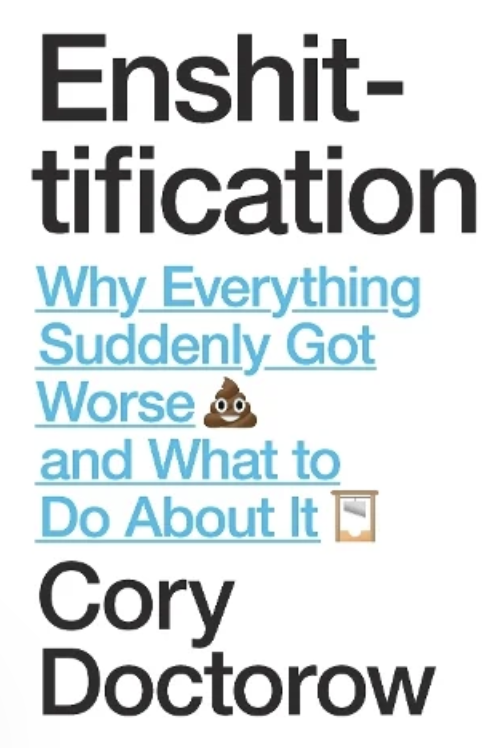
It’s been hard to remain unaware of Cory Doctorow’s concept of ‘enshittification’ – it was after all a 2024 word of the year. But I finally got round to the book Enshittification: why everything suddenly got worse and what to do about it, which is an excellent read. It has four sections: Natural History, Pathology, Epidemiology and Cure. The first three – as these headings indicate – describe the problem (through case studies – Twitter, Amazon, Facebook and the iPhone), anyalyse its structure, explain how it came about and spreads (policy choices), and proposes some counter-actions.

There are two key revelations for me. One is the sustained role of intentional policy actors in enabling big (mainly tech) companies to get away with this. For example, although the adverse effects of the DMCA are well-known, I had not previously known that it was made possible by US official Bruce Lehman doing what he described as ‘an end-run around Congress’ by bringing in the WIPO and international treaties that then had to be implemented in US law. The US law was then enforced extra-territorially by US Trade Representatives threatening tariffs on countries which did not implement similar domestic legislation. This long predated Trump’s passion for tariffs.

The other is the importance of interoperability. As Doctorow puts it, all computers are “Turing complete universal von Neumann machines” – they can run any programme. “The fact that every computer can run every valid program means that every enshittificatory gambit has a potential disenshittificatory countermanoeuvre.” The obstacle to doing so is – the DMCA and threat of legal action for breach of copyright by jailbreaking the software restrictions.

Everyone who does anything online is wearily familiar with the deteriorating experience, which makes the Cure section especially interesting. Policy was the cause, and policy is the cure. Doctorow emphasises antitrust policy and regulation. Economists who have studied digital markets will warmly agree. Enforcing interoperabiility is a key weapon – if we can’t force the companies to behave better, we could make them less important, reduce their gatekeeper status. Also, the more I think about it, the more I believe copyright law needs a broad rethink; it isn’t serving society well in sectors other than tech.

So there is technically well-informed good sense in these. But it leaves me thinking – as with many things I’ve read recently – that the barriers are political. There are clear policy options, implementable, and yet they seem outside the famous Overton Window. In this excellent Chicago Booth podcast with Cory Doctorow, he observes that political science has under-theorised the role of policy domains such as anti-trust, and this seems correct. Perhaps the EU, now that US hostility has been made so plain in the new National Security Strategy, will stop trading its digital enforcement for favours on tariffs; as the tariff weapon has already been fired it has lost some threat potential.

Hard to predict. But I have a strong sense, given evident public anger about the state of modern market economies, that something, somewhere, will start to give. It probably won’t be pretty.

Screenshot 2025-12-13 at 12.02.36

Markets won’t save humanity

In his series of books (Banking Across Boundaries, Rentier Capitalism, The New Enclosure, Our Lives in Their Portfolios) Brett Christophers has provided a forensic analysis of the fundamental plumbing of the global and (especially) UK economy. For example, the first of these identified the statistical construct of ‘financial intermediation services indirectly measured’ (FISIM) as an artefact inflating the apparent contribution of the financial sector to the economy and thus enhancing its political lobbying power. He was the first researcher to point out this consequence (and is cited in my GDP book). Our Lives in Their Portfolios assembles evidence on the scale and scope of private equity ownership of assets in the US and UK, and the adverse consequences for the ability of key infrastructure to provide continuing services.

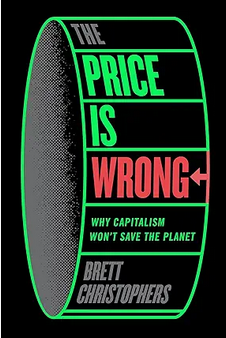
He continues this grand project of analytically dissecting the neoliberal economic order (even before it has entirely died) – at its most extreme in the UK – in his new book, The Price is Wrong: Why Capitalism Won’t Save the Planet. The book is a persuasive assault on the idea that renewable energy generation has become cheap enough that capitalist self-interest will ensure the green transition without continuing government subsidy and regulation. The analysis has three key points.

First, as the legacy industry fossil fuel generation has high sunk costs and low investment needs, whereas renewables need upfront financial investment as high fixed and low marginal cost generators. Second, the once vertically-integrated electricity business now has a separate wholesale market into which generators sell power, so investors in renewables need to earn their return from selling electricity to the grid. Third, the habit (it seems to be no more) of pricing wholesale electricity at the highest marginal cost makes the potential return to renewables investment dependent on highly volatile prices. Without either feed-in-tariffs or contracts-for-difference to reduce the volatility, a more important purpose than subsidising the renewables generators, it is hard for the rate of return calculation to stack up.

The book has a lot of fascinating detail about the structure of electricity markets, in India China and elsewhere as well as the US, UK and EU. Other design details matter. For example, it matters who bears the cost of connecting new generators to the grid – if it is they themselves rather than spreading the cost over the industry, that is another obstacle to investors earning an adequate return on wind or solar. For wind and solar farms are generally located where land is cheap and the power has to get to where people live, but land is expensive.

All these factors mean that the data point underlying the claim that renewable energy is cheap enough for the market to deliver the energy transition is misleading. This is the ‘levellized cost of energy’ (LCOE) or average net present cost of electricity generation for a generator over its lifetime. Although their zero marginal cost (because the fuel is free) makes renewables attractive on this measure, it ignores the hurdle of the initial and separate calculation of the expected rate of return on the investment in generating capacity. A wind turbine is cheap to operate but costly to install – so how will the developer doing the installation make a profit?

The message I take away is the need to be super-careful about market design in energy. These are state-organised markets (as indeed are all, but even more so in this case). The detail sometimes swamps the thread of the argument, but I’d commend The Price is Wrong to anybody interested in energy transition, and in more broadly in the dysfunctions of modern capitalism.

Screenshot 2023-12-03 at 13.57.57


Who owns Kent?

Brett Christophers has become the leading expert on the role the financial sector has played in shaping the UK economy – for better or worse, usually the latter. I first came across his 2013 Banking Across Boundaries, where he was the first person to point out the pernicious effect of the ‘FISIM’ (financial intermediation services indirectly measured) construct in flattering the contribution of finance to the economy – a point later taken up by others. Subsequent books have looked at UK land ownership (The New Enclosure) and rentiership (Rentier Capitalism).

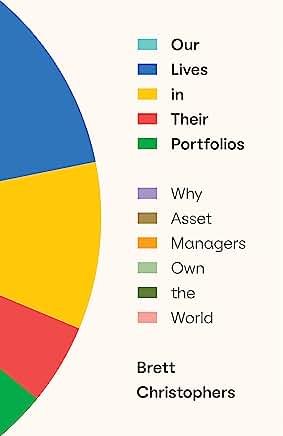
His new book, Our Lives In Their Portfolios: Why asset managers own the world, lives up to the high expectations established by the earlier ones. The subject is the scale and scope of the ownership of physical infrastructure – mainly in the UK but with examples from the US and Australia too – by large and generally little-known asset managers. Take Kent for example: water and wastewater infrastructure is controlled by Macquarie and Morrison, while the gas network is owned by Global Infrastucture Partners and Brookfield. Blackstone, Harrison Street and Safanad own much housing. EQT Partners owns the charging stations for electric vehicles. And so on.

In short, a group of global asset management companies act for investors such as pension funds and companies, creating funds that invest in real assets and buy in services to operate them. However, while the investors have long term horizons and look for steady returns (such as rents or fee income), and the infrastructure itself is long-lived, the funds set up by the asset managers coming in between are short term – a few years at most. Ownership of the assets by different managers churns frequently, and the managers have every incentive to cut maintenance costs and raise charges or rents. As all the operational aspects are contracted out to service companies, the asset managers are neither energy or water companies, nor investors in such companies: they are pure rentiers. The risks are borne entirely by others – and particularly the people experiencing crumbling homes or essential services.

Despite the large impact this subterranean ownership structure therefore has on people’s lives – through lack of maintenance and repairs and rising costs – there is scant public information. One of the major contributions of the book is the evidently huge amount of work that has gone into stitching together what information is available: “Researching and writing about asset-manager society is sometimes much more like detective work than it should be.” There is a shout-out here to the FT’s Jonathan Ford, who has done some excellent reporting on various UK rentiership scandals. The book organises the material by considering the asset classes (housing, energy, farm land, transport), the geography (where are the investments mainly located – US, UK –  and where do the asset managers headquarter), and who are the major commercial players.

PFI projects clearly boosted the asset manager business no end, and there are continuing pressures for the government to bring more private long term investment into infrastructure, given that the state has seemingly abdicated from such investments in the country’s future. While I don’t have a problem with the idea of private money coming into infrastructure investment, there is a clear incentive issue: as Avner Offer’s excellent recent (2022) book Understanding the Private-Public Divide set out, private money will always require pay-back faster than a major piece of infrastructure can deliver, so there are challenges in structuring the investment and governance. And the lack of transparency and failures of governance over the maintenance and operation of infrastructure and housing, resulting from the financialized structure of the investment through asset managers, are shocking. I defy anyone to read this book without being at least a bit scandalized about the blatant disregard for the people using these essential services.

What to do about it? Not clear, but the first step is clearly the disinfectant of light. Our Lives in Their Portfolios is an essential start. The book is out in late April.

61B5IQQImbL._AC_UY436_QL65_

Rawls, reloaded

A few weeks ago I read Thomas Aubrey’s All Roads Lead to Serfdom, which argued for an alternative philosophical foundation to simple-minded utilitarianism for economic policy, if market liberalism is to survive. In Free and Equal: What Would A Fair Society Look Like, Daniel Chandler offers a modern interpretation of Rawls as an alternative to Aubrey’s Ordoliberalism.

The first part of Free and Equal is a clear and useful summary of what Rawls said. It’s over 40 years since I read A Theory of Justice, so this was a terrific refresher. And indeed for a liberal-minded person there is much to like in the Rawlsian approach, which is presented here as both comon sense and yet quite radical given where we are.

The second part of the book takes the themes – freedom, democracy, equality of opportunity, shared prosperity and democracy at work – and analyses the current state of the world in the light of each. It has many policy recommendations, many of them familiar such as UBI, worker rights in gig jobs, proportional representation in elections, all justified in terms of the underlying Rawlsian philosophy. Again, there are some unexpected overlaps with the ordoliberal case for power dispersion: Chandler writes: “Properly understood, the difference principle is concerned not just with the distribution of income and wealth but with the concentration of economic power and control.”

It seems hard to disagree with the contention that both wealth and power have become too concentrated in the western democracries and some things badly need fixing. But reading Free and Equal so soon after All Roads Lead to Serfdom crystallised for me an uneasiness I have with both underpinning philosophies, namely their individualism. Take Universal Basic Income for instance. Chandler is an advocate, but recognises there are critiques – such as undermining the sense of purpose people get from work, or the cost. The one critique he does not address is the one I’m going to label the Coyle Critique: you can’t buy a public realm – transport services, decent schools, waste collection – with your UBI.

Both books have plenty of specific recommendations, and a fine liberal individualist philosophy, but no positive account of the public realm. Improving economic and social outcomes will require a shift in public philosophy away from the bankrupt post-1980 set of assumptions; while there is much to like and much sense in Free and Equal, it doesn’t achieve this, although recognising the need to get away from the false dichotomy of market fundamentalism vs statist socialism. It argues that Rawls’ ‘difference principle’ lays the foundation for “a richer and more nuanced conversation about our economic structures,” but for me it doesn’t add up yet to “a new and inspiring political economy.”

Still, it’s unfair to expect a ready-packaged answer. Free and Equal makes an important contribution to the conversation, also explored in the recent special issue of Daedalus and elsewhere. It’s an optimistic take, and it’s interesting to revisit Rawls in such depth.

71bqIUaMi8L._AC_UY436_QL65_