
Facebook, your neocortex and democracy

A little while ago I came across this delightful essay, On Being the Right Size, by [amazon_link id=”0199237700″ target=”_blank” ]J.B.S Haldane[/amazon_link], courtesy of the always-interesting Farnam Street blog. An essay that seems to be about biology (and for more on this see 2010’s Royal Institution Christmas Lectures by Mark Miodownik) ends with a clever twist as an article about the optimal size of political institutions, and its relation to communications technology:

“[J]ust as there is a best size for every animal, so the same is true for every human institution. In the Greek type of democracy all the citizens could listen to a series of orators and vote directly on questions of legislation. Hence their philosophers held that a small city was the largest possible democratic state. The English invention of representative government made a democratic nation possible, and the possibility was first realized in the United States, and later elsewhere. With the development of broadcasting it has once more become possible for every citizen to listen to the political views of representative orators, and the future may perhaps see the return of the national state to the Greek form of democracy. Even the referendum has been made possible only by the institution of daily newspapers.”

Today, for irrelevant reasons, I had to spend hours waiting and re-read the Haldane essay, along with this one from Foreign Policy magazine about the complementary roles of online social networks and old-fashioned on-the-ground political organisation. Put these thoughts together with Dunbar’s Number, which says the size of the human neocortex limits our number of stable social contacts to a relative small 150 (or 230 – estimates differ). And there is an obvious essay question: what does the widespread adoption of social networks imply for the optimal size of political territory and mode of participation? Not to mention the obvious follow-up – are any political reformers at work getting us from here to there? After all, the degree of dissatisfaction with conventional politics strongly suggests reform is needed to revive participation.

[amazon_image id=”0199237700″ link=”true” target=”_blank” size=”medium” ]What I Require From Life: Writings on science and life from J.B.S. Haldane[/amazon_image]
Optimistic pessimism about Africa

Alec Russell reviews favourably (in today’s Financial Times) a new book by George . Ayittey, [amazon_link id=”0230108598″ target=”_blank” ]Defeating Dictators: Fighting tyranny in Africa and around the world[/amazon_link]. The review describes it as an essential read for anyone interested in learning how to topple dictators, and anyone tempted to think it’s ok for the west to work with authoritarian regimes which are economic liberalisers, because they’re on the pathway to political freedom. Wrong, according to Prof Ayittey, who has an earlier book about African kleptocrats, [amazon_link id=”0312080581″ target=”_blank” ]Africa Betrayed[/amazon_link].

It is both encouraging – because a basis for realism – and depressing – because of the reality – that there are now a number of clear-eyed diagnoses of the nexus of political and economic problems in African countries. Martin Meredith’s [amazon_link id=”0857203878″ target=”_blank” ]The State of Africa: A History of the Continent Since Independence [/amazon_link] is a rather pessimistic analysis of the continuing shadow colonialism casts over present day political dysfunction. Deborah Brautigam’s [amazon_link id=”B005PUWRM4″ target=”_blank” ]The Dragon’s Gift[/amazon_link] is a fascinating study of Chinese investment in Africa, its geo-political and economic purposes, and the difficulties encountered by the Chinese. Tim Besley in [amazon_link id=”0691152683″ target=”_blank” ]Pillars of Prosperity[/amazon_link] is excellent on why politics matters for economic development.

We shouldn’t be too pessimistic, though. Africa’s economic performance has improved somewhat in recent years. Besides, understanding is always a better foundation for action than ignorance.

[amazon_image id=”0230108598″ link=”true” target=”_blank” size=”medium” ]Defeating Dictators: Fighting Tyranny in Africa and Around the World[/amazon_image]

How to worry in style

When I was a teenager in a small northern British town, it was my ambition to become a French philosopher when I grew up, and spend my days reading and writing in an atmospheric Paris cafe. My old friend Daniel Cohen, an economics prof at the Ecole Normale Superieure, has achieved this ambition on my behalf. His new book [amazon_link id=”026201730X” target=”_blank” ]The Prosperity of Vice: A Worried View of Economics[/amazon_link] (out next month) covers the territory that interests me – historical trends, the changing deep structure of the economy, the multiple crises or points of inflection facing our societies – and does so in an elegantly Gallic way. This is a slim 200 page volume, not a three volume tome. Once on a business trip in Paris during an election campaign, I caught a late night discussion programme on TV. The guests had evidently been given a fine meal and plenty of wine in the studio, then the cameras quietly turned on. This book reminded me of the character of that discussion: rather abstract and high-fallutin’, but immensely entertaining too. You have to like that style to enjoy the book: I very much do like it.

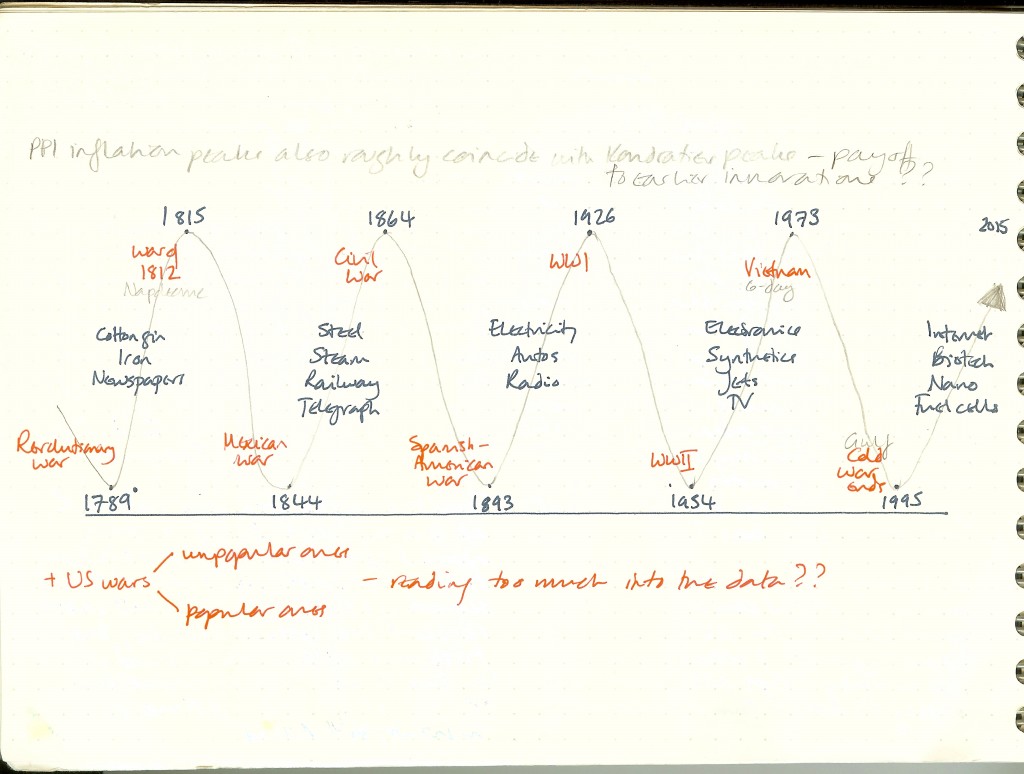
The bulk of the book addresses global economic history, looking at the different accounts of what has driven economic growth and the escape from the Malthusian trap: culture, the competition of ideas, institutions, resources, trade. The classics of economic history are all referred to, both French and English (I am needless to say not familiar with the former group). Daniel includes a discussion of Kondratiev cycles, which [amazon_link id=”1843763311″ target=”_blank” ]Carlotta Perez[/amazon_link] has recently popularised again in the Anglo-sphere. Here is a diagram from one of my old notebooks (2002) which sums it up:

The Kondratiev long wave view

The worry to which Daniel’s subtitle refers is that the limit of post-Malthusian growth has been reached because of both environmental and social constraints. The latter include the emerging generational conflict due to demographic change and apparently intractable inequality. (He does also worry about the supposed breakdown between growth and happiness. Regular readers of this blog will know about my happiness-scepticism, so I’ll draw a polite veil over this section of the book.)

The book does end on a slightly more cheerful note, discussing the importance of ideas and images – “the other theatre of globalization”. He even refers to the ‘weightless’ economy (although alas not citing my 1996 book The Weightless World (pdf).). This may yet allow us to develop a new form of global society and new technologies to address the ecological crisis, he suggests. “At a time when it is tempting to wander around in the cyber-world, human kind should accomplish a cognitive task as immense as that realized during the Neolithic Revolution or the Industrial Revolution: to learn to live within the limits of a solitary planet.” (p188). But that’s not quite his last word – he concludes that there is huge uncertainty about whether we are up to the challenge.

So there is an melancholic mood in the end. If you find yourself in a reflective and philosophical mood one quiet Sunday afternoon, when it’s cold and grey outside, but cosy on the sofa with some Bach or Keith Jarrett or maybe the new Leonard Cohen album playing in the background, this is an ideal read.

[amazon_image id=”026201730X” link=”true” target=”_blank” size=”medium” ]The Prosperity of Vice: A Worried View of Economics[/amazon_image]

What *should* President Obama have been reading?

The Daily Telegraph has a list of books President Obama – a voracious reader – is known to have read in recent years. As the article notes, the range of his interests is impressively wide. Also impressive, given the anti-intellectualism of modern politics, is the fact that he’s not ashamed to be known as a reader. (One has to wonder what the Republican candidates say when asked about their reading. If admitting to speaking a foreign language is an election negative, they must be tempted to hide any evidence of literary taste or intellectual aspiration.)

There are some terrific books on his list. [amazon_link id=”0141043725″ target=”_blank” ]Team of Rivals[/amazon_link] by Doris Kearns Goodwin is marvellous. Political biography features prominently, not surprisingly.

However, there are not many economics books there. Jeff Sachs makes it with [amazon_link id=”0141026154″ target=”_blank” ]Common Wealth [/amazon_link]and I suppose one can (reluctantly) include Thomas Friedman’s [amazon_link id=”0141036664″ target=”_blank” ]Hot, Flat, and Crowded: Why We Need a Green Revolution—and How It Can Renew America. [/amazon_link]But clearly the President needs to read more books about economics.

I nominate as essential:

[amazon_link id=”0691142165″ target=”_blank” ]This Time is Different[/amazon_link] by Carmen Reinhardt and Ken Rogoff

[amazon_link id=”1846140552″ target=”_blank” ]Thinking, Fast and Slow[/amazon_link] by Daniel Kahneman

[amazon_link id=”0674057759″ target=”_blank” ]Capitalist Revolutionary: John Maynard Keynes[/amazon_link] by Roger Backhouse and Bradley Bateman

[amazon_link id=”B005WTR4ZI” target=”_blank” ]Race against the Machine[/amazon_link] by Brynjolfssion and McAfee and [amazon_link id=”0525952713″ target=”_blank” ]The Great Stagnation[/amazon_link] by Tyler Cowen

as relevant recent reads. Other suggestions please!

An update: by serendipity, I just came across this article (pdf) by Australian MP Andrew Leigh about what top Australian politicos read. He expresses the importance of considered reading beautifully:

“[W]hen it comes to our leaders, the need for an inner life, so often fostered and nourished through reading, is not some elitist private matter of little concern to the wider public. Deep and considered reading furnishes the mind with standards, gives wing to the moral imagination, maps the expanses of the individual and national character and dusts off the detritus of political life. It can teach our leaders how we might do things better, not just in terms of policy, but in terms of the responsibility, measure and humility we need within our own lives and within the country at large.”

Oh, and the answers ranged from Potter (Harry) to Plutarch.

Not embarrassed by books

Bankers, bananas and politics

The 2012 edition of Banking Banana Skins (published by the Centre for the Study of Financial Innovation) is out and as ever makes fascinating reading. It reports a survey of bankers, regulators and observers of the industry – in particular, their views about the top current risks.

In one sense there is an impressive consensus. All three categories of respondents are extremely gloomy – the risk index is at the highest ever recorded by the survey (which has run since 1998). All three say the top dangers are macro-economic weakness, credit risk and liquidity (lack of), although in slightly varying orders.

There are some revealing differences, however. “The bankers’ response is especially notable for its concern with the negative impact of regulation, and growing political interference in the business,” says the report, written by David Lascelles. Well, with Fred Goodwin losing his knighthood, this is understandable at one level – there’s a nasty whiff of populism about this decision.

On the other hand, the populism is the consequence of dissatisfaction with the (lack of) action so far over the abuse of political and economic power by the financial sector. We are into the fourth year of recession, output remains well below its pre-crisis levels, unemployment is rising – and there is still a financial crisis. Nothing has changed in the banking industry. Large, complex, interconnected global financial institutions still cannot be allowed to fail, and are still being supported by cheap central bank funding, while at the same time they are not lending to business and not delivering good customer service (with no mis-selling). The bankers’ apprehension about political banana skins is understandable, but then so is the politicisation of banking.

Banking Banana Skins 2012