Guess the top economist from the bookshelf

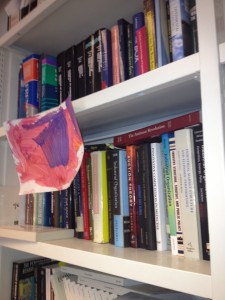
It was Alfred Chandler’s [amazon_link id=”0674789954″ target=”_blank” ]Scale and Scope: Dynamics of Industrial Capitalism [/amazon_link] that caught my eye first on this top London-based economist’s bookshelf, but anyway other people’s book collections are always compelling. The collection included [amazon_link id=”0684824299″ target=”_blank” ]The Bell Curve[/amazon_link] by Herrnstein and Murray, [amazon_link id=”0691123241″ target=”_blank” ]The Box[/amazon_link] by Marc Levison, Krishna’s [amazon_link id=”0123745071″ target=”_blank” ]Auction Theory[/amazon_link] and – as can be seen from enlarging the picture below – a lot of titles on industrial organization and competition.

[amazon_image id=”0674789954″ link=”true” target=”_blank” size=”medium” ]Scale and Scope: Dynamics of Industrial Capitalism[/amazon_image]

I wonder if anybody can guess the owner’s identity? One clue – obviously the parent of a young child.

Whose books?

Chic economics

Another of my holiday reads was Alaa Al Aswany’s [amazon_link id=”0007243626″ target=”_blank” ]The Yacoubian Building[/amazon_link] (which explains a lot about recent events in Egypt). It’s a terrific novel, but one sentence in particular struck me:

“For some reason, the Faculty of Economics and Political Sciences of Cairo University is associated in people’s minds with affluence and chic.”

The author obviously (and reasonably) finds this mystique hard to understand. Of course, I love the idea that economics can be considered chic – an association that would cause people to howl with laughter in the countries I know well.

So this prompted an obvious question, or rather two: in which countries is economics a fashionable subject, and is this correlated with the proportion of female students? I’m looking for a 0-1 variable in answer to the first (a 1 means yes, fashionable) and a percentage of female undergraduates for the second. I can track down UK and probably US data. If readers can help with others, I’ll report the results in due course.

[amazon_image id=”0007243626″ link=”true” target=”_blank” size=”medium” ]The Yacoubian Building[/amazon_image]

When China does what?

Lounging by a pool on a well-deserved holiday this week, I mostly read thrillers, but my  serious reading was the new edition of [amazon_link id=”0140276041″ target=”_blank” ]When China Rules The World[/amazon_link] by Martin Jacques. It is a very interesting and well-informed book, whose argument I couldn’t agree with. Reading it in the week when Chinese politics took a dramatic turn, with the highly public dismissal of Bo Xilai and detention on his wife in a murder investigation, it seems obvious to me that the China’s future in the world remains highly uncertain, no matter how inevitable the decline of the west appears. (See this analysis in the FT this weekend, and this fascinating Foreign Policy article by John Garnaut on the current political contest in China.)

Having said that Jacques’ historical determinism doesn’t persuade me, the book is nevertheless compelling, and the first edition obviously deserves its best-seller status. The history of China and its entire region is lengthy but stuffed with things I’d never known, and a great overview for newcomers to the subject. Jacques picks up on some interesting points that are often overlooked. For example, he makes I point I’ve often thought important and underestimated:

“We should not forget the increasing importance of Chinese subcontractors as ‘systems integrator’ firms in the global supply chain of many foreign multinationals, a developlment which might, in the long term at least, prove to have wider strategic significance for these multinationals in terms of their management, research capability and even ownership.” (p226)

Jacques is also interesting on aspects of Chinese culture. He is far too much of a cultural relativist for my taste – women’s rights for me are a universal, and people never seem bothered about political freedom until, suddenly, they are. However, the book gave me real insight into the very different perspective on the state, with its Confucian origins, in China. It is also eye-opening on Chinese racism. This is a subject of which the author has tragic first-hand experience, given the death of his Indian wife due to her wholly inadequate care in a Hong Kong hospital. It does make one wonder about the future of China’s investments in Africa.

However, the Chinese economic model is understandably of great interest to developing countries, and Justin Yifu Lin at the World Bank is one Chinese economist who is helping move the global development consensus away from the disgraced “Washington Consensus” to a far more statist approach (see this pdf). Jacques sums up the Chinese approach as a competent and strategic state combined with extremely vigorous competition – including competition between state firms and between them and the private sector. He writes:

“First, there is a ubiquitous state, operating at national, provincial and city level, which is highly active and involved in multifarious ways in the economy and society. Second there is, at the same time, a powerful commitment to the market and a very strong belief in competition: the Chinese government is inimical to monopolies.” (p621)

This combination looks rather compelling to other countries whose governments would like to emulate China’s growth record. But it may be that the role and economic competence of the state in China, combined with its uniquely large scale market, will make it hard for others to follow the same model. In many poor countries the state remains predatory, as Acemoglu and Robinson so forcefully point out in [amazon_link id=”1846684293″ target=”_blank” ]Why Nations Fail[/amazon_link].

As for China’s politics and geopolitical status, the events of the past week seem to me to illustrate the uncertainty. China may ‘rule the world’ one day but it is surely, to borrow the famous saying, too soon to tell.

[amazon_image id=”0140276041″ link=”true” target=”_blank” size=”medium” ]When China Rules The World: The End of the Western World and the Birth of a New Global Order[/amazon_image]

 

European growth (lack of)

I was dipping into [amazon_link id=”052149964X” target=”_blank” ]Economic Growth in Europe Since 1945[/amazon_link], edited by Nick Crafts and Gianni Toniolo, and published in 1996, interested to see what difference of perspective the intervening 16 years and Great Financial Crash have brought. The collection very much focuses on the insights of endogenous growth theory, on human capital formation and technology transfer. However, the editors’ essay notes that these factors do not tell the whole story of the Golden Age, les Trentes Glorieuses. They highlight also trade liberalization. And add, interestingly:

“A full understanding of Europe’s Golden Age of economic growth requires a subtle appreciation of the impact of policy and institutions on incentives to invest and obstacles to complete catching up.”

The subsequent chapter by Barry Eichengreen emphasises labour market institutions as the main explanation for differences between European countries, while Mancur Olson looks at Eurosclerosis through the lens of rent seeking. Both actually stand the test of time pretty well. Worth revisiting now that growth is the only hope of a benign path out of the mess we Europeans are in now.

[amazon_image id=”052149964X” link=”true” target=”_blank” size=”medium” ]Economic Growth in Europe since 1945[/amazon_image]


Can free markets be fair?

‘Yes’ is the vigorous answer in [amazon_link id=”069114446X” target=”_blank” ]Free Market Fairness[/amazon_link] by John Tomasi. In both the popular view and among left-inclined intellectuals, free markets are intrinsically unfair, and the economic growth they foster only reaches people on low incomes through the notoriously fickle ‘trickle down’ effect. Freedom in the economic domain and fairness are in conflict.

Tomasi has two main counter-arguments. One is that long run economic growth in free market economies has done far more to benefit the poor than any alternative approach to organising the distribution of resources. He calls economic growth “the great fact.” I agree that the everyday benefits of growth – such as plumbing and affordable lighting and antibiotics and toothpaste and tea bags and …… – are almost always overlooked and certainly do benefit those on low as well as high incomes. However, I don’t think he addresses adequately the social justice question being asked in the aftermath of the Great Financial Crash, which is why almost none, none, of the real GDP gains of the past generation have gone to anyone below the top fifth or so of the income distribution. (I would probably answer this by saying we have only had a pretence of free markets, as a cover for creeping oligopoly.)

However, his second main argument is a powerful one often overlooked by many on the left of centre (although very much not ignored by Amartya Sen in his [amazon_link id=”0141037857″ target=”_blank” ]The Idea of Justice[/amazon_link]), that people who are poor care at least as much about freedom – including economic freedom – as people who are rich. Freedom is a good in itself, and social institutions should not be seen only instrumentally as a means of attaining an ideal distribution.

Anyway, this rather densely-argued book does a pretty good job of bridging the ground between libertarians and liberals (using the American terminology). He calls this third way “market democracy” and says it involves a “fundamentally deliberative approach to the questions of political life.” This emphasis on procedural justice is derived from (as in Sen) from [amazon_link id=”019825055X” target=”_blank” ]John Rawls[/amazon_link]. Tomasi’s plea for us to step away from polarized views is surely welcome – although it seems pretty unlikely to make much headway in the US this presidential election year.

[amazon_image id=”069114446X” link=”true” target=”_blank” size=”medium” ]Free Market Fairness[/amazon_image]