Did economics win the war?

World War II literature isn’t my cup of tea normally, but there are some outstanding books. I loved Richard Overy’s [amazon_link id=”0140284540″ target=”_blank” ]Interrogations: Inside the Mind of the Nazi Elite[/amazon_link], about the period before the Nuremberg Trials when victors and prisoners had their first encounters about the cataclysm that had just ended. Overy’s powerful point is that people can switch between different moral universes astonishingly – scarily – quickly and thoroughly. Some of the prisoners had made that switch since their arrest. Another one of my favourite books is [amazon_link id=”0141042826″ target=”_blank” ]Most Secret War: British Scientific Intelligence 1939-45[/amazon_link] by R.V.Jones, about the huge espionage and intelligence effort, including the decoding of German communications by Bletchley Park – it covers the Whitehall and military hinterland as well, and the organisation of the enormous and wholly secret effort to deploy work at the frontiers of science and technology.

[amazon_image id=”0141042826″ link=”true” target=”_blank” size=”medium” ]Most Secret War (Penguin World War II Collection)[/amazon_image]

[amazon_image id=”0140284540″ link=”true” target=”_blank” size=”medium” ]Interrogations: Inside the Minds of the Nazi Elite[/amazon_image]

I’ve just started [amazon_link id=”1591144914″ target=”_blank” ]Keep From All Thoughtful Men: How US Economists Won World War II [/amazon_link]by Jim Lacey, and it already promises to join this distinguished company. Of course, it’s gratifying to see economists as heroes for once. Still, what I like about all these books is the reminder they bring that events are never, ever simple. Things turn out the way they do because of a lot of different contributory factors, few of them high profile. Or, as I like to put it in economist-speak, history is over-determined.

[amazon_image id=”1591144914″ link=”true” target=”_blank” size=”medium” ]Keep From All Thoughtful Men[/amazon_image]

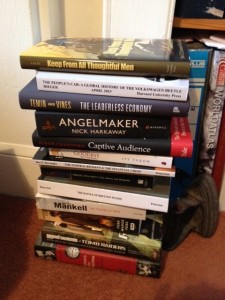
The current pile

It’s time to choose my next book to read, and the pile is quite high at the moment (albeit including my incoming fiction as well as serious books).

The current pile

I think I’m going to go for the one at the top, [amazon_link id=”1591144914″ target=”_blank” ]Keep From All Thoughtful Men: How US Economists Won World War II[/amazon_link] by Jim Lacey, as it might be relevant for my new book, sitting with my publisher in draft at the moment.

[amazon_image id=”1591144914″ link=”true” target=”_blank” size=”medium” ]Keep From All Thoughtful Men[/amazon_image]

The English intelligentsia – a contradiction in terms

One of the interesting aspects of Tony Judt’s [amazon_link id=”009956355X” target=”_blank” ]Thinking the 20th Century[/amazon_link] (which I’ve nearly finished) is the insider-outsider perspective he has on England. He grew up in London, the son of an immigrant father and second generation immigrant mother, and emigrated to the US in his late 20s. So he has a nice combination of familiarity and objectivity about his birthplace (and I mean England, not the UK, as he has a very London-centric view).

Given that I spent my teenage years in a small Lancashire mill town pining to be a philosopher sitting in a French cafe, I was particularly taken with Judt’s comments about the way the English dismiss intellectuals – ‘English intellegentsia’ is not a meaningful social concept. His hypothesis is “that the intellectual agenda which drove ideologically configured political movements in continental Europe was quite absent in London.” This lack of ideology was a blessing for most of the 20th century. As Judt points out, the penalty Eric Hobsbawm paid for being a lifelong Communist was no more serious than having to be a professor at the University of London rather than Cambridge. That tolerance would surely not have played out in the same way on the Continent.

There is also a nice passage describing the way the furthest reaches of Empire – George Orwell’s Burma, India, the Caribbean – seem comfortable and familiar to the English thanks to language and cultural references, whereas the Continent seems wildly exotic. Even for Shakespeare the “coast of Bohemia” was a mysterious distant land, and as for Slovenia or Bulgaria, or even the longingly imagined Paris of my adolescence….

[amazon_image id=”009956355X” link=”true” target=”_blank” size=”medium” ]Thinking the Twentieth Century[/amazon_image]

[amazon_image id=”0140004564″ link=”true” target=”_blank” size=”medium” ]Burmese Days[/amazon_image]

The Great Rebalancing

Chapter 1 of [amazon_link id=”0691158681″ target=”_blank” ]The Great Rebalancing: Trade, Conflict and the Perilous Road Ahead for the World Economy[/amazon_link] by Michael Pettis is available to read for free online at the Princeton University Press website.

It isn’t often that I bill anything as a must-read, but this really is, for anybody who wants to understand what has been happening in the world economy in the past decades, the causes and consequences of global imbalances. As another recent comment on my previous post on this book puts it, this book is a game changer. Click through and read the sample chapter!

[amazon_image id=”0691158681″ link=”true” target=”_blank” size=”medium” ]The Great Rebalancing: Trade, Conflict, and the Perilous Road Ahead for the World Economy[/amazon_image]

The 20th Century

I’ve started [amazon_link id=”009956355X” target=”_blank” ]Thinking the Twentieth Century[/amazon_link], the final book by Tony Judt, a conversation with historian Timothy Snyder. The first of Judt’s books I read was the supreme [amazon_link id=”009954203X” target=”_blank” ]Postwar[/amazon_link], followed by [amazon_link id=”0718191412″ target=”_blank” ]Ill Fares the Land[/amazon_link] and [amazon_link id=”009955559X” target=”_blank” ]The Memory Chalet[/amazon_link]. So I’ve been looking forward to getting the paperback of this last one.

[amazon_image id=”009956355X” link=”true” target=”_blank” size=”medium” ]Thinking the Twentieth Century[/amazon_image]

One comment in what I’ve read so far brought me to a halt, though,  in a passage about the wide and lasting damage inflicted by two wars on European culture but also the economy, due to the retreat from early 20th century globalization. “It took until the mid-1970s for even the core economies of western Europe to get back to where they had been in 1914. … In short, the industrial economies of the west (with the exception of the United States) experienced a 60 year decline, marked by two world wars and an unprecedented economic depression.” Reading this on the Tube, I was sure it was an overstatement – what about Les Trentes Glorieuses, the post-world war 2 golden years of growth?

And so it proves. Turning to the invaluable (xls spreadsheet) Angus Madison database of world GDP over the centuries, per capita GDP (in 1990 Geary-Khamis dollars) in western Europe grew by about half a percent a year between 1914 and 1945, and substantially faster after that. Still, the figures don’t undermine the underlying point about the economic price paid for political upheaval and war in Europe in the first half of the 20th century. Nor do GDP figures capture the destruction of assets – and lives – or the psychological effects of that terrible half century.