Globalisation and legitimacy

It has always been a bit depressing reading about trade negotiations, which have long been a battleground between competing interests – nation against nation, industry lobbies against the general interest, developing against rich world. Mutual gains from trade, anyone? The World Trade Organisation has been a particular focus of suspicion on the part of people who are anti-capitalism or anti-corporate. Most economists note that no country has ever developed out of poverty without opening up to trade, although of course views differ about how to do so, with some liking the idea of protecting certain industries.

I think these arguments are almost always wrong – the extremely rare potential exceptions involve very large economies of scale where the global market can only support a very few  competing firms (aerospace?) and culturally important goods or services where replacement of domestic by global goods could have adverse non-economic externalities (French movies?).

There are claims that the successful Asian economies only developed because they protected their new industries but this misreads the character of state intervention. Joe Studwell’s excellent book [amazon_link id=”1846682428″ target=”_blank” ]How Asia Works[/amazon_link] shows that the success stories in the region provided production subsidies and infrastructure but made very sure domestic ‘champions’ were exposed to the full blast of international competition.

[amazon_image id=”1846682428″ link=”true” target=”_blank” size=”medium” ]How Asia Works: Success and Failure in the World’s Most Dynamic Region[/amazon_image]

Still, the economic arguments don’t explain why it’s so hard to get a trade deal. In theory the WTO is a better forum than its predecessor, the GATT talks, because it is rules-based and puts every member on an equal footing. Yet there have always been suspicions about its legitimacy as a place where all countries get a fair deal. It is one element of the wider shortcomings of global economic governance. Jim O’Neill’s new book in the Perspectives series, The BRIC Road to Growth, calls for urgent reforms of the governance institutions. The ones we have can’t respond quickly to events, and don’t reflect the shift of economic gravity that has already occurred and will continue. These are linked: effectiveness is rooted in legitimacy. Whatever the outcome of the talks in Bali, the wider global governance problem just won’t go away.

[amazon_image id=”1907994130″ link=”true” target=”_blank” size=”medium” ]The BRIC Road to Growth (Perspectives)[/amazon_image]

Poverty, fear and loathing

Economics is famously, or notoriously, abstract. It is a discipline focused on the calculating parts of human behaviour, rather than the emotions. This would have made no sense to Adam Smith. As Emma Rothschild argues in her book [amazon_link id=”0674008375″ target=”_blank” ]Economic Sentiments[/amazon_link], “Economic life is a system of sentiments.” This is why for Smith, [amazon_link id=”1840226889″ target=”_blank” ]The Wealth of Nations[/amazon_link] followed [amazon_link id=”0143105922″ target=”_blank” ]The Theory of Moral Sentiments[/amazon_link]. Economic behaviour only makes sense in the context of understanding what drives human beings.

[amazon_image id=”0674008375″ link=”true” target=”_blank” size=”medium” ]Economic Sentiments: Adam Smith, Condorcet and the Enlightenment[/amazon_image]

Julia Unwin’s book Why Fight Poverty? in our Perspectives series lies in this tradition, and makes a really important contribution to the public policy debate. She argues passionately that poverty is not inevitable, it can be reduced, but nothing will change unless we face up to the emotions that seeing poverty arouse in most of us – the fear, the shame, the sense of disgust, giving rise to the creation and retelling of myths about poor people.

[amazon_image id=”1907994165″ link=”true” target=”_blank” size=”medium” ]Why Fight Poverty? (Perspectives)[/amazon_image]

The role of ‘moral sentiments’ in addressing poverty is a timely theme on the day the Joseph Rowntree Foundation and Prospect are launching a recent set of essays (free e-book) on poverty at an event in the House of Commons. One of the chapters in Julia’s book is titled ‘Is poverty inevitable?’ The answer is no.

What does Cleveland, Ohio have that London doesn’t?

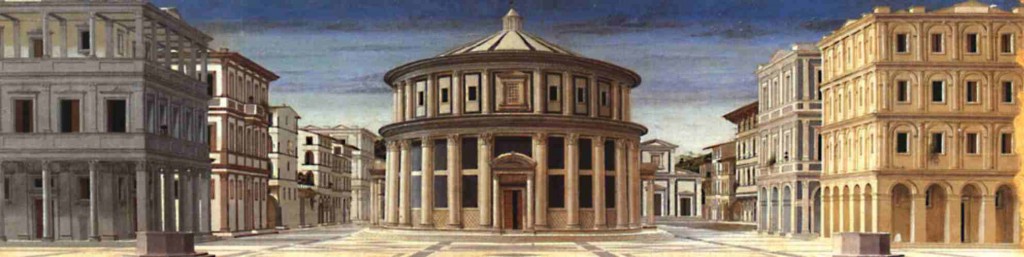
This summer we visited the wonderful gallery in the ducal palace in Urbino, where the painting that most absorbed me was Laurano’s Citta Ideale.

Citta Ideale

Of course it isn’t ideal – no people, no bustle. For any fan of Jane Jacobs’ [amazon_link id=”067974195X” target=”_blank” ]The Death and Life of Great American Cities[/amazon_link] or [amazon_link id=”0394729110″ target=”_blank” ]Cities and the Wealth of Nations[/amazon_link], it’s the anti-ideal.

Cities are clearly having a major renaissance, in debate if not in reality. Last year brought Ed Glaeser’s excellent [amazon_link id=”0330458078″ target=”_blank” ]Triumph of the City[/amazon_link]. Benjamin Barber has just published If [amazon_link id=”030016467X” target=”_blank” ]Mayors Ruled the World: Dysfunctional Nations, Rising Cities[/amazon_link], which I’ve not yet looked at. I’ve just been reading a very interesting analysis of the economics and politics of US cities, [amazon_link id=”081572151X” target=”_blank” ]The Metropolitan Revolution: How Cities and Metros are fixing our broken politics and fragile economy[/amazon_link] by Bruce Katz and Jennifer Bradley. The first part is descriptive, looking at four American urban areas and the ground-up initiatives under way to stimulate economic revival and involve citizens in urban and civic renewal. The four are New York, Denver, north eastern Ohio (Cleveland, Akron, Canton etc) and Houston. For a non-American it is simply interesting to learn what’s been happening, although the chasm between rich and poor areas is in my experience far greater in the US than anywhere in Europe (bad as it is in our cities too).

[amazon_image id=”081572151X” link=”true” target=”_blank” size=”medium” ]The Metropolitan Revolution (Brookings Focus Book)[/amazon_image]

The second part is analytical, drawing together some of the themes about the effectiveness of different approaches to economic development, in the context of big technical, demographic and cultural changes. Technology-driven innovation has clearly increased the value of the externalities that occur in densely-populated and well-connected cities – ideas and trade are the vital ingredients.

The recipe for combining them to achieve economic and cultural success is the subject of the final two chapters. They constitute a call to enhance the devolution of political power down to the city-region level (and of course American cities already have freedoms to act that British city leaders can only wistfully dream of), and to have the confidence to act with conviction in creating their own destiny. I particularly like Katz’s and Bradley’s emphasis on “the informal power to convene.” It’s what I think of as proper, old-fashioned politics, talking the people and getting them to line up in support of a common aim. The Ohio example is particularly interesting here, as the book describes its (partial) economic recovery as a matter of building networks of enterprise, investment and civic engagement. The details are specific to the US, but it seems obvious to me that the general principles apply here in the UK too.

The other new book to mention in this context is Bridget Rosewell’s Reinventing London, in our Perspectives series. Bridget is probably the most knowledgeable and authoritative commentator on the London economy, given her involvement over many years in developing its economic strategy. The book draws lessons about the post-financial crisis shape of London’s economy from the city’s past successful adaptations to profound structural changes. Its recommendations cover four areas: supporting service industries other than finance, making London a place people want to live especially by ensuring there is enough housing in pleasant areas, and investing urgently in infrastructure and also specifically connectivity – including deciding soon on new airport expansion, wherever the new runways are to be built.

[amazon_image id=”1907994149″ link=”true” target=”_blank” size=”medium” ]Reinventing London (Perspectives)[/amazon_image]

Needless to say, I strongly recommend it!

Is this the dawn of an era of powerful cities and weak nations – much like the age of city states half a millennium ago? It seems highly likely. More than half the world’s people live in urban areas now. Most economic activity consists of trade in ideas and people and goods and services between cities. Mayors are important figures, who for the most part feel less bound by the constricting conventions of national party politics. As ever, though, political and social institutions lag behind technological and economic trends, and in centralised polities like the UK urban renaissance would involve some big changes. Even London, with more powers than any other UK city, has only limited control over its own destiny, airport included. But if all these books are right about the inexorable trend towards city-driven economies, this will be an important debate.

That time of year

Mist, yellow leaves drifting, the scent of frost on the early morning run – it’s late November and the papers are running their books of the year sections. I read somewhere recently that many bookshops earn a quarter of their annual revenues in the few weeks before Christmas. This morning the FT had its experts’ choice, and I have not yet read all that many of them.

These are the tantalisingly unread ones that caught my eye today (from all genres):

[amazon_link id=”0465031560″ target=”_blank” ]The End of Power[/amazon_link] Moises Naim

[amazon_link id=”0297868411″ target=”_blank” ]Give and Take[/amazon_link] Adam Grant

[amazon_link id=”1408842068″ target=”_blank” ]Writing on the Wall[/amazon_link] Tom Standage

[amazon_image id=”1408842068″ link=”true” target=”_blank” size=”medium” ]Writing on the Wall: Social Media – The First 2,000 Years[/amazon_image]

[amazon_link id=”059307047X” target=”_blank” ]The Everything Store[/amazon_link] Brad Stone

[amazon_link id=”0871404508″ target=”_blank” ]Fear Itself[/amazon_link] Ira Katznelson

[amazon_link id=”0571251285″ target=”_blank” ]The Unwinding[/amazon_link] George Packer

[amazon_link id=”0691043809″ target=”_blank” ]Prague: Capital of the 20th Century[/amazon_link] Derek Sayer

[amazon_image id=”0691043809″ link=”true” target=”_blank” size=”medium” ]Prague, Capital of the Twentieth Century. A Surrealist History.[/amazon_image]

[amazon_link id=”1849761221″ target=”_blank” ]Lowry and the Painting of Modern Life[/amazon_link] TJ Clark and Ann Wagner

[amazon_image id=”1849761221″ link=”true” target=”_blank” size=”medium” ]Lowry and the Painting of Modern Life[/amazon_image]

[amazon_link id=”1781681406″ target=”_blank” ]The View from the Train[/amazon_link] Patrick Keiller

[amazon_image id=”1781681406″ link=”true” target=”_blank” size=”medium” ]The View from the Train: Cities and Other Landscapes[/amazon_image]

[amazon_link id=”1848547528″ target=”_blank” ]The Broken Road[/amazon_link] Patrick Leigh Fermor

I announced the Enlightened Economist prize for 2013 – [amazon_link id=”0691155674″ target=”_blank” ]Worldly Philosopher [/amazon_link]by Jeremy Adelman – a few weeks ago. A big book but a page turner and a must for the economist in your life. For non-economists, Tim Harford’s [amazon_link id=”1408704242″ target=”_blank” ]The Undercover Economist Strikes Back[/amazon_link] is a wonderfully well written and balanced explanation of what has happened to the economy in the past few years and how economists think about it.

Democracy, the El Farol bar and Captain Kirk

The El Farol problem, named by Brian Arthur (pdf), concerns a popular bar in Santa Fe. It’s so popular it gets very crowded, to such a degree that people then start to stay away. Then, when the crowds thin out, people start going back. The bar oscillates between being over-crowded and being too empty.

David Runciman’s superb book [amazon_link id=”0691148686″ target=”_blank” ]The Confidence Trap: A History of Democracy in Crisis from World War I to the Present[/amazon_link] reminded me of the El Farol model. He uses the examples of several turning points in democracy – World War I, the Depression, post-war reconstruction, the Cold War, the mid-70s economic crisis, the collapse of communism in 1989 and the global financial crisis – to argue that democracies exist in a (so far) stable instability. Democracies are inherently flexible, adaptable (echoes of Tim Harford’s [amazon_link id=”0349121516″ target=”_blank” ]Adapt[/amazon_link]), and so are better than autocracies at coping with crisis; but having coped with so many crises, don’t bother to adapt because of a high degree of confidence that everything will turn out ok in the end.

The book is full of wonderful variations on this central paradox. “Democracy is more durable than other systems of government not because it succeeds when it has to, but because it can afford to fail when it has to. It is better at failure than its rivals.” “Autocrats are often highly sensitive to public opinion, which is why they go to such lengths to control it.” Echoes in this next one of Dominic Sandbrook’s entertaining TV history of the Cold War, Strange Days: “To take their minds of nuclear Armageddon they [Western citizens] watcheyd TV and went shopping. And that’s how the Cold War was won: by people whose attention was elsewhere.” “Democracy is only doomed if people come to believe it is doomed; otherwise, it can survive anything.” On President Obama: “He symbolized change, which meant he did not need to specify it.”

The continuing ability to cope is messy and unattractive, if so far effective. There is a pervasive and constant disappointment with actually existing democracies. Still, muddling through is a better outcome than the alternatives.

[amazon_image id=”0691148686″ link=”true” target=”_blank” size=”medium” ]The Confidence Trap: A History of Democracy in Crisis from World War I to the Present[/amazon_image]

In the end, democracy involves a kind of collective game of chicken. If things get really bad, we’ll do something about it. Until then, no need to change because it will turn out ok in the end. As Runciman points out, this kind of game is fine – until it isn’t, when it turns out to be catastrophic.

Is this “typical democratic recklessness: short term gain at the expense of long-term stability” sustainable? The book doesn’t answer the question definitively. Yet the historic, existential challenges of war, political rivalry, environmental collapse, and financial over-extension remain. Runciman is not optimistic:

“We should not assume that democracies will always be able to improvise a solution to whatever challenges they face. …. The assumption that it is bound to happen increases the likelihood it will stop happening. It breeds the sort of complacency that allows dangerous crises to build up, invites decisive action to be deferred and encourages brinksmanship. This is tempting fate.”

There is no ultimate crisis, but the crises keep on coming, and there is no reason to expect democratic adaptability to remain successful indefinitely, he writes. He even suggests that the current crisis may be decisive, marking as it does the unwinding of an extended political/economic experiment – call it ‘neoliberalism’ – since the mid-1970s. The world’s democracies are bound together by complicated financial, technological, and institutional arrangements. Failure in one place can have large repercussions elsewhere. (This systemic nature of modern risks is something Ian Goldin is writing about.) The short-term restlessness of democracy is both its biggest strength and greatest weakness. “I do not know what will happen,” Runciman concludes.

I don’t know either. Watching Strange Days has reminded me of the nightmares I used to have as a child about nuclear winter and being the only person left alive. The late 70s, one of the crisis episodes in [amazon_link id=”0691148686″ target=”_blank” ]The Confidence Trap[/amazon_link], was a terrible period. The emotional impact of the current economic/political/environmental challenges is not as intense for me – I wonder what it has done to today’s teenagers? – but I don’t have great optimism about what our world will look like in another 10 or 20 years. That’s why it’s so important to build the optimism, to create new institutions and insist on our societies living their stated values, and in fact being the adaptability Runciman writes about.

That’s hard to do in an El Farol world. But another story the book reminded me about was the Kobayashi Maru scenario in Star Trek. Star Fleet cadets are placed in a war game with no possibility of victory – it is a test of character, not a test of ability. Captain Kirk is the only cadet ever to triumph; he re-codes the scenario (for which Spock later criticises him). That’s what we have to do.

I’ve not yet read other reviews of David Runciman’s book, but there have been plenty. Here are: The Guardian; The Economist; the FT;  and an extract in Foreign Policy.