
Back to the future in economics

As I was clearing out some stuff, I came across a January 1991 special centenary edition of the Economic Journal. The editors invited 22 distinguished economists to speculate about the next 100 years of their discipline.

It’s fascinating to see the similarity of the points made about the changes under way, or needing to get under way, in economics then and now. Will Baumol warns that there is too much mathematics for its own sake in economics. He welcomes the new research in behavioural economics but says it is disappointing to see how slowly it is being incorporated into economists’ everyday work – he suggests this is because behavioural economists have spent too little time researching when people (or animals) act rationally and when instead their behavioural biases take over. Andrew Oswald was encouraged by the growing use of microeconomic data sets to do empirical work. Frank Hahn predicts that evolutionary theory will contribute more to economics, and Charles Plott says that in general economics will move closer to the life sciences, with particular focus on how people’s preferences are formed. Richard Schmalensee says economists will have to pay more attention to the effects of technology in service industries, and the importance of R&D and intellectual property.

So you could end up feeling pessimistic that the debate – and the subject – has moved on little since 1991. Or optimistic that the encouraging current trends to use maths more sparingly and psychology more often, to look at evolutionary models, or big questions like technology and jobs have such long and deep roots among economists – perhaps economics will actually develop in this way.

The one constant that is truly depressing is the low proportion of women included in this high-profile special issue – zero. But I fear that the same exercise now would result in only 1 or 2 women being invited to contribute. The problem isn’t that there are not enough good female economists, for there are plenty. It’s in the social construction of careers in economics and the definition of what makes an economist ‘good’.
Myths and realities of decline?

Incoming

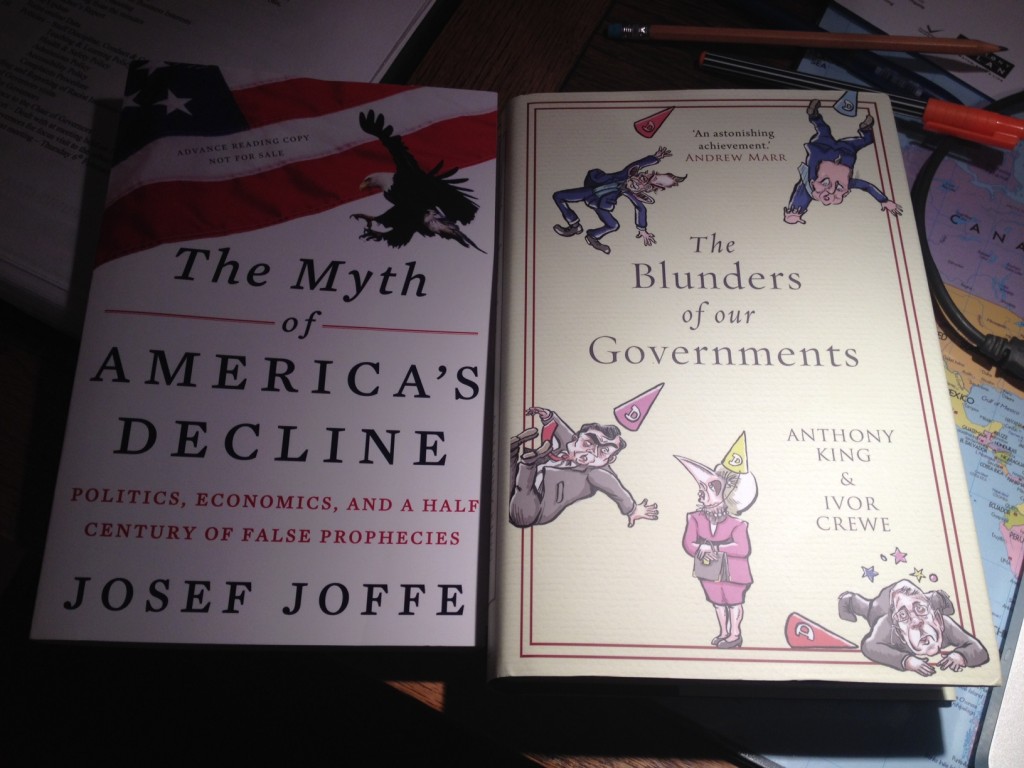
Looking forward to reading both of these, just arrived for review. [amazon_link id=”0871404494″ target=”_blank” ]The Myth of America’s Decline[/amazon_link] by Josef Joffe is out in January – the blurb says it is a history of declinism that debunks the current wave. [amazon_link id=”1780742665″ target=”_blank” ]The Blunders of our Governments[/amazon_link] by Anthony King and Ivor Crewe has been widely reviewed and sounds excellent. I’ll read it for this blog – a volunteer to review it for the next issue of The Business Economist would be welcome.

Dancing nimbly round a stumbling giant?

A while ago I reviewed Jonathan Fenby‘s [amazon_link id=”1847394116″ target=”_blank” ]Tiger Head, Snake Tails[/amazon_link], which I liked because its answer to the question about China’s prospects for economic and geopolitical success is essentially ‘it depends’. It’s a rare book that gives an effective overview while resisting the temptation to be either a China-booster or China-basher. I’ve now read another China book that probably falls into the latter camp, Timothy Beardson’s [amazon_link id=”0300165420″ target=”_blank” ]Stumbling Giant: The Threats to China’s Future[/amazon_link].

[amazon_image id=”0300165420″ link=”true” target=”_blank” size=”medium” ]Stumbling Giant: The Threats to China’s Future[/amazon_image]

The author would surely describe it as China-realism though. It is certainly more nuanced than some others, pointing to the country’s amazing recent achievements. He lives in Hong Kong and has done business in China for decades. The book is full of interesting and informative detail and insights. For example, in the chapter on the knowledge economy, I learned that plagiarism is a pervasive problem in the Chinese academic world. One biologist, Fang Shimin, documented 500 cases of plagiarism in his field in one year, 2007. A professor named as a culprit arranged for criminals to attack Fang with a hammer. Beardson goes on to claim that while plagiarism is a global problem, the culprits in other universities are often Chinese, citing a consultancy to US universities advising clients to expect half of all Chinese applicants to submit forged transcripts. Of course I haven’t done any additional research into Beardson’s figures but this is indeed an interesting perspective on the capacity of the country’s education system to turn out creative, innovative thinkers. Another example – the description of an increasing number of incidents of large-scale public violence in the past 20 years, including more very large scale incidents, albeit against the background of very high (80-80%) support for the government and belief the country is heading in the right direction.

The book runs through a series of important challenges facing China’s leaders: its ‘broken’ economic model (other authors might dispute that description of course); the elusiveness of the knowledge economy; a fragile financial sector distorted by state intervention in lending; the absence of adequate social welfare; adverse demography; environmental degradation and pollution; civil stability; the future of the Communist party; the geopolitics of east Asia and relations with the US; ethnic unrest in central Asia; the battles in cyberspace. That’s quite a list – it’s a chunky book covering lots of ground.

Can they be overcome? Beardson concludes: “Many of the challenges which China confronts appear to an international audience to have clear solutions. However, they must be viewed in the context of a government which is driven by the desire to stay in power and yet has a sense of fragility. Many obvious policy solutions are avoided as they carry political costs or risks.” He thinks it “inconceivable” that China will overtake the US this century. The challenges have solutions but these will not be implemented. I found it impossible to assess this ultimately political judgement.

What does seem clear is that events in China will be – one way or the other – extraordinary. If you’re interested, this book is a very welcome addition to the collection of well-informed perspectives on a country that has unavoidably become part of our future. ‘[amazon_link id=”0300165420″ target=”_blank” ]Stumbling Giant[/amazon_link]’ is an apt title: it’s an alarming prospect and it could take some nimble footwork from the rest of us to avoid collateral damage.

What can economics contribute to public policy?

I’ve been thinking about what would be covered in my ideal course on economics for public policy. What would really shape economics students into well-informed citizens about government decisions, and useful recruits into the public policy world, while satisfying their evident appetite to engage with the big issues of the day? Behind this lies the broader question of what economic analysis can contribute to public policy, something I’ve been mulling over for a bit via some lectures (the Tanner lectures in Oxford in 2012 and the Pro Bono Economics lecture in 2013).

If you look around at the public policy economics courses and reading lists available online, universities typically either approach the subject from the perspective of the theory of public goods, public choice theory and transactions cost/institutional economics. Or they take a topics approach so cover, say, education fees and vouchers, valuing the environment, competition policy etc. This is necessarily context-specific, so the readings are about individual countries. Finally, there’s the traditional public finance focus, tax, spending, the welfare state. My undergraduate option a million years ago was in this tradition – our textbook was Musgrave and Musgrave’s [amazon_link id=”0070441278″ target=”_blank” ]Public Finance in Theory and Practice[/amazon_link]. It’s rather interesting to see that there are completely distinct approaches.

The most-used texts (in the UK) seem to be:

[amazon_link id=”0199297819″ target=”_blank” ]The Economics of the Welfare State[/amazon_link] – Nicholas Barr

[amazon_image id=”0199297819″ link=”true” target=”_blank” size=”medium” ]Economics of the Welfare State[/amazon_image]

[amazon_link id=”0393966518″ target=”_blank” ]The Economics of the Public Secto[/amazon_link]r – Joseph Stiglitz

[amazon_image id=”0393966518″ link=”true” target=”_blank” size=”medium” ]Economics of the Public Sector[/amazon_image]

[amazon_link id=”0230553001″ target=”_blank” ]The Economics of Social Problem[/amazon_link]s – Julian LeGrand, Carol Propper and Sarah Smith

[amazon_image id=”0230553001″ link=”true” target=”_blank” size=”medium” ]The Economics of Social Problems[/amazon_image]

I have on my shelf Lee Friedman’s [amazon_link id=”0691089345″ target=”_blank” ]The Microeconomics of Public Policy Analysis[/amazon_link], which I like, although it’s US-centric. Jonathan Gruber’s [amazon_link id=”1429219491″ target=”_blank” ]Public Finance & Public Policy[/amazon_link] has been recommended to me, but it’s a silly price.

There are obviously some classics too, at least for the first approach, such as Tullock’s [amazon_link id=”0865972184″ target=”_blank” ]The Calculus of Consent[/amazon_link], Olson’s [amazon_link id=”0674537513″ target=”_blank” ]Logic of Collective Action[/amazon_link], Ostrom’s [amazon_link id=”0521405998″ target=”_blank” ]Governing the Commons[/amazon_link], Schelling’s [amazon_link id=”0393329461″ target=”_blank” ]Micromotives and Macrobehaviour [/amazon_link](one of my all-time favourite books).

[amazon_image id=”0393329461″ link=”true” target=”_blank” size=”medium” ]Micromotives and Macrobehavior[/amazon_image]

My thoughts are still unformed, so I’d be interested to know what other people would recommend.

The hollow economy

Looking for the next small (pre-party) book, I picked up G.D.H. Cole’s little 1938 Pelican [amazon_link id=”B000SHWV16″ target=”_blank” ]Persons and Periods[/amazon_link] (I have a 1945 edition). It’s a collection of essays by the economist and leading Fabian intellectual on Daniel Defoe (somebody who would now be considered a leading economic journalist, a Martin Wolf of his day, as well as a famous novelist) and his times.

[amazon_image id=”B000SHWV16″ link=”true” target=”_blank” size=”medium” ]Persons & Periods[/amazon_image]

There are some amusing parallels with modern debates about the state of the nation. In Defoe’s writings, and evidently in 1938 too, people bemoaned the dominance of London. “In 18th century England all roads, by land or by water, seemed to lead to London. …. London was, in Defoe’s day, the only town in England that could be reckoned large. … No wonder London seemed to Defoe and his contemporaries a prodigious place. overshadowing the whole country with the multitude and wealth of its consuming public.”

The following chapter is about ‘Roads, rivers and canals.’ In the 18th century, as now, travellers constantly complained about the state of the transport network, although the roads were being improved. “The trouble was not that the roads were getting worse but that they were being called upon to carry a quite unprecedentedly heavy volume of traffic.” Cole argues that the 19th century development of the canals, launched by the Duke of Bridgewater, and then railways, changed the location of people and activity: “In effect, with the advent of the canals, England ceased to be hollow.” The era of the great manufacturing cities of the north and Midlands followed.

Lessons here for our current ‘hollow’ economy? For a rebalanced economy, where the new infrastructure goes will be important.