Long reads for short journeys

It’s one of those weeks, wall-to-wall meetings, all on different subjects so I’m reading the papers on the train on the way there to get my head around things. So for a bit of mental relaxation I’ve been reading a wonderful book recommended to me by Tim Harford. That’s [amazon_link id=”1594482675″ target=”_blank” ]The New Kings of Nonfiction[/amazon_link], edited by Ira Glass , producer of the utterly brilliant This American Life.

As the title suggests, this is a collection of long non-fiction essays. They amount almost to a new genre, one greatly encouraged by the web for reasons I’m not sure I understand. After all, the conventional wisdom is that people only read short items online. Maybe it’s because the scope of the addressable market for this work is so much increased. Maybe it’s the arrival of iPads and other tablets, and this kind of short long-form work is perfect for commuting. The revival of long essays and short books these days is a very welcome phenomenon.

The style is distinctive too. Reportage meets the techniques of good fiction, so the stories are gripping. Anyway, highly commended. And proceeds from the book’s sales go to a Chicago literacy programme.

[amazon_image id=”1594482675″ link=”true” target=”_blank” size=”medium” ]The New Kings of Nonfiction[/amazon_image]

Moral markets?

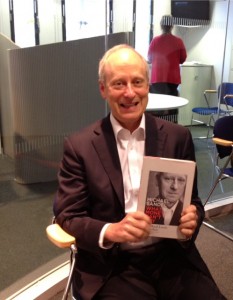
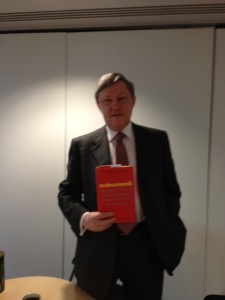
I took part in a very stimulating debate on BBC Radio4’s Start The Week with Michael Sandel, author of [amazon_link id=”184614471X” target=”_blank” ]What Money Can’t Buy[/amazon_link], and Grigory Yavlinsky, author of [amazon_link id=”0300159102″ target=”_blank” ]realeconomik[/amazon_link]. The podcast is available on the Start the Week website. Here are the two authors just before we went into the studio.

Michael Sandel


Grigory Yavlinsky

realeconomik and realism

I’ve finished reading Grigory Yavlinsky’s [amazon_link id=”0300159102″ target=”_blank” ]realekonomik: The Hidden Cause of the Great Recession (And How to Avert the Next One)[/amazon_link]. This was a prelude to discussing with him and with Michael Sandel (whose new book is [amazon_link id=”184614471X” target=”_blank” ]What Money Can’t Buy: The Moral Limits of Markets[/amazon_link]) the issue of markets and morality on BBC Radio 4’s Start the Week.

Yavlinsky’s argument is one that will strike a chord with many people, post-Crash, namely that the main problem is that the financial markets in particular, but markets in general, are not so much amoral as immoral. He has good reason to be pessimistic about markets given his experience with Russia’s transition away from a planned economy – Yavlinsky’s own ‘500 Days’ plan was usurped by ‘shock therapy’ and the disorderly privatizations that accompanied it. He has since seen the rise of Russia’s oligarchs at the expense of living standards and even life expectancy for the great majority of ordinary people. It is not surprising that he sees parallels between that oligarchy and the western financial services oligarchy. realeconomik (the title is of course a play on realpolitik) has an excellent chapter on Russia, and is also convincing on the way structures such as intellectual property rights make it hard for developing countries to benefit from globalisation. Although I think it essential for this group of countries to participate in global production chains, it has always been clear that the TRIPS is a dreadful regime.

Yavlinksy concludes, pessimistically, in this book, that nothing has changed in the power of the financial oligarchs since the Crash: “Calls have gone unheard for a far-reaching change in moral attitudes and for deep and meaningful reform of modern capitalism.”

He’s right. It is pretty clear to me that the financial elite became disconnected from any normal notion of appropriate moral behaviour at some stage during the 90s or noughties, and are still on the whole inhabiting a different moral universe from the rest of us. That will have to change, although – despite the subtitle – Yavlinsky does not offer much guidance on how to bring about that change.

However, I differ from both him and Sandel in thinking the issue is more one of social norms than ‘markets’ in the abstract – because markets are not abstract, they are themselves a form of institution embedded in society and can operate in either moral or immoral ways. Indeed, you have to get beyond inveighing in general, abstract terms about ‘markets’ to be able to come up with specific proposals for change. It will take realism to overcome realeconomik.

I reviewed Sandel’s book recently for The Independent. My Tanner Lectures on these issues will be available shortly on the Brasenose College website.

[amazon_image id=”0300159102″ link=”true” target=”_blank” size=”medium” ]Realeconomik: The Hidden Cause of the Great Recession (and How to Avert the Next One)[/amazon_image]

Teaching economists to communicate

I’m mid-way through editing some essays about how the way economics is taught in universities needs to change  – they will be out in September. The essays are a follow up to the conference (pdf) held at the Bank of England earlier this year, and there is also a working group looking at what practical steps are required in the UK. Anyway, one of the themes is the need for economics graduates to have the skill of communication to non-specialists, as there are no jobs outside the academic world that do not feature that as a central task.

The communication theme has also been on my mind as I prepare to give the Tanner Lectures (pdf) in Oxford on May 18th and 19th. The title is ‘The Public Responsibilities of the Economist’ and I’m finding that – as always – I need to explain that most economists do not do what everyone else thinks. People think economists go on the news/Twitter and pronounce confidently (albeit differently) about growth, austerity, the Euro etc, whereas although macroeconomics is an important function, most working economists are herbivores who spend their days looking at specific markets.

One of my conclusions is that economists need to take far more seriously the responsibility to communicate their subject – we are slow to do so, compared to scientists. As it happened, a column by Michael Burda about the Euro zone sent me today to David Hume’s [amazon_link id=”0865970564″ target=”_blank” ]Essays Moral, Political and Literary[/amazon_link] (online here). In his essay On Essay Writing, he divides people into two categories, the learned and the conversible – academics and the chattering classes. And he says:

“‘Tis with great Pleasure I observe, That Men of Letters, in this Age, have lost, in a great Measure, that Shyness and Bashfulness of Temper, which kept them at a Distance from Mankind; and, at the same Time, That Men of the World are proud of borrowing from Books their most agreeable Topics of Conversation. ‘Tis to be hop’d, that this League betwixt the learned and conversible Worlds, which is so happily begun, will be still farther improv’d to their mutual Advantage; and to that End, I know nothing more advantageous than such Essays as these with which I endeavour to entertain the Public. In this View, I cannot but consider myself as a Kind of Resident or Ambassador from the Dominions of Learning to those of Conversation; and shall think it my constant Duty to promote a good Correspondence betwixt these two States, which have so great a Dependence on each other. I shall give Intelligence to the Learned of whatever passes in Company, and shall endeavour to import into Company whatever Commodities I find in my native Country proper for their Use and Entertainment.”

[amazon_image id=”0865970564″ link=”true” target=”_blank” size=”medium” ]Essays – Moral, Political and Literary[/amazon_image]

Oh dear, this time *is* different – it’s much worse

The Euro crisis has re-entered a phase which makes turning on the news slightly nerve-wracking – and I’m not even a policy maker. So I turned off the radio and picked up once again that indispensable reference book, [amazon_link id=”0691152640″ target=”_blank” ]This Time Is Different[/amazon_link] by Carmen Reinhart and Kenneth Rogoff. Their argument of course is that every time during the past eight centuries an economy has been in a financial bubble, people have deluded themselves that it will all end well this time.

Looking at their conclusions on managing out of a debt crisis, however, it’s hard to escape the sinking feeling that the scale of the challenge this time around *is* absolutely unprecedented. They note:

1. It is vital to have a full picture of all government indebtedness, not just external, and include the contingent liabilities such as future pensions. (Has anybody done this for Spain or Italy with their rapidly ageing and shrinking populations?)

2. We must remember that very, very few economies grow their way out of a debt crisis, and the realisation that this hope is delusional often brings about a sudden halt to all capital inflows.

3. “Many governments have succumbed to the temptation to inflate away domestic debt.”

4. Banking crises are protracted.

I’m not a macroeconomist, and have been watching the tennis match between pro-stimulus and pro-austerity macro people with the same bemusement as the general population. So although I appreciate that very eminent economists insist there is no danger of inflation given the current weakness of growth, and that it is naive to say QE will result in inflation, I’m still going to turn my thoughts to index-linked and real assets when it comes to pension planning. I suspect I’ll be competing with all those Greeks, Italians, Spaniards and Portuguese looking to park their savings outside their own economies.

[amazon_image id=”0691152640″ link=”true” target=”_blank” size=”medium” ]This Time Is Different: Eight Centuries of Financial Folly[/amazon_image]