Theorists versus scientists

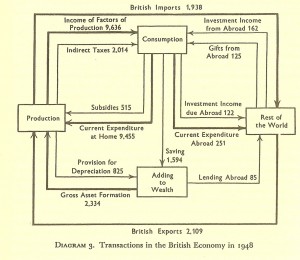
In the course of my research yesterday, I came across this from Colin Clark, in his 1940 book [amazon_link id=”B0006DB6N6″ target=”_blank” ]The Conditions of Economic Progress[/amazon_link] (via an Angus Maddison essay on Clark):

“There is room for two or three economic theorists in each generation, not more. Only men of transcendental powers of reasoning can be candidates for these positions. The rest of us should be economic scientists, content steadily to lay stone on stone in building the structure of organised knowledge”.

The scientific approach he defined as: “Careful systematisation of all observed facts, the framing of hypotheses from these facts, prediction of fresh conclusions on the basis of these hypotheses, and the testing of these conclusions against further observed facts.”

To put this another way, he argued for more inductive than deductive thinking in economics. We’ve had it the other way round, I fear.

The Conditions of Economic Progress

True transparency and clear thinking

This story about the Public Accounts Committee‘s call for public data to be made easier to use sent me to two of my favourite reference books, Edward Tufte’s [amazon_link id=”0961392142″ target=”_blank” ]The Visual Display of Quantitative Information[/amazon_link] and Howard Wainer’s [amazon_link id=”0691134057″ target=”_blank” ]Graphic Discovery: A Trout in the Milk and Other Visual Adventures[/amazon_link]. There is an apt Tufte quotation: “Good information design is clear thinking made visible, while bad design is stupidity in action.” This is just as true of words: if you don’t think clearly, you can’t write clearly. Writing that is not clear might not reflect a lack of authorial understanding, but I tend to take it as a serious possibility.

[amazon_image id=”0691134057″ link=”true” target=”_blank” size=”medium” ]Graphic Discovery: A Trout in the Milk and Other Visual Adventures[/amazon_image]

When it comes to data and the presentation of statistical analyses, what the PAC says is obviously correct in a way: true transparency involves structuring data, not sending it out in a raw torrent. On the other hand, structuring data requires a lot of time and effort, and public agencies have neither the resource nor necessarily the expertise. So beyond a certain point it is surely fine to expect somebody else to make sense of the data and present it appropriately.

However, there is surely still a gap in the market for very easy to use (and affordable) software to handle data and present it flexibly. Part of the tyranny of Powerpoint, against which Tufte rails so powerfully, is the rigidity of the graphing tools. I know there are lots of other visualisation tools available and The Guardian for one has done terrific work educating us about this, but that’s the challenge – there really are lots. Here’s another list and another of data visualization tools and another. Here’s Tableau’s free software. Lots of it out there. But nothing has become the standard to replace Powerpoint when you’re in a hurry. This is the path dependency/first mover effect in action. OK, one has to invest the time in learning new tools, but I haven’t yet found one to settle on, and don’t want to learn fifteen. No doubt somebody will tell me what an idiot I am for not having discovered the answer to my problem – I hope so!

[amazon_image id=”0961392142″ link=”true” target=”_blank” size=”medium” ]The Visual Display of Quantitative Information[/amazon_image]

Provincial radicals vs big finance

Mulling over the strangely subdued response to the Kay Review, published at the end of last week, I was browsing through a book sent to me recently by that fine social science bookseller Sean O’Donoghue of O’Donoghue Books in Hay-on-Wye. It’s [amazon_link id=”0199589089″ target=”_blank” ]After the Great Complacence: Financial Crisis and the Politics of Reform,[/amazon_link] by Ewald Engelen and colleagues at the University of Manchester’s CRESC. The essays consider how the financial sector captured the regulators before the crisis, and have a hold on regulatory and political decisions still. The story is a mix of the intellectual grip of a particular market-based view of the world, the incentives not to rock the boat created by the pre-crisis financial boom, and the sheer politics of lobbying.

Looking at these influences as barriers to post-crisis reform, the intellectual landscape has changed and continues to change, the incentives to reform finance are strong – and yet there has been scandalously little reform of either the legal and regulatory framework or the norms of behaviour in finance. That does put lobbying under the spotlight. Yesterday I found these shocking data – which look completely sound although presented in a tendentious way  – on the amount spent by financial lobbyists in the US: $1,331 per minute, every minute since 2006. And as the book notes: “If finance succeeded in blocking significant reform in either London or New York, it would nullify reform efforts elsewhere.”

The book goes on to argue that financial lobbying has been unusually effective because it has been extremely well-organized through industry bodies (in my view there is very little competition in financial markets, much tacit collusion) and has supported a persuasive storyline about the importance of the sector to the national economy.

However, UK elections are significantly less money-driven than US ones. Perhaps I’m naive, but surely at some point our politicians will appreciate the additional votes in the widespread anger people feel about the absence of contrition or behavioural change in finance, the continuing misselling scandals, the mounting evidence of fraud and money laundering? Surely?

The CRESC authors are less optimistic and conclude that even UK political parties are too dependent on corporate funding, and the City too closed an elite. It might in the end depend on “provincial radicals”, they say, citing C Wright Mills ([amazon_link id=”0195133544″ target=”_blank” ]The Power Elite[/amazon_link]); somebody with a non-elite perspective needs to persuade us all of another story. I wish them well!

[amazon_image id=”0199589089″ link=”true” target=”_blank” size=”medium” ]After the Great Complacence: Financial Crisis and the Politics of Reform[/amazon_image]

Macro, micro and meso answers to the crisis

Prompted by Mario Draghi’s decisive new tone in his recent comments, welcomed by Charles Wyplosz among others, I pulled off the shelf this morning Ben Bernanke’s [amazon_link id=”0691118205″ target=”_blank” ]Essays on the Great Depression[/amazon_link]. I was wondering what lessons from the 1920s and 1930s Mr Draghi might have in mind. The book (published in 2000) presents what had become the economics profession’s consensus that the single most important reason for the international propagation of depression was the Gold Standard. A couple of the essays pose the obvious resulting question – why was there no equilibrating real economy response to such a massive and prolonged monetary tightening? – and they present what became the consensus answer – it’s because nominal wages are sticky. But the absence of labour market adjustment and the consequent pro-cyclicality of productivity remained a ‘puzzle’ in macroeconomics for many years.

In fact, this was the subject of my doctoral thesis, at the height of the early 1980s madness of real business cycle theory. I looked at possible equilibrium explanations such as the efficiency wage hypothesis, using industry-level data. All industries turn out to behave completely differently over the course of the business cycle. It was the start of my journey from macroeconomics to micro. Meanwhile, in macroeconomics the ‘new Keynesian’ consensus took sticky nominal wages as a given.

The striking thing, though, about the Bernanke volume from 2000, and quite a lot of the discussion of the macroeconomy now, is that institutional features are largely absent from the macro policy debate. Yet perhaps the single most important lesson of the current crisis for economics is the importance of the institutions of the banking and financial sector. This is the heart of the Minsky critique of conventional models in [amazon_link id=”0071592997″ target=”_blank” ]Stablizing an Unstable Economy[/amazon_link]. The role of banking was as important in the 1930s too – see for example Benjamin Roth’s [amazon_link id=”1586489011″ target=”_blank” ]The Great Depression: A Diary.[/amazon_link] The Kay Review and the continuing Libor, money laundering and other banking scandals, are reminders that in addition to the (macro) challenge of preventing further economic slump, there is a big (microeconomic) policy challenge in market reform.

Interestingly, though, both Mr Draghi’s recent comments and Professor Wyplosz’s assessment centre on the structure of the banking sector, so the emerging attempt to stabilize the Eurozone may not be such an institution-free project. Still, the ‘meso’ layer of banking and financial markets also needs careful attention if policy makers are to get the ‘macro’ right.

[amazon_image id=”0691118205″ link=”true” target=”_blank” size=”medium” ]Essays on the Great Depression[/amazon_image]

Non-linear vision

In the moments between watching and re-watching the Olympic Opening Ceremony in the past 48 hours, I’ve been reading [amazon_link id=”0956766242″ target=”_blank” ]No Straight Lines: Making Sense of Our Non-Linear World[/amazon_link] by Alan Moore.

[amazon_image id=”0956766242″ link=”true” target=”_blank” size=”medium” ]No Straight Lines: Making Sense of Our Non-linear World[/amazon_image]

I met Alan earlier in the week to talk about the book, which is about redesigning business models taking into account both the dramatic effects of digital technologies and the multiple crises – financial, environmental, social – crashing over western economies at present. It seemed quite an apt choice of reading material, having seen Danny Boyle’s brilliant vision of a Britain socially and culturally shaped by our responses to successive technologies. This moment in time really does feel like a turning point in our collective approach to the organisation of the economy and society.

Alan Moore

Alan’s perspective as someone who has worked with many businesses over the years provides interesting examples of successful change to work on the basis of more (financially, socially, environmentally) sustainable principles, such as Yeo Valley Organic. He also looks at sectors where businesses are not adjusting well, from banking and big pharma to local newspapers. I like the way the book ranges across a huge territory, for as well as all these areas of business it also discusses health care and education. In short, it takes a systems approach, or general equilibrium as we might describe it in economics. Moore presents the current array of economic and social problems as a kind of design challenge, where what is being redesigned is the organisation of society as a whole. Insanely ambitious, but I rather like that.

His final chapter distils the lessons into six principles: be participatory; focus on craftsmanship (echoes of Richard Sennett’s [amazon_link id=”0141022094″ target=”_blank” ]The Craftsman[/amazon_link], cited here); be adaptive (Tim Harford’s [amazon_link id=”0349121516″ target=”_blank” ]Adapt[/amazon_link]); learn to live with ambiguity and uncertainty; be open, and therefore resilient; have vision.

In sum: “Imagine the impossible, then create it.” Our hero Danny Boyle would agree.

Olympics opening ceremony (photo credit: Shimelle, creative commons)