
Culture in austere times

In the evenings I’m still reading Dominic Sandbrook’s [amazon_link id=”0141032154″ target=”_blank” ]State of Emergency: Britain 1970-74[/amazon_link], a book too big to carry around on the tube (although I’d never read it on an e-reader). A passage about the resurgence in high culture against the background of an ailing economy and bitter strikes struck a chord. Sandbrook quotes David Lodge in 1971 saying there was “unprecedented cultural pluralism which allows, in all the arts, an astonishing variety of styles to flourish simultaneously.” It was a rich era for British fiction, for blockbuster exhibitions like the Tutankhamun show at the British Museum (I queued for hours as a schoolgirl to get into that), or Turner and Constable at the Tate. In classical music, the 70s brought operas by Benjamin Britten, Michael Tippett was at his peak, Harrison Birtwistle and Peter Maxwell Davies came to prominence. The Observer in 1975 commented on the mass enthusiasm for “sales of LPs, prints and paperbacks; the viewing statistics for opera, ballet and drama on television.” It added that there was a surge too in amateur dramatics, Sunday painting, community arts centres and other indicators of eagerness to participate.

[amazon_image id=”1846140315″ link=”true” target=”_blank” size=”medium” ]State of Emergency: The Way We Were: Britain, 1970-1974[/amazon_image]

The chord this struck was with an excellent book about the 1930s, Richard Overy’s [amazon_link id=”0141003251″ target=”_blank” ]The Morbid Age: Britain and the Crisis of Civilisation 1919-39[/amazon_link]. He too made the link between economic upheaval and huge enthusiasm for seriousness in the arts and books. Overy highlighted, for example,  the astonishing popular success of the Left Book Club, and political and literary publications.

[amazon_image id=”0141003251″ link=”true” target=”_blank” size=”medium” ]The Morbid Age: Britain and the Crisis of Civilisation, 1919 – 1939[/amazon_image]

Are we experiencing the same kind of phenomenon now? One aspect that stands out for me personally is the growth of huge audiences for modern dance and classical ballet – I’ve been attending performances for years, and while these were considered challenging, minority interests 20 years ago, they’re tremendously popular now. Another is the passion so many people have for serious debate – lectures and debates are packed. The Festival of Economics at the weekend was one manifestation of it. There is certainly an appetite to understand what’s happening in the world.

So, another parallel between the 1930s, the 1970s and the 2010s: a cultural revival in austere times?
Economic festivities

The UK’s first Festival of Economics in Bristol on 23-24 November was a triumph, I think it’s safe to say. Despite horrible weather affecting travel, around 1400 people attended altogether over four sessions, and the debate was fantastic: lively, informed, engaged. So already plans are underfoot for next year’s follow-up – and warmest thanks to this year’s sponsors and supporters, the Government Economic Service, the Joseph Rowntree Foundation, Princeton University Press, the Royal Economic Society and Wiley, as well as Business West and Bristol Chamber – and my huge thanks to the leading spirit of the Festival of Ideas, Andrew Kelly, who responded enthusiastically earlier this year to my tweeted suggestion that the UK needed a Festival of Economics. The videos of the event will be online shortly – I’ll update this with a link when they are. The live tweets are under the hashtag #economicsfest.

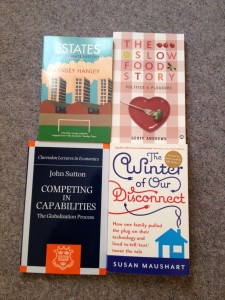
I went to Bristol with one book to give to someone and (as is the way with books) came back with four to read: [amazon_link id=”1847087027″ target=”_blank” ]Estates[/amazon_link] by Lynsey Hanley, [amazon_link id=”0745327443″ target=”_blank” ]The Slow Food Story[/amazon_link] by Geoff Andrews, [amazon_link id=”1846684641″ target=”_blank” ]The Winter of Our Disconnect[/amazon_link] by Susan Maushart and [amazon_link id=”0199274533″ target=”_blank” ]Competing in Capabilities[/amazon_link] by John Sutton. The Festival pop-up bookstore was provided by the fab Arnolfini bookshop. I think next year we need to include an Economics Cafe with some debates….

Festival books

Festival of Economics

It’s an exciting day – the kick-off of what I think is the UK’s first Festival of Economics, taking place in Bristol tonight and tomorrow. There’s a fantastic line-up, including a number of authors of excellent books. So here’s the Festival bibliography:

David Smith [amazon_link id=”1781250111″ target=”_blank” ]Free Lunch: Easily Digestible Economics[/amazon_link]

John Kay [amazon_link id=”1846682886″ target=”_blank” ]Obliquity[/amazon_link]

Larry Elliott and Dan Atkinson [amazon_link id=”0230392547″ target=”_blank” ]Going South: Why Britain Will Have A 3rd World Economy by 2014[/amazon_link]

Daniel Stedman-Jones [amazon_link id=”0691151571″ target=”_blank” ]Masters of the Universe: Hayek, Friedman and the Birth of Neoliberal Politics[/amazon_link]

Geoff Andrews [amazon_link id=”0745327443″ target=”_blank” ]The Slow Food Story: Politics and Pleasure[/amazon_link]

Lynsey Hanley [amazon_link id=”1847087027″ target=”_blank” ]Estates: An Intimate History[/amazon_link]

Vicky Pryce [amazon_link id=”184954400X” target=”_blank” ]Greekonomics: The Euro Crisis and Why Politicians Don’t Get It[/amazon_link]

Peter Marsh [amazon_link id=”0300117779″ target=”_blank” ]The New Industrial Revolution[/amazon_link]

Diane Coyle [amazon_link id=”0691156298″ target=”_blank” ]The Economics of Enough: How to Run the Economy as if the Future Matters [/amazon_link]and [amazon_link id=”1907994041″ target=”_blank” ]What’s The Use of Economics: Teaching the Dismal Science After the Crisis?[/amazon_link]

The hashtag for the events is #economicsfest and the podcasts will be online in a few days’ time.


The Social Life of Information

Browsing my shelves gently, nibbling at books, I picked up for the first time in ages [amazon_link id=”0875847625″ target=”_blank” ]The Social Life of Information[/amazon_link] by John Seely Brown and Paul Duguid (2000). I’ve loved this book for providing me with the insight, so often validated by life, that while everyone thinks computers are predictable and people are unpredictable, it’s actually the other way round.

The book is about the social context in which digital technologies are used, my preoccupation since the mid-1990s. Today I came across this passage contrasting information (which we hold and can pass around) and knowledge:

“Knowledge is something we digest rather than merely hold. It entails the knower’s understanding and some degree of commitment. Thus while one person often has conflicting information, he or she will not usually have conflicting knowledge. And while it seems quite reasonable to say, ‘I’ve got the information but I don’t understand it’, it seems less reasonable to say, ‘I know but I don’t understand’, or ‘I have the knowledge but I can’t see what it means.’” (p120)

Machines do information, knowledge needs people, they conclude.

[amazon_image id=”0875847625″ link=”true” target=”_blank” size=”medium” ]The Social Life of Information[/amazon_image]

Greek tragedy – politics, not economics

One of the books I’m currently reading, Dominic Sandbrook’s [amazon_link id=”0141032154″ target=”_blank” ]State of Emergency[/amazon_link], is too big to carry around so on the Tube I’ve read [amazon_link id=”184954400X” target=”_blank” ]Greekonomics: The Euro crisis and why politicians don’t get it[/amazon_link] by Vicky Pryce. It’s an excellent contribution to understanding the Eurozone crisis.

Pryce is Greek by origin and so has the authority to criticise her native country about its genuine faults – clientilism is one of the major issues she highlights. However, she rejects two arguments sometimes heard: that the Greeks are to blame for the crisis because they’re lazy and expected to consume without producing; and that the Euro crisis is all the fault of the peripheral indebted nations – Portugal, Ireland and Spain as well. She writes: “While the political, administrative and judicial systems in Greece are dysfunctional, there is potential in sectors of the economy which could be harnessed to drive a more prosperous future.”

In fact, politics is the major theme of the book: it argues that the Euro’s creation was a political project not rooted in sound economic analysis. The initial hubris involved in launching the single currency was followed by a failure to either plan for the inevitable tensions or crises, and total failure to enforce and implement the structural reforms that might have made the Eurozone economically viable. She makes a forceful case. Before the Euro was launched, while seeing it as mainly a political project, I thought the macroeconomic inflexibility it involved would be more than offset by supply-side improvements, including the achievement of a genuine single market without currency barriers. This optimism was obviously misplaced. Indeed, we are still seeing in the crisis countries how hard it is politically to deliver structural economic reforms.

What to do next? Pryce argues, first, that European leaders need to recognise that if Greece leaves, the Euro itself will collapse, at huge economic cost. And, secondly, that a large chunk of the peripheral country debts will have to be written off. Germany cannot avoid either accepting partial default or the collapse of the Euro. However, she is optimistic about the scope for continuing progress on productivity in Greece.

No doubt some readers will disagree with parts (or all) of her analysis, but the book sets out the debate very readably, and underlines the links between the political and the economic forces at play –  links everybody overlooked in those long-ago pre-crisis years.

[amazon_image id=”184954400X” link=”true” target=”_blank” size=”medium” ]Greekonomics: The Euro crisis and why politicians don’t get it[/amazon_image]