
Which way to the future?

I’ve enjoyed reading Bernard Carlson’s [amazon_link id=”0691165610″ target=”_blank” ]Tesla: Inventor of the Electrical Age[/amazon_link] (although, as I confessed, skipping over the physics). How exhilarating to read about the exceitement as thousands of people crammed into lecture halls to hear Tesla speak about his discoveries. “The demand for seats was so great that tickets were being scalped outside the hall for three to five dollars,” Carlson writes of an 1893 lecture in St Louis (that’s $80-130 in today’s dollars).

[amazon_image id=”0691165610″ link=”true” target=”_blank” size=”medium” ]Tesla: Inventor of the Electrical Age[/amazon_image]

The book is particularly interesting on the lack of form and direction in the early stages of commercial development of a new technology. Standards had not been agreed. Different technical approaches seemed equally viable. Companies were forming – and going into receivership – and the investment risk was substantial. Rich investors (hello J.P.Morgan) were trying to corner new markets. Patent litigation was common.Tough choices had to be made between promoting ideas and licensing the patents versus holding patents and going into manufacturing.

In this confusion, sober analysis was insufficient to make technical and financial choices. What Carlson calls ‘illusion’, the building of sufficient belief in a single path to the future, was critical: “We need to understand and appreciate how inventors and entrepreneurs forge relationships that foster a balance between imagination and analysis.” The inventor has to inspire his (or her) backer, the businessman has to keep the creative genius grounded (no pun intended). One could see it as creating the focal point in a game with many possible outcomes, and hence sometimes the phenomenon of [amazon_link id=”0141031638″ target=”_blank” ]lock-in[/amazon_link] to what might be not the best technical outcome.

So, a fascinating read on the early development of an important new technology, as well as an extraordinary character. As the book observes, there was always a kind of minority interest in Tesla, a real maverick; but he deserves this fine biography.
Statistics in a disordered world

I’m writing about GDP in particular and economic statistics in general again – can’t keep off the subject (& by the way, [amazon_link id=”0691169853″ target=”_blank” ]GDP[/amazon_link] is out now in paperback!) Today I picked up Adam Tooze’s marvellous 2001 book [amazon_link id=”0521039126″ target=”_blank” ]Statistics and the German State 1900-1945[/amazon_link]: “This book … has sought to portray the construction of a modern system of economic statistics as a complex and contested process of social engineering … A functioning statistical system … implied a particular model of political order and in particular a vision of the relationship between state and civil society.”

The national accounts framework in place today is a modernist project. Like so many of these, it is being unravelled in unpredictable ways by technology, globalisation, and the changing character of the state. My writing task today is responding to the call for evidence on the current Review of Economic Statistics. It’s a tall order to say something succinct about getting from the categorisation of the world coded into current statistics to something closer to (disordered) realities, especially when there is an important element of performativity in statistical categories.

[amazon_image id=”0521039126″ link=”true” target=”_blank” size=”medium” ]Statistics and the German State, 1900-1945: The Making of Modern Economic Knowledge (Cambridge Studies in Modern Economic History)[/amazon_image]   [amazon_image id=”0691169853″ link=”true” target=”_blank” size=”medium” ]GDP: A Brief but Affectionate History[/amazon_image]

Big blue plenty

Courtesy of the terrific weekly newsletter from Benedict Evans, this link to a terrific article about Krushchev’s 1959 visit to IBM in what later became Silicon Valley. This is a good excuse to plug again one of my favourite books, [amazon_link id=”0571225241″ target=”_blank” ]Red Plenty[/amazon_link] by Francis Spufford. The book also has a supplementary website with some fascinating short essays by the author – like this one on ‘plenty’ or (lack of) [amazon_link id=”0691156298″ target=”_blank” ]enoughness[/amazon_link].

Among the many reasons I love [amazon_link id=”0571225233″ target=”_blank” ]Red Plenty[/amazon_link] is that it must be the first time a literary author has been able to describe the formal equivalence between a competitive general equilibrium and a centrally planned economy, as set out in the socialist calculation debate of the 1930s. Anyway, the book starts with Krushchev’s 1959 US visit, although not his admiration of the cornucopia of food and democratic access in the IBM cafeteria in San Jose. It is a gripping read, a true story told with the verve of a novel.

[amazon_image id=”0571225241″ link=”true” target=”_blank” size=”medium” ]Red Plenty[/amazon_image]

Not the end of history, again

This morning I picked up Tony Judt’s brilliant 2005 book [amazon_link id=”009954203X” target=”_blank” ]Postwar, a history of Europe since 1945[/amazon_link]. He wrote in the Introduction:

“An era was over and a new Europe was being born. … What had once seemed permanent and somehow inevitable would take on a more transient air. … Europe’s future would look very different – and so too would its past.”

[amazon_image id=”009954203X” link=”true” target=”_blank” size=”medium” ]Postwar: A History of Europe Since 1945[/amazon_image]

Until re-reading this passage, I had forgotten that Austria did not join the EU until 1995, and that in 1999 Jorg Haider and his “Freedom Party” won 27 per cent of the vote.

Judt continues, explaining the roots of the 2nd World War in the 1st, “The little countries that emerged from the collapse of the old land empires in 1918 were poor, unstable, insecure – and resentful of their neighbours.” It is only 20 years since the last, dreadful & bitter, Balkans conflict.

I do hope that somewhere in Europe there are political leaders reflecting on this past rather than obsessing about what the latest opinion polling tells them about popular attitudes to migrants. Century-old resentments and suspicions are not far below the surface; keeping them in their place is an unfinished, probably permanent, task.

Investing in electric dreams

I’ve got some way into Bernard Carlson’s book [amazon_link id=”0691165610″ target=”_blank” ]Tesla: Inventor of the Electrical Age, [/amazon_link]which is out in paperback now. It’s very interesting, although the physics washes over me. The difference between a rotor, a stator, a transformer and a conductor? It just doesn’t stick. It must be like this for non-economists reading about economics. Anyway, the terms make sense once if you concentrate really hard but then just evaporate from the mind.

[amazon_image id=”0691165610″ link=”true” target=”_blank” size=”medium” ]Tesla: Inventor of the Electrical Age[/amazon_image]

On the other hand, I’m finding the depiction of the early electrical industry in the US and Europe very interesting – the fierce competition, patenting of different approaches, seriously risky capital investment, the uncertainty over what would emerge as an industry standard, the dastardliness of some rich investors, the works.

One chapter describes Tesla’s early investors and how they got interested in electricity. One had started with a telegraph line between Washington DC and Chicago: “Peck discovered that there were banks and merchants who were interested in leasing dedicated wires in order to conduct their business securely.” So, as now, the finance industry was a big customer of the new technologies.

I also liked this parallel with modern times: Tesla persuaded his investors to provide more funds with a demo involving spinning an egg on its pointy end on a wooden table thanks to some electrical whatevs underneath. They loved it. “This episode taught Tesla that invention would require a degree of showmanship in order to create the right illusions about his creations. People do not invest in inventions built out of tin cans; they invest in projects that capture their imagination.”

And, to my delight in these early chapters, Tesla turns out to have got his start at the Ganz electrical works in Budapest. I visited the factory in early 1990, when it took immediate advantage of the collapse of communism to look for western investors, and hired a stockbroker from London who took some journalists (including me) on a trip. It was fascinating. The managing director’s secretary had the only key to the cupboard in which the toilet paper was kept so she knew exactly when everybody in the party had to go – clearly a powerful woman in the enterprise. The factory itself was ginormous and took in steel, ore and coal at one end and turned out trams and ligh bulbs at the other end. Spectacular. Monstroously inefficient.

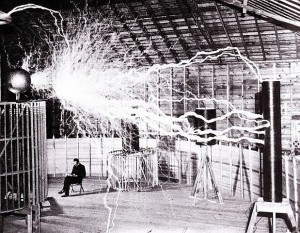
I’m 4 chapters in. Have always loved this image of Tesla.

Nikola Tesla

Nikola Tesla