Robots, humans and other animals

John Markoff’s [amazon_link id=”0062266683″ target=”_blank” ]Machines of Loving Grace: The Quest for Common Ground Between Humans and Robots[/amazon_link] ends with a reference to Thorstein Veblen’s [amazon_link id=”123033128X” target=”_blank” ]The Engineers and the Price System[/amazon_link] (not a book I’ve read – I’ve always found Veblen really heavy going). Apparently Veblen argued that the increasing technological complexity of society would give political power to the engineers. Markoff draws the analogy with the central role of algorithms in modern life: “Today the engineers who are designing the artificial intelligence-based prorams and robots will have tremendous influence over how we use them.”

[amazon_image id=”0062266683″ link=”true” target=”_blank” size=”medium” ]Machines of Loving Grace: The Quest for Common Ground Between Humans and Robots[/amazon_image]  [amazon_image id=”1614273707″ link=”true” target=”_blank” size=”medium” ]The Engineers and the Price System[/amazon_image]

[amazon_link id=”0062266683″ target=”_blank” ]Machines of Loving Grace[/amazon_link] is a history of the tension between artificial intelligence (AI) research, which substitutes robots for human activity, and ‘intelligence augmentation’ (IA) complementing human skills. It is also a call for those engineers to ensure their work is human-centred. It’s all about the humans, not about the machines, Markoff concludes. The book dismisses what he calls the ‘Apocalyptic AI’ tradition embraced by people like Ray Kurzweil and Hans Moravec, looking forward to the Singularity, the [amazon_link id=”1503262421″ target=”_blank” ]Frankenstein[/amazon_link] moment when our machine intelligence creation becomes conscious and alive. Yet Markoff worries about the failure of the ‘AI’ (rather than ‘IA’) researchers to stay alert to the dangers of not writing people into the algorithmic script.

[amazon_image id=”0141439475″ link=”true” target=”_blank” size=”medium” ]Frankenstein: Or, the Modern Prometheus (Penguin Classics)[/amazon_image]  [amazon_image id=”1614275025″ link=”true” target=”_blank” size=”medium” ]Cybernetics: Second Edition: Or the Control and Communication in the Animal and the Machine[/amazon_image]  [amazon_image id=”0691168423″ link=”true” target=”_blank” size=”medium” ]The Butterfly Defect: How Globalization Creates Systemic Risks, and What to Do about It[/amazon_image]

The danger has always been apparent. Norbert Wiener’s [amazon_link id=”1614275025″ target=”_blank” ]Cybernetics[/amazon_link], “Posed an early critique of the arrival of machine intelligence: the danger of passing decisions on to systems that, incapable of thinking abstractly, would make decisions in purely utilitarian terms rather than in consideration of richer human values.” (A comment that struck me because economics is of course purely utilitarian and notorious for setting the ‘richer human values’ aside.) Another danger is pointed out later in the book, attributed here to Alan Kay: that relying on machines, “Might only recapitulate the problem the Romans faced by letting their Greek slaves do their thinking for them. Before long, those in power were able to think independently. ” Markoff cites evidence that reliance on GSP is eroding memory and spatial reasoning. There is also, surely, the problem Ian Goldin underlines in his book [amazon_link id=”B00SLUBSJ8″ target=”_blank” ]The Butterfly Defect[/amazon_link]: that greater reliance on complex networks means greater vulnerability when they go wrong, or are attacked.

[amazon_image id=”B00IIB2CUY” link=”true” target=”_blank” size=”medium” ]The Coming Of Post-industrial Society (Harper Colophon Books) by Bell, Daniel (1976) Paperback[/amazon_image]

To go back to the Veblen point, his was a political argument in the Progressive era. Accumulations of political power, via ownership of assets including technology and skills, always trigger political struggles. Daniel Bell made a similar point in [amazon_link id=”B00IIB2CUY” target=”_blank” ]The Coming of Post-Industrial Society[/amazon_link] – that the political faultline of the post-industrial age would be technocratic expertise versus populist demands. Perhaps he was too early: we seem to be deep into a populist backlash against the technologists right now. But for me the question isn’t so much whether the robots are human-friendly as whether the political and economic structures within which technological advance occurs are human-friendly. It isn’t looking promising.

Anyone prompted to mull over the question of what makes a silicon-based non-human being intelligent should read this wonderful article about carbon-based non-human intelligence. If it’s ever a case of us against the machines, we’ll have the dogs, dolphins and chimpanzees on our side.

Of robots and dogs

I’m part way through [amazon_link id=”0062266683″ target=”_blank” ]Machines of Loving Grace[/amazon_link] by John Markoff, which is about whether ‘robots’ spell automation (substitutes for humans) or augmentation (complements to humans), and the history of the tension within the field of AI between these strands. A review will follow in a couple of days. But one sentence early in the book stopped me short:

“Humans appear to want to believe they are interacting with humans even when they are conversing with machines. We are hardwired for social interaction.” [my italics]

[amazon_image id=”0062266683″ link=”true” target=”_blank” size=”medium” ]Machines of Loving Grace: The Quest for Common Ground Between Humans and Robots[/amazon_image]

So given that we are building the machines, why can’t we hardwire them for social interaction too? I want Siri to love me as much as my dog loves me – and is inclined to love other humans apart from the postman.

Dog of loving grace

Dog of loving grace

Complements and substitutes

I spotted some tweets this morning about increases in the sales of physical media, including books.

MaxCRoser
Print books are on the rise again 571 million paper books have been sold in the US in 2015 https://t.co/1KcL5lApE6 https://t.co/eYYt5zE8cU
21/12/2015 09:18
robertcottrell
Book sales rising; biggest movie opening ever; fastest album sales ever, WaPo doing OK. We owe the internet an apology.
21/12/2015 08:21

These developments seem to overturn the narrative of ever-greater cannibalisation by online consumption.

But that narrative assumes physical and digital versions are always substitutes for each other, when there is no a priori reason to think that substitutability is boundless. The same substitution assumption was made about telephones when they first spread, but the empirical evidence seems to be that telephone and face-to-face contact might have become complements for each other rather than substitutes. The easier it became to arrange to meet someone in person, the more often it happened.

This is unlikely to be true for all physical media. While it is easy to see how reading part of a book online, or an article about a book, could start to increase physical sales, or how listening to music online can stimulate concert-going and maybe CD buying (even LPs!), it is less obviously true about newspapers, say. I don’t want to be all Pollyanna about this – and Anita Elberse’s [amazon_link id=”0805094334″ target=”_blank” ]Blockbusters[/amazon_link] for one provides some of the gloomier evidence about the effect of the switch to digital on most content suppliers even if the aggregate figures look healthy.

But the moral is, at least be aware of what you assume about substitutes and complements when predicting the future impact of digital; if you haven’t thought about it, you’ve still made an assumption. It might be wrong.

[amazon_image id=”0571309224″ link=”true” target=”_blank” size=”medium” ]Blockbusters: Why Big Hits – and Big Risks – are the Future of the Entertainment Business[/amazon_image]

The rhetoric of economics, ctd.

From [amazon_link id=”0521094461″ target=”_blank” ]Theoretical Welfare Economics[/amazon_link] by J De V Graaff: “On the one hand, it could be argued that the term ‘real national income’ is a mere definition, devoid of normative significance. … On the other hand, it could be objected that ‘the real national income’ is an emotive expression; and to say it has increased in to imply that the state of affairs thus described is approved or is in some sense thought to be good or desirable.”

He argues – and I wholeheartedly agree – that we should use the terminology as people normally understand it, with its normative connotation, and not like economists insisting that all that [amazon_link id=”0691169853″ target=”_blank” ]GDP[/amazon_link] measures is what it is defined to include.

[amazon_image id=”0521094461″ link=”true” target=”_blank” size=”medium” ]Theoretical Welfare Economics[/amazon_image]

Cotton, empire and mill workers

I finished reading Sven Beckert’s prize-winning [amazon_link id=”0141979984″ target=”_blank” ]Empire of Cotton: A new history of global capitalism[/amazon_link] in Cottonopolis, aka Manchester. I grew up in Lancashire in a family many of whose members worked in the cotton mills. The noise and hot greasy, dusty smell of the mills was part of my childhood. At school we were taught that we had been the cradle of the Industrial Revolution: John Kay, Richard Arkwright, Samuel Crompton, created their inventions just down the road. In Lincoln Square in Manchester stands a statue of Abraham Lincoln, a recognition of the support Lancashire mill workers had given to the Union side in the American Civil War, even though the blockade of southern ports created the ‘cotton famine’ that was the source of the great hardship they were experiencing.

[amazon_image id=”0141979984″ link=”true” target=”_blank” size=”medium” ]Empire of Cotton: A New History of Global Capitalism[/amazon_image]

Not surprisingly, I’ve been immensely looking forward to reading [amazon_link id=”0141979984″ target=”_blank” ]Empire of Cotton[/amazon_link], saving it as a treat. And although I enjoyed reading it, it also left me very uneasy. The book wraps a huge amount of fascinating detail and insight around a single unwavering theme: that ‘war capitalism’, the violence of empire and slavery and thus the creation of a global trade with protected markets, made possible industrial capitalism. Now, I’m no imperialist, and there’s no question about the horrors of the slave trade – and the riches it created in the UK. David Olusoga’s recent BBC TV series about the UCL project on the legacy of British slave ownership highlighted the foundational importance of slavery for the UK’s 19th century prosperity, despite abolition. Even so, I distrusted the book. In 441 pages of great detail, was there really no room to mention those Lancashire mill hands? It isn’t an unknown story: Radio 4’s In Our Time had a fabulous episode on it earlier this year. Yet the book’s chapter on the cotton famine speaks only of ‘Manchester’ as a solo voice and its concern about the Union blockade. Life – and history – are more complicated than a [amazon_link id=”0415304458″ target=”_blank” ]Rosa Luxemburg[/amazon_link]-like frame with no room for anything that clouds the simplicity of an argument.

But this is – well, more than a quibble, just not enough to have stopped me enjoying the book. Three points were particularly interesting.

First was the analysis of the interaction between the labour-intensive upstream production and the capital-intensive downstream production, and how the technological practicalities shaped the organisation of processing, manufacture and trade. Although cotton is probably now the lowest profile industry of the industrial revolution, [amazon_link id=”B00PYY1AQU” target=”_blank” ]Empire of Cotton [/amazon_link]makes a persuasive case that it was the most powerful driver of globalised industrial capitalism – global precisely because of the differing production technologies along the supply chain.

Second is the emphasis on the interaction between private interests and the state, and the prevalence of the same kind of argument we still hear from industrialists who talk about the importance of free trade and yet constantly lobby the government to shape taxation, infrastructure, trade rules etc in their interests. The American Civil War prompted much British investment in Indian infrastructure, for example, as cotton manufacturers successfully lobbied for government assistance to create new sources of their raw material. More generally, the book quite rightly underlines the joint innovation of technologies, the organisation of production and trade, and financial and social institutional innovations.

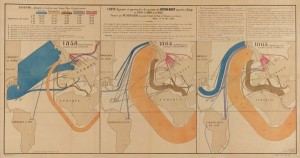
Minard's infographic on the flows of raw cotton imports showing the effect of the Civil War

Minard’s infographic on the flows of raw cotton imports showing the effect of the Civil War

Third – and this is a truly nerdy point – I found fascinating the role of standardisation (of types and qualities of cotton) as the trade grew. In the early stages of the rise of cotton, the gathering of detailed information was a source of competitive advantage. Over time, places that collected information, and then provided it in standardised form, became central to the business. Liverpool was the centre of both physical and informational trade in the UK; in the US, although the South grew the cotton, New York became the hub. Ultimately, US standards dominated: in 1923 the Cotton Standards Act made it illegal to use anything but American standards in interstate or foreign commerce, so they became global standards. “The state also became an important supplier of statistics that made the market more legible, rendering much less central the sophisticated networks of information gathering and exchange that merchants had forged…. The state, centrally concerned with the reliable flow of inexpensive raw materials into the vortex of manufacturing enterprises, now quite literally made the market.”

So, I agree with some of Beckert’s argument and do recommend reading [amazon_link id=”0141979984″ target=”_blank” ]Empire of Cotton,[/amazon_link] – but with a large pinch of scepticism.

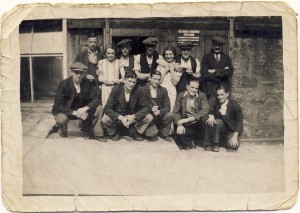
Joseph Coyle (far right, front, aged 14 with his workmates at the Old Ground Mill in Ramsbottom, Lancashire.

Joseph Coyle (far right, front, aged 14 with his workmates at the Old Ground Mill in Ramsbottom, Lancashire.