
State, market – and community

Raghuram Rajan is best known for publicly warning of an impending financial crisis in August 2005, at the annual Jackson Hole conference, for which he was mocked by some of the big names present. He then wrote one of the best books about the underlying causes of the crisis, Fault Lines, still well worth reading. Subsequently he was the highly respected central bank governor of India. Not surprisingly, I was very much looking forward to his new book, The Third Pillar: How Markets and the State Leave the Community Behind. The subtitle says it all, and I couldn’t agree more. There is a false dichotomy in much public debate, the claim that organising the economy is a matter of either the state or the market, whereas it is impossible to disentangle the two. But more than this, other non-market, non-state institutions are part of the economic system too. This includes businesses – as Herb Simon once pointed out – but also the kind of institutions Rajan considers in this book, civic and above all local organisations responding to specific local need.

He opens by stating: “In my adult life, I have never been more concerned about the direction our leaders are taking us than I am today.” Surely this sense that capitalism and liberal democracy are fundamentally broken is widespread. The argument here is that part of the solution is to recognise the importance of the neighbourhood and include it as part of the balance of a mixed economy. In a sense community and market are at different ends of a spectrum – from personal relationships to anonymity, Gemeinschaft and Gesellschaft. Rajan argues for some decisions to be taken at the level of the community, rather than the remoter processes of market and state.

The first part of the book is a concise historical survey looking at the emergence of the state and the market. The second part turns to the context of modern capitalism, driven toward the goal of shareholder value maximisation, and fuelled by technological innovation and automation. Rajan is highly critical of the shareholder value mantra – and it’s interesting to see a growing chorus of criticism of Milton Friedman’s toxic contribution to capitalism, such as Colin Mayer’s recent Prosperity. Rajan points out: “When an enormous source of independent power, the private sector, is passive or, worse, rendered suspect in the eyes of the community because its every action has to be in pursuit of corporate profits, there are fewer checks on the arbitrary power of the state.” He argues that the “enormous gamble” states took in the early years of the 21st century – that borrowing in deregulated financial markets would be the source of broad-based sustainable growth – utterly failed. Populism is thus the legacy of the financial crisis.

The book then considers some of the manifestations of the failed gamble, and this echoes a now sadly all too familiary genre studying the decline of communities around all the western economies, such as Janesville and The Unwinding. Rajan advocates the devolution of power, “from the international sphere to nations, and within nations from the federal to the regional to the community level.” The Third Pillar needs to be reinvigorated. There needs to be more scope for people to fill in gaps left by formal economic structures, to experiment with structures of political and economic governance, to create meaningful, non-market local work. I agree with this, again, but the book wisely accepts that this is not easy and local success will be slow. There is a bootstrapping process to get localities onto a virtous circle.

Rajan does not offer specific proposals, and in a way could not because it’s in the nature of local solutions not to be easy to generalise. It would be well worth trying to understand more systematically what kinds of decisions are best taken at what level of governance – as far as I know there is relatively little social science on this, although it’s easy enough to see that, say, climate change policy or digital competition policy needs international co-operation, whereas public services could be far more devolved and differentiated. The issue of Victorian institutional innovation also intrigues me: among the responses to the Industrial Revolution were the emergence of trade unions, mutual savings societies, working men’s literary and philosophical clubs, co-operatives…. is there any comparable social innovation today, and is anybody tracking it and sharing the lessons?

The Third Pillar is published in a couple of weeks, available for pre-order now. It’s author was very right in 2007. He’s very right again now.

[amazon_link asins=’0008276269′ template=’ProductAd’ store=’enlighteconom-21′ marketplace=’UK’ link_id=’e6be7204-05d0-47f3-a2f4-beb8cffcccfe’]
Truth and lies

I’m late to Bad Blood: Secrets and Lies in a Silicon Valley Startup, John Carreyrou’s gripping tale about the Theranos scandal. It takes courage to be a whistleblower anywhere, but particularly so in the US where rich people can buy corrupt lawyers and ruin the tellers of truth. The truth behind the rise of Theranos is utterly shocking. One reason is the total absence of morality on the part of Elizabeth Holmes, the Steve Jobs-wannabee CEO, from lying to investors, through bullying staff (and others), to putting patients at risk through blood tests that clearly did not work and delivered false results.   As Carreyrou concludes, one can’t be sure that Elizabeth Holmes is a sociopath, but…. it certainly is hard to understand what she thought she was doing on any other hypothesis.

The other shocker is how many very intelligent and experienced people were misled by the confection of lies Holmes and her lover/deputy Sunny Balwani constructed. She did cost many experienced investors many millions of dollars and lured many big names on to her board. All were swift to defend her when the truth began to trickle out and slow to accept how comprehensively she had duped them. After all, the truth was going to make them lose a lot of money.

The book is a terrific read but I found it rather sobering to realise how easy it is for liars to thrive, and how much rests on the shoulders of the courageous few. So hats off to the whistleblowers who spoke to Carreyrou and the doctors who helped him uncover the false blood test results, and even to Rupert Murdoch who let the Wall Street Journal run the stories even though he stood to lose his investment in Theranos. This is a cautionary tale for our times when so many people so badly want to believe in tech miracles, and there’s a lot of money swishing around looking for unicorn-style returns.

[amazon_link asins=’1509868062′ template=’ProductAd’ store=’enlighteconom-21′ marketplace=’UK’ link_id=’3f9faac5-e719-4021-9c69-adbd685725fa’]

Nudging people to be free

I read Cass Sunstein’s latest, On Freedom, while on the train today. It’s both slim and small – just over 100 passport sized pages – so the argument is pretty straightforward. Sunstein is addressing the ‘libertarian paternalism’ critique of nudging. His argument is that suitable choice architecture makes people more, rather than less, free. The book points to earlier responses, such as the fact that there has to be a default so why not use a better one than the status quo? There is always a design. If advertisers are constantly nudging people to eat junk food, why would you *not* want the authorities to nudge in the other direction.

The new element here is the argument that freedom of choice is meaningless without navigation aids: “Freedom of choice is important, even critical, but it is undermined or even destroyed if life cannot be navigated.” His analogy is GPS: people can choose where they want to go but should be helped find the most straightforward route. Freedom needs to be actionable. I was surprised the book didn’t pick up on the attention scarcity point so eloquently set out in Mullanaithan and Shafir’s book Scarcity; it would have been another strand to the argument.

I’m one of those made uneasy by the trend towards nudging, not being sure I do want my government treating me like one of the recipients of an advertising exec’s wiles. One chapter in On Freedom considers the prospect that preferences are endogenous and can be determined by nudges. “After being nudged, they will be happy and even grateful.” This is a highly counter-productive argument for me. Yet I see the strength of some pro-nudge arguments too. Anyway, this book is a very clear and by construction concise case for nudges as freedom.

[amazon_link asins=’B07JD9TDY2′ template=’ProductAd’ store=’enlighteconom-21′ marketplace=’UK’ link_id=’ec8577ed-96ee-4305-ac73-236b1a1c4d74′]

The importance of small decisions

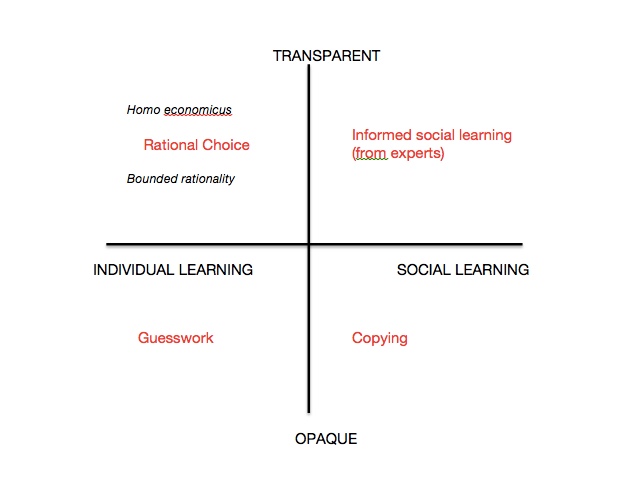
The importance of small decisions (by M O’Brien, A Bentley and W Brock) is a neat little primer on an evolutionary approach to decision theory. I read it under the influence of severe jet lag and so nothing at all should be read into the fact that I find it hard to summarise the argument – there’s also an awful lot of explanation by way of analogy to American football, which doesn’t help me at all. My takeaway is the title, plus this very neat diagram putting decision making modes into four quadrants separated along the dimensions transparent/opaque and individual learning/social learning:

      Quadrants

It’s a short book so anyone whose interest is piqued will find it easy to read (sporting analogies aside).

[amazon_link asins=’0262039745′ template=’ProductAd’ store=’enlighteconom-21′ marketplace=’UK’ link_id=’1ccd5cd0-b34d-4dc2-9f55-2058015524c3′]

The globots are coming

Richard Baldwin’s latest book, The Globotics Revolution, is a terrific primer on two trends promising to disrupt the world of middle class work in the rich economies. One is competition from ‘Remote Intelligence’ or in other words a tidal wave of talent in countries such as China and India increasingly well able to compete with better-paid professionals in the OECD. The other is comptition from AI, increasingly well able to compete with etc etc. Combine more globalisation and robotics and you get the ‘globotics’ of the title (a terrible word, but never mind). The book argues that the combination is something new and significant in scale, more than just a bit more of existing trends.

The bulk of the book considers each of the two elements in turn, providing excellent, accessible summaries of the economic research and the projections of the likely impact on work. Some of the forces identified may not manifest as fast as expected –  the spread of autonomous vehicles, for instance. The book is also more gung-ho about the continuation of Moore’s Law than many others who pay close attention to the computer industry.

I’m also a little sceptical about the extent to which remote workers will substitute for highly paid professionals, mainly because there is something separately valuable in the know how and experience gained from face to face contact in specific places. With hindsight, it was a mistake for so much manufacturing to be offshored because of loss of engineering know how (see for example this great article by Gregory Tassey); this will be truer in services. Mancur Olson’s point in Big Bills Left on the Sidewalk – that an immigrant to a rich country from a poor one becomes more productive overnight because of the social and physical capital around them in their new environment – applies.

Even so, the bottom line is that job disruption at the lesser and slower end of the range of possibilities will still have a profound impact on people’s livelihoods. We should be getting prepared. Baldwin argues that there is no mystery about the policies needed. He argues for Denmark-style flexicurity, with ease of being fired compensated by significant transitional funding and training – or even for slowing down the pace of change by making it harder to fire people (despite the evidence this contributes to high unemployment rates). With the need to prepare – and to implement far more effective policies than was the case in the earlier phases of deindustrialisation and automation – it’s surely impossible to disagree.

The book ends on an oddly positive note, given the jobs-ocalypse it predicts: “I am optimistic about the long run.” In the very long term it forsees an economy where the things machines (and I guess offshore workers) cannot do: more local, more human and more prosperous (thanks, robots!) society. “Our work lives will be filled with far more caring, sharing, understanding, creating, empathizing, innovating and managing …. The sense of belonging to a community will rise and people will support each other.” This is wonderfully upbeat, a world where machines do all the drudge work and humans brew craft beer and care for each other. It’s hard to see how to get there from today’s fractious world where the absence of a sense of community is pretty manifest in many places and only the few can afford the craft beer. I hope he’s right, though.

Agree with the book’s rosy long-term vision or not, it’s a thorough introduction to the economic debates about globalization and automation, and the forces that are going to change our world in the next few decades, populist backlask or no.

[amazon_link asins=’B07FMJXTC9′ template=’ProductAd’ store=’enlighteconom-21′ marketplace=’UK’ link_id=’17a1291f-184a-4bb1-ab19-cf48d1294522′]