Happiness? Bah, humbug!

Human emotions are elusive, easy to recognise but hard to define and harder still to command. So why are so many economists and politicians convinced they can and should deliver on a happiness target?

A new collection of essays from the Institute of Economic Affairs, [amazon_link id=”0255366566″ target=”_blank” ]….and the Pursuit of Happiness[/amazon_link], edited by Philip Booth, has a valiant attempt at derailing the happiness policy bandwagon, although I suspect it is just too fashionable and appealing in these anxious times to knock off the tracks. It makes an interesting contrast to a book by a dear friend of mine, Henry Stewart, [amazon_link id=”0956198619″ target=”_blank” ]the happy manifesto[/amazon_link]. Henry runs Happy Computers, which is certainly where I would want to work if I were not my own boss, and is a stalwart of the campaign Action for Happiness.

One of the things that bugs me about the happiness business is that the campaign is based on a statistical error, one that has now been pointed out by many people (including Paul Ormerod, and Betsey Stevenson and Justin Wolfers, who have essays in the IEA volume, and again this week by Stefan Bergheim of the Zentrum für gesellschaftlichen Fortschritt (there’s a link to his slides here). The origin of the idea that there’s no link between the level of GDP and happiness is Richard Easterlin’s original observation that although within any country rich people reported themselves to be happier than poor people, and average happiness levels were higher in rich countries than poor ones, happiness did not keep pace with GDP in any individual country over time. Therefore, many people concluded, economic growth doesn’t bring happiness. Forget growth! Forget economics!

But happiness is reported on an index running from 1 to 3 or 1 to 10 and can never get above the top of that scale. GDP can increase without limit. There will never be a statistical correlation between the two over time just because of the way the statistics are constructed. The absence of correlation between the two time series therefore has no economic meaning. Look instead at GDP growth (not its level), and this is correlated with happiness.

Does this matter? Yes. Happiness studies certainly offer some important findings. For example, mental health is greatly under-resourced in our health system, and changing that would significantly contribute to well-being. As Henry’s happy manifesto advises, the happiness perspective can make businesses better-managed and more productive. I would commend the advice he offers in this delightful book to anybody running a business, large or small.

However, the well-being agenda at the aggregate level is diverting attention from the important policy priority of enabling growth and employment. A job is the most fundamental contributor to happiness – it gives people meaning and social relations as well as an income (if it is a paid job rather than unpaid care or home-working). Given population and productivity growth, the UK economy needs to grow by about 2.5% a year to keep employment levels where they are. GDP growth is about zero currently. What’s more, as Pedro Schwartz explains in the IEA book, the utilitarianism and psychology underpinning the happiness bandwagon bring some philosophical problems. To give just one example, if poor people in a developing country report themselves to be as happy as, say, the French, on average, what is the justification for anti-poverty policies and aid? Why bother?

As readers of my book [amazon_link id=”0691145180″ target=”_blank” ]The Economics of Enough[/amazon_link] will know, I strongly favour using other indicators as well as GDP, but I would really prefer it if the government and statisticians were not faffing about measuring well-being and telling me to be happy. Stick to the knitting – deliver the jobs, and yes, resource mental health services, cut commuting times, keep down noise and other pollution levels, the things we do know people care about. Leave happiness where it belongs, in the hearts of individuals, including fabulous bosses like Henry Stewart.

[amazon_image id=”0956198619″ link=”true” target=”_blank” size=”medium” ]The Happy Manifesto: Make Your Organisation a Great Workplace – Now![/amazon_image]

Sir Samuel Brittan has reviewed the IEA volume in the FT today. As he points out, the government in Aldous Huxley’s [amazon_link id=”0099518473″ target=”_blank” ]Brave New World [/amazon_link]fed happiness pills to the population, and we consider that a dystopia…..

Working class heroes

My esteemed chairman (of the BBC Trust), Lord Patten, gave a marvellous speech at the Oxford Media Convention today. Do read it – Is the BBC as good as it can be? –  if you have an interest. A large part of the speech is about respecting the seriousness and ambition of audiences. As he expressed it: “I remain unashamedly of the view that introducing people to good books, great paintings, or beautiful music – allowing them to better pursue and appreciate their passions and interests – helps to enrich them as individuals and to improve the quality of civic life for all of us.”

Lord P cited a book I absolutely loved, Jonathan Rose’s [amazon_link id=”0300098081″ target=”_blank” ]The Intellectual Life of the British Working Classes[/amazon_link].The book traces the rise – and decline since the mid-20th century – of the strong auto-didactic tradition among working people, including the role played by the BBC. As Lord P notes, the BBC’s Third Programme was fiercely and intentionally elitist, making no concessions to middlebrow listeners (as the snobbish Virginia Woolf characterised them). Yet a third of the audience in the first week consisted of working class listeners, and  by 1949 21% of working class audiences had listened to it (compared with 63% of the middle classes). (P437, 2002 paperback edition.) Similarly, Wilfred Pickles successfully broadcast poetry on his Light Programme show, The Pleasure’s Mine, despite being advised by more elitist types that it would never work (p195).

As for news, in January 1938 the BBC found that 60% of working class listeners regularly tuned in to the 6pm news, compared with 54% of middle class listeners. Rose writes that the BBC’s newscasts: “Made political discourse intelligible to the under-educated, something that ‘quality’ newspapers, weekly reviews, and most statesmen failed to do.” He gives the example of a 1939 speech by Labour politician Herbert Morrison, a populist who had been a shop assistant – a survey of his audience found that 50 words had been over their heads – ‘lineal’, ‘suppliant’ and so on. (p223)

The book only touches on the BBC. The tradition of working class self-improvement went far, far wider. Rose’s account of the passion and determination of so many people to learn and debate and participate is very moving. It’s a terrific book which deservedly won a bunch of prizes.

I have a particular soft spot for the Workers’ Educational Association, still in existence. In her retirement my mother took one of its courses for working people (wine appreciation, no longer available alas) along with a watercolour class provided by her local council. Suitable retirement hobbies, I think, for a clever woman who had been forced out to work in a factory at the age of 14 but sent her own four children to Oxford and on to PhDs.

[amazon_image id=”0300098081″ link=”true” target=”_blank” size=”medium” ]The Intellectual Life of the British Working Classes (Yale Nota Bene)[/amazon_image]

Too big to know

A flight and a night in a hotel have been the perfect opportunity for polishing off David Weinberger’s [amazon_link id=”0465021425″ target=”_blank” ]Too Big to Know[/amazon_link]. I don’t mean to be as disparaging as this might sound, but it’s the perfect book for business travel. I mean it’s well written, with pithy thoughts, and not over-demanding. Ironically, as the theme of the book is that the web is rendering long-form thinking and writing (ie books) redundant, it would have made a perfect long form online read, or a very long magazine article. The examples are all very nicely done, but the basic idea gets stretched a bit too much.

The basic idea: it’s that we now have this medium that allows us to store knowledge in a different way, outside the confines of pages and minds. As Weinberger puts it in a phrase that’s become quite well known: “the smartest person in the room is the room itself: the network that joins the people and ideas in the room and connects to those outside of it.” (pxiii) His argument is that we need to learn to use the room effectively. One of the most interesting chapters is about the access the network of knowledge gives us to a diversity of perspectives, for more effective decision-making. Weinberger cites one of my favourite books, Scott Page’s [amazon_link id=”0691138540″ target=”_blank” ]The Difference: How the Power of Diversity Creates Better Groups, Firms, Schools, and Societies[/amazon_link], on this subject. It’s simple really: people who know different things than you do have more to offer you than people who know the same things because of their similarity to you.

I also very much enjoyed Weinberger’s turn of phrase. For example, talking of post-modernism, he writes that this kind of writing tends to be impenetrably dense “because they are using the fog of language to hide the emptiness of their ideas.” (p89) Hear, hear! Having skewered them effectively, he goes on to give the clearest, concisest and most appealing definition/summary of postmodernism I’ve ever come across. It made me realise that the pomo mistake has been to think their perspectives on discourse exhaust all there is to say, when they are only part of the whole.

Weinberger’s loves books but argues that we should not romanticise them. We think of leather armchairs in cosy libraries, he argues, not crumbling paperbacks coved in dust. I think he needs to check out the bookshelf porn website…but of course have to agree. Of course it must be true that access to the web is changing how we store and access knowledge. I think this must be a good thing; perhaps we lose some memory skills but we gain many, many other things. And anyway, we mustn’t be romantically nostalgic about the shape of memory any more than we are about its storage devices.

The one truly important point, and the one this book ends on, is that access to knowledge is distinct from creating knowledge. No technology can substitute for the slow and painstaking work of Charles Darwin before he published [amazon_link id=”B000JML90Y” target=”_blank” ]On the Origin of Species By Means of Natural Selection, or, the Preservation of Favoured Races in the Struggle for Life[/amazon_link]. No amount of linking substitutes for investigative journalism. Assuming otherwise is the real danger the ability to access knowledge online poses for us.

[amazon_image id=”0465021425″ link=”true” target=”_blank” size=”medium” ]Too Big to Know[/amazon_image]

Top people’s reading

I’ve spent a few days at a high-powered conference, and it’s always interesting to know what the members of the economic elite are reading, or citing. It was an intriguing mix at this one. As ever these days, everyone had read Reinhardt and Rogoff’s [amazon_link id=”0691142165″ target=”_blank” ]This Time is Different[/amazon_link]. If you haven’t yet done so, now is the time.

Other titles referred to were: [amazon_link id=”1848872321″ target=”_blank” ]The Pinch[/amazon_link] by David Willetts, [amazon_link id=”0674000781″ target=”_blank” ]A Theory of Justice[/amazon_link] by John Rawls, [amazon_link id=”0199265925″ target=”_blank” ]On What Matters[/amazon_link] by Derek Parfitt, Adair Turner’s forthcoming [amazon_link id=”026201744X” target=”_blank” ]Economics After the Crisis[/amazon_link], Voltaire’s [amazon_link id=”0140455108″ target=”_blank” ]Candide[/amazon_link] and [amazon_link id=”1857883535″ target=”_blank” ]The Geography of Though: How Asians and Westerners Think Differently and Why [/amazon_link]by Richard Nesbitt.

I’ve only read about half of these. There’s nothing like being in a room full of very smart people to keep you from resting on your intellectual laurels. Back to my reading….

[amazon_image id=”026201744X” link=”true” target=”_blank” size=”medium” ]Economics After the Crisis: Objectives and Means (Lionel Robbins Lectures)[/amazon_image]

Revolutionary institutions

I’ve thoroughly enjoyed [amazon_link id=”0226014746″ target=”_blank” ]The Institutional Revolution[/amazon_link] by Douglas W Allen, although it wasn’t what I had been expecting. The book combines a fascinating institutional economics descriptive approach to some specific historical institutions, in Britain of the 17th to 19th centuries with some highly thought-provoking analysis of the way technology changes social and economic institutions. As noted in my curtain raiser, the book analyses some specific institutions that on the face of it look inefficient or even irrational from the perspective of transactions costs. So much of life was subject to the vagaries of nature that measuring a person’s effort was impossible. Meritocracy was therefore impractical – the measurement/transactions costs were too high. Instead, the ruler – the king in this case – exerted power through institutions that forced people to demonstrate loyalty in order to access wealth, or institutions that in some way aligned private incentives with those of the monarch.

For example, the very existence of the aristocracy as a ruling class – small and immensely wealthy – was due to this need to demonstrate loyalty. People who would enter from the lesser gentry or climb the aristocratic ranks had to make large investments in social capital such as building a large and fairly isolated country estate, taking part in the right dances and teaching the daughters of the house music and needlework, mingling only with the right sort of people. All very Jane Austen. The reward would be offices handed out by patronage, giving access to what we might see as bribes but were then simply the income for the job. Disloyalty resulted in social ostracism. All that ‘sunk’ social capital would go to waste and the source of income gone. It was, he argues, an economically efficient system: “Britain, by becoming the most aristocratic of societies, also became the wealthiest and most powerful.” (p79)

Allen sees duelling in the same light. It would be social death not to challenge to a duel somebody who accused one of lying or dishonourable behaviour, but there were strict conventions about the weapons and format. It had to be impossible not to take the risk of a duel if one wanted to hang on to that social capital, with enough danger of death to discourage pretenders but not enough danger of death that duels were frequently fatal. Drawing blood was usually enough to win.

He goes on to look at other institutions from the same transactions cost perspective, from the rules for joining and promotion as an officer in the army and navy, to the justice system and policing, to lighthouses.

Technology changed everything. “In modern times, our ability to measure service performance allowed for the development of bureaucratic institutions.” For instance, until the 19th century, lighthouses were all privately run because all ships sailed close to shore for much of the time, so poor was navigation and control over sailing ships. Every vessel used the lighthouses, so every one paid lighthouse dues to the company when they put in to harbour. The combination of measuring longitude and steam power changed sailing in such a way that many ships did not have to put into harbour, and it was not possible to tell who was and who was not using the lighthouse services. Therefore a free rider problem emerged, and lighthouses became public goods as we conventionally think about them.

The changing technology of the Industrial Revolution – reliable timekeeping, rail travel, steam power – changed the economically efficient shape of the institutional landscape across the board. “The problem was that the evolution of institutional responses, which allowed for the full exploitation of technological advances, took time to develop.” (p222) The economic benefits of technological change were therefore slow – something we have seen in our own times with the full impact of the information and communications revolution. But when they do come along, they have spillover effects, and economic change is rapid.

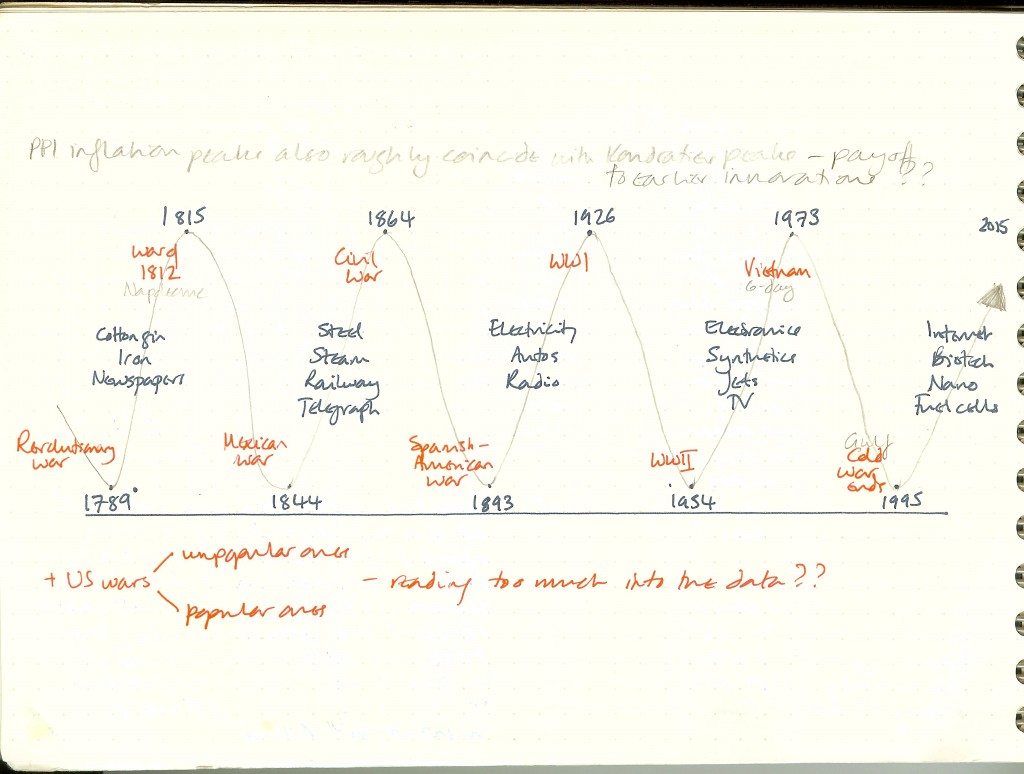
Allen doesn’t speculate about today, but I found it impossible to resist. Bureaucratic administration, which we still have, was ideal for the mass production economy in which goods and services are standardised and an individual’s effort easy to monitor. Increasingly, though, the new technologies mean computers are doing the things that are standardised and measurable, and people are once again doing work where their effort is hard to monitor, whether that is writing large computer programmes or devising an advertising campaign or caring for an elderly person. [amazon_link id=”0691145180″ target=”_blank” ]I’ve argued before[/amazon_link] that we have institutions that lag behind our technologies. This book really helped me understand the shapes institutions can take when there are specific kinds of measurement and transactions costs. The emerging high trust economy will end up being governed in ways that look revolutionary from today’s perspective.

[amazon_image id=”0226014746″ link=”true” target=”_blank” size=”medium” ]Institutional Revolution: Measurement and the Economic Emergence of the Modern World (Markets and Governments in Economic History)[/amazon_image]