
Classical chic?

At a recent GES/Bank of England conference on how to improve the education of economists, a paradox became apparent. The academic world is slow to change and universities have done nothing since the financial crisis to reverse the previous trend in the undergraduate economics curriculum towards a narrower and increasingly technical education. Yet all the participating employers, from investment banks to the Government Economic Service, called for students to be given more context, in the form of both history of the economy and the history of economic thought. Who would have expected an investment banker to demand more reflective graduates while the universities resist providing them?

I read a lot of history already, and am old enough that it was still a required course in my PhD program, but know shockingly little about the history of thought in economics (albeit more than many other economists – it’s a low bar). Recently I read an excellent book, [amazon_link id=”0691148422″ target=”_blank” ]Economics Evolving[/amazon_link], by Agnar Sandmo, from which I learned a lot. Yesterday I picked up Thomas Sowell’s collection of essays [amazon_link id=”0300126069″ target=”_blank” ]On Classical Economics[/amazon_link], which has made its way to my book pile for reasons too complicated to go into here.

Only one chapter in, it has opened my eyes. I suppose I knew that Adam Smith was an anti-colonialist, but had wiped the memory: “Great fleets and armies … acquire nothing which can compensate the expense of maintaining them,” hindering the development of the colonies while not benefiting the imperial power. James Mill described the British Empire as “a vast system of outdoor relief for the upper classes.” The classical economists opposed slavery, mainly but not only for moral reasons; they also argued that: “Its key economic weakness was the absence of the incentive of self interest by the worker,” (to quote Sowell. p7).

The classical economists were no fans of the landed aristocracy. John Stuart Mill was scathing about landlords growing richer “in their sleep”, Ricardo saw them as profiting at the expense of capitalists and workers, the productive groups in society. J.B Say even expressed a view not dissimilar to the thought-experiment of [amazon_link id=”0674000781″ target=”_blank” ]Rawls’s veil of ignorance[/amazon_link]:

“Persons, who under a vicious order of things have obtained a competent share of social enjoyments, are never in want of arguments to justify … such a state of society… If the same individuals were tomorrow required to cast anew the lots assigning them a place in society, they would find many things to object to.” (quoted p 12)

Throw in Smith’s scathing verdict on politicians who regulate everybody else’s behaviour except that of their own kind, and it all starts to sound more radical than classical. Fascinating.

[amazon_image id=”0300126069″ link=”true” target=”_blank” size=”medium” ]On Classical Economics[/amazon_image]
The mystery of money

If you’re interested in money – and who isn’t? – David Wolman’s [amazon_link id=”0306818833″ target=”_blank” ]The End of Money[/amazon_link] is a cracking good read. People think economics is all about money but actually very few economists think about money at all. If only more had done so – it obviously shouldn’t have been left to the bankers. I’ve always found that once you start trying, it quickly becomes rather mysterious and difficult, so I’ve always found it fascinating without entirely understanding how it works. There, I confessed.

[amazon_image id=”0306818833″ link=”true” target=”_blank” size=”medium” ]End of Money[/amazon_image]

The End of Money is a highly entertaining way to start thinking about the deep mysteries of money, which touch on how we organise ourselves in society, the role of government, our sense of identity. The key to money working at all, furthermore, is that not many people think about the mystery at all, given that it is a collective illusion. We emote about it but mustn’t analyse too closely.

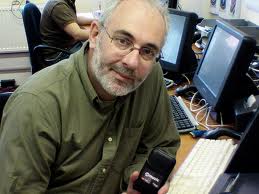
The book is in fact about the end of cash, and the author’s Virgil on this journey is my friend Dave Birch, well known to readers of this blog and his own. (David Wolman describes Dave B as looking like a portly theologian, which is a little harsh. Which of us is not expanding around the waistline as the years go by? His picture is below so you can judge for yourselves.) Although the book gently makes fun of Dave’s enthusiasm for the death of cash, it reaches the same conclusion: modern technologies are inexorably making cash redundant.

Dave Birch

Dave Birch

It’s a persuasive case, and I was particularly impressed that the author managed not to use cash for a whole year, but it seems to me that there are two big barriers to its general demise.

One is covered in the book, namely the psychological or emotional attachment we have to cash. It describes the behavioural finance findings about how much easier psychologically it is to spend on a credit card than by cash, and so on. Maybe, as the book suggests, there are clever technological ways around these human frailties, that could be built into the design of apps.

A second hurdle is raised but not easily resolved. That is that we have far greater trust in governments than in banks (ok, that’s not saying much). In October 2008, when it seemed to me highly likely that a big UK bank would fail and the ATMs and electronic payment systems would stop working, I withdrew as much cash as I could for a while. That danger has receded, but there are still trust barriers to relying entirely on plastic and the benevolence and efficiency of our banks and card companies. So although I agree with The End of Money‘s argument that we may see a proliferation of technology-based means of transaction, I’m not so willing to predict the End of Cash. No doubt Dave Birch will argue with me in the comments below….

It’s well worth making your own mind up. This is a really lively and interesting book, stuffed with interesting facts (such as the central role of North Korea in global counterfeiting – who knew?). It’s also timely reading in these times of perpetual financial crisis.

The dynamic duo, Hayek and Keynes

I’ve just finished reading Nicholas Wapshott’s enjoyable book [amazon_link id=”0393077489″ target=”_blank” ]Keynes-Hayek: The Clash That Defined Modern Economics.[/amazon_link] I’ll be writing a full review for The Business Economist, so will save the detail for then. But one thing that struck me was actually a striking similarity between the two of them, compared to the kind of macroeconomics prevailing since the 1940s. That is the role dynamics played in their thinking. I mean real dynamics, one kind of reaction following another, unfolding in time and not in the abstract. Keynes clearly saw this as a disequilibrium process, Hayek as a process that was extended over time because of the role of investment and capital.

[amazon_image id=”0393077489″ link=”true” target=”_blank” size=”medium” ]Keynes Hayek: The Clash That Defined Modern Economics[/amazon_image]

What a contrast in either case to the comparative statics, giving way to the instantaneous solving of differential equations, that has characterised modern macroeconomics. Post-crisis, we know the modern macro is wrong, a discredited intellectual framework. Who knows yet what will crystallise the new consensus – but it has something to take from Keynes and Hayek.

As it happened, as I finished the book, Tim Harford alerted his devoted Twitter followers to this blog by Greg Fisher looking at Hayek through the prism of complexity theory. Very interesting.

Is demography destiny?

At the weekend, Tony Barber reviewed a new batch of books on Europe – Walter Laqueur’s [amazon_link id=”1250000084″ target=”_blank” ]After The Fall[/amazon_link], [amazon_link id=”1107662567″ target=”_blank” ]The Future of Europe[/amazon_link] by Jean-Claude Piris, and [amazon_link id=”0857420232″ target=”_blank” ]Brussels, the Gentle Monster: Or the Disenfranchisement of Europe[/amazon_link], by Hans Magnus Enzenberger. After all, there is a lot to say about the subject at the moment.

[amazon_image id=”1250000084″ link=”true” target=”_blank” size=”medium” ]After The Fall[/amazon_image]

However, I was most struck by the apparent emphasis on demography in the first of these. According to the review:

‘Laqueur foresees a potential clash of generations as young Europeans, increasingly outnumbered by the old, are condemned to more expensive education, more precarious jobs and less generous pensions. “Depriving citizens of services that were taken for granted could lead sooner or later to a political earthquake, and even a lethargic Europe could witness violence,” he forecasts grimly.’

This is a theme of a recent book by David Willetts, [amazon_link id=”1848872313″ target=”_blank” ]The Pinch[/amazon_link], and I also touch on exactly this last point in the quotation in my book [amazon_link id=”0691145180″ target=”_blank” ]The Economics of Enough[/amazon_link]. What I’m now wondering is whether an economy with an ageing population – and shrinking too as many European ones will have before long – can achieve real economic growth? China has managed so far but is enjoying catch-up growth to the world productivity frontier. And apart from the absence of counter-examples, endogenous growth theory also predicts that a higher population contributes to higher per capita growth (because knowledge is embodied in people, and with a positive feedback loop – Michael Kremer did a nice paper about this.)

Besides, I’ve always found it odd that nobody quite understands why the birth rate fell so much in some European countries, and why it has the north-west/south-east gradient it does. The only demographer I’ve discovered who addressed this at all was [amazon_link id=”1845290585″ target=”_blank” ]Emmanuel Todd[/amazon_link], although no doubt there are others.

So a final question – is it demography, and not history or geography, that is destiny? If so, it casts an even gloomier light on the Greek and Italian debt traps.

High speed history

Who are the historians of the strange institutional developments in modern financial markets? I mean the straight narrative accounts that could, say, be used as reading material in university courses on money and banking (whose re-introduction was one of the suggestions made at the recent Bank of England/Government Economic Service conference on the teaching of economics). David Kynaston’s history of the [amazon_link id=”0701186534″ target=”_blank” ]City of London[/amazon_link], a work to which the adjective magisterial has to be applied, runs up to 2000 and is London-centric. (John Lanchester explains here why it’s  essential reading.) Michael Lewis has given us [amazon_link id=”0340767006″ target=”_blank” ]Liar’s Poker[/amazon_link] for the 1980s and [amazon_link id=”1846142571″ target=”_blank” ]The Big Short [/amazon_link]for the 20002. There have also been some terrific books, post-crash. Gillian Tett’s [amazon_link id=”B002VK2EK6″ target=”_blank” ]Fool’s Gold[/amazon_link] is one that illuminates a corner of the investment banking world in the 2000s. But I hunger for the kind of book which is common in business history – there are loads looking at the car industry, the oil industry, the computer industry. Finance suffers from a dearth of this kind of scrutiny, a mix of history, sociology and journalism.

[amazon_image id=”0701186534″ link=”true” target=”_blank” size=”medium” ]City of London: The History: 1815-2000[/amazon_image]

The reason this comes to mind is because of some of my weekend reading. One is a terrific essay by Andy Haldane of the Bank of England, The Doom Loop, in the London Review of Books. It has some obviously good suggestions. For example, bankers’ pay should be linked not to the return on equity (which incentivises them to take risks) but to return on assets (i.e. the loans they make, which would test whether they were doing their basic job of intermediating between savings and investment). The essay notes the increasing concentration of banking in the UK and the evolution of incentives to take risks. How did banking change its character so much? What regulatory and technological and social changes got us here?

The second was a terrifying Wired report on new research into high speed trading. ‘Flash crashes’ like the one that occurred in May 2010 turn out to happen very often, except normally so fast that humans can’t spot them. A new $300m undersea cable is being laid across the Atlantic (the first since the mid-1990s) to cut 0.006 of a second off the time it will take computers to communicate financial orders between the US and UK. How did this high speed financial market come about, who are the participants, what is being traded and where?

For now we have fiction – Robert Harris’s [amazon_link id=”0099553260″ target=”_blank” ]The Fear Index[/amazon_link], John Lanchester’s forthcoming [amazon_link id=”0571234607″ target=”_blank” ]Capital[/amazon_link]. One sociologist – Donald MacKenzie – has also looked at high frequency trading. But we need more light on this hidden world of finance. This is the story I want to be told.