Making economics digestible

Economics is a late starter in the popularisation stakes, but there is a growing abundance of popular economics books now, in the wake of science, mathematics and history. About time, in my view, as economists claim such an important role in public policy, making public understanding of what we are saying vital for legitimacy. And there’s still a long way to go. So the new revised issue of David Smith’s [amazon_link id=”1781250111″ target=”_blank” ]Free Lunch: Easily Digestible Economics[/amazon_link] is very welcome.

It is really clear and accessible, as you would expect from one of the UK’s most distinguished economics journalists. This new edition incorporates issues that have become more pressing since the onset of the financial crisis (although it’s impossible to keep up with events  – Libor hasn’t made it in here). I particularly like the ‘Arguing over Coffee’ section, which looks at controversies in economics and is useful to help readers understand the reasons economists so vigorously disagree with each other on issues such as the effects of taxes, or globalisation.

There are now enough popular economics books that the Journal of Economic Methodology has a forthcoming special issue on them. We will all have our favourites. Tim Harford’s [amazon_link id=”0349119856″ target=”_blank” ]The Undercover Economist[/amazon_link] turned my eldest son into an economist – he is being turned loose on the world of economic consultancy in September. It would be remiss of me not to mention my own [amazon_link id=”1587991470″ target=”_blank” ]Sex, Drugs and Economics [/amazon_link]and [amazon_link id=”0691143161″ target=”_blank” ]The Soulful Science[/amazon_link]. New additions to the catalogue are always welcome, to spread the word, and keep things up to date. Free Lunch is terrific and as Jeff Randall highlights in his comment on it, it “cuts through the mind-numbing waffle” of much economic commentary. Highly recommended for students and general readers.

[amazon_image id=”1781250111″ link=”true” target=”_blank” size=”medium” ]Free Lunch: Easily Digestible Economics[/amazon_image]


Final Fantasy Finance

As a young financial journalist in the late 1980s, I went to visit the Chicago Board of Trade when it remained an entirely open outcry market. The impact of the noise when trading began after the opening bell, a physical reaction in the pit of the stomach, has stayed with me all these years. In those days, of course, the computer revolution was in its infancy, and all the major markets were open outcry. I don’t think many people outside the financial world appreciate how minor a role humans now play in the financial markets.

Computers do about three-quarters of the trading on US stock markets, a quarter in Europe, and rapidly growing proportions in other asset markets, with this algorithmic trading occurring at intervals of fractions of a second  – so fast that the speed of light is a material barrier to trade, and high frequency traders co-locate their computer servers in the same building as the servers of the exchanges. Asset prices display extreme volatility. The ‘Flash Crash’ was one, but research suggests there are thousands of them, just so fast we don’t notice. The average holding period for shares has dropped from about 4 years in the 1950s to 22 seconds now. The number of companies listing on US stock markets has declined from 530 a year in the 1990s to 126 a year by the late 2000s, and the number of listed companies has fallen from 8,200 in 1997 to about 4,000 by the end of 2010.

[amazon_link id=”1847940978″ target=”_blank” ]Dark Pools[/amazon_link] by Scott Patterson tells the story of the rise of algorithmic trading, and it’s both a fascinating and a completely terrifying tale. The development of computerised trading began as a sort of revenge of the nerds and mavericks against the insiders of the NYSE and Nasdaq, albeit seasoned with the classic greed of the financial markets. The book describes the motivation of Josh Levine, the developer of one of the key early electronic trading systems, as a classic hacker desire for transparency and information. He wanted a fairer, freer market, and the rise of the algorithmic traders was indeed greatly assisted by anti-trust actions against the main markets.

Levine, though, has left finance now. For the titans of the financial markets did what they do when upstarts begin to make headway against them: bought them out. The NYSE and Nasdaq, and major banks like Goldmans and Credit Suisse, acquired the most successful of the computerised traders.

What’s more, as the book explains, successful algorithms trade so well that either they engage in an arms race among themselves for minuscule advantage, or they need to be fed a constant diet of less successful traders from whom they can profit. That would be me and you, either as retail investors or through our pension and mutual funds. The rules of the market enable computers to jump to the head of the queue for trading a particular stock; so if a big investor has placed an order, the algorithmic investor will see it and take advantage of its pre-cognition. The computerised traders are also paid ‘make’ fees by exchanges for providing liquidity, while the ‘takers’ (i.e. you and me again) pay for it. The computers can finally jump around from exchange to exchange, the result of well-intentioned regulation, and use their unique speed to their advantage as well.

In short, this is a rigged market, ineptly regulated, in which the owners of the main electronic trading systems steadily milk money from savers. And algo trading is spreading from stock markets to other assets. There is some evidence (although it is challenged) that the creation of commodity indices traded electronically has contributed to spiking food prices. Today’s FT suggests Goldmans and other mega-banks now want to play an active role in the oil market. I hope the regulators turn them down, but expect they won’t.

There is a fundamental problem of trying to achieve information transparency in an asset market, inherently characterised by at least an asymmetry of perception and probably  often an actual asymmetry of information. It makes the competitive structure of the market all the more important, and [amazon_link id=”1847940978″ target=”_blank” ]Dark Pools[/amazon_link] suggests to me that the anti-trust authorities need to step in again. But that is a slow and uncertain process, and meanwhile the financial system is just not pooling savings to place into productive investments, which will generate a return for savers. On the contrary, it has become a global video game, Final Fantasy Finance, with unfortunate real life side effects. The best bet may be, as Andrew Haldane hinted in one of his recent speeches, to work around the dysfunctional financial ‘markets’ and build new financial institutions such as the peer-to-peer lenders. It will be very important for regulators not to strangle these by throwing up impossible barriers to their growth.

Meanwhile, I highly recommend [amazon_link id=”1847940978″ target=”_blank” ]Dark Pools[/amazon_link]. It is a terrific read, both for a history of high frequency trading well told, and for a different kind of perspective on what’s gone so wrong with finance. If you really want to scare yourself, pair it with Robert Harris’s [amazon_link id=”0099553260″ target=”_blank” ]The Fear Index[/amazon_link], and to think about what to do, turn to the speeches of the Bank of England’s Andrew Haldane and Robert Jenkins.

[amazon_image id=”1847940978″ link=”true” target=”_blank” size=”medium” ]Dark Pools: The rise of A.I. trading machines and the looming threat to Wall Street[/amazon_image]

Half a century forward, a decade going back

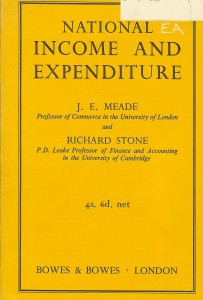
A cold has turned my brain to cotton wool over the weekend, but I have been paging through a pamphlet that turned up courtesy of Abe Books, [amazon_link id=”B001OVBYXG” target=”_blank” ]National Income and Expenditure[/amazon_link] by J.E.Meade and Richard Stone. (I’ve got the 4th, 1957 edition; it was first published in 1944.) This is research for my next book, which is about GDP – contain your excitement. Modern national accounts manuals run to hundreds of dense pages. This first, crystal clear, description is 44 pages long.

It is startling, too, to be reminded how much the economy has changed. In 1954, personal consumer expenditure on food amounted to 21% of GNP at market prices, spending on communication services 0.45%. The percentages in 2011 were 5.5% and 1.3% respectively. Spending on clothing is down as a share, spending on entertainment up. We are living in difficult times, but these changed patterns are the measure of prosperity since the first systematic work on national accounts. It’s just as well that what might turn out to be a decade of GDP going backward came after a half-century going forward.

Meade and Stone

American plutocracy – the evidence

I’ve been looking through a book that arrived here yesterday, [amazon_link id=”B008AU9LZM” target=”_blank” ]Affluence & Influence: Economic Inequality and Political Power in America[/amazon_link] by Martin Gilens, a Princeton political scientist. Although I haven’t read it at all carefully, paging through makes it clear that there is important evidence here that in the United States public policies have increasingly been shaped in the interests of the top 1% (not even the 10%) of the income distribution. There does not appear to be any ranting at all, not a vampire squid in sight. This is serious, empirical social science and lots of it, careful multivariate regression analysis.

The conclusion: “The patterns of responsiveness found in previous chapters often corresponded more closely to a plutocracy than a democracy.”

The influence of the rich is sometimes tempered a little by a closely divided Congress and legislative gridlock, and by an approaching Presidential election. Otherwise, the very rich have bought policies, literally – campaign donations prove be the main channel of influence. Professor Gilens is not optimistic about the prospects for campaign finance reform. Yet as he warns:

“Further concentration of political influence among the country’s affluent threatens both the perception and the reality of a shared political community so central to the health of even the modestly democratic republic we currently enjoy.”

So this rather dense-looking work of political science has a sobering message for the United States, and for all of us non-Americans who used to greatly admired what was, once, the world’s leading example of democracy and opportunity.

[amazon_image id=”B008AU9LZM” link=”true” target=”_blank” size=”medium” ]Affluence and Influence: Economic Inequality and Political Power in America[/amazon_image]

Books and bits are complements, not substitutes

Last night I started reading [amazon_link id=”0099552450″ target=”_blank” ]This is not the end of the book[/amazon_link], by Umberto Eco and Jean-Claude Carrière – a very Euro-intellectual offering (a ‘curated conversation’) sponsored by the French Ministry of Culture. I’m loving it, as one of those Anglo-Saxons who wishes we were allowed to have intellectuals here in the UK. One of Eco’s early points is that it doesn’t do to get worked up about formats:

“The book is like the spoon, scissors, the hammer, the wheel. Once invented, it cannot be improved. You cannot make a spoon that is better than a spoon.” (p4)

And he goes on to point out that no formats last. Papyri have crumbled. Books printed on wood pulp that are 50 years old are crumbling too. Computer discs are obsolete. Online is insecure – as the saga of 3am magazine’s recent disappearance dramatically reveals. (Its rescue came about thanks to the magazine’s Twitter followers tracking down the former owner of the server to a Missouri tattoo parlour.)

[amazon_image id=”0099552450″ link=”true” target=”_blank” size=”medium” ]This is Not the End of the Book: A conversation curated by Jean-Philippe de Tonnac[/amazon_image]

Serendipitously, this morning’s FT reports Bloomsbury’s latest results, which reveal a 70% year on year increase in e-book sales in the first quarter, offsetting a 2% decline in revenues from physical books. But CEO Nigel Newton dismissed the idea that e-books are killing real books:

“It will be a mixed market. Just as it has been for 40 years for hardback and paperback formats – it’s just another new format.”

Eco and Carrière in fact conclude that in the age of the computer, words have become more important than ever. We are communicating more than ever, and in words not pictures. In books, e-pamphlets, blogs, public lectures and debates, tweets… As we seem to need to rediscover every time a new communication technology happens along, modes of communication are complements, not substitutes.

As a footnote, the FT has also been running a very good series on Amazon all week. In another happy coincidence, today’s feature is about its mixed success with digital formats – a strong performance in e-books, not so great in music and video. This is consistent with my view that publishing and bookselling have been relatively successful in innovating with the new technologies, in contrast to the music industry.