
Banks behaving badly

It’s five years since Northern Rock hit the rocks, and four years since Lehman Brothers went bust. The banking system remains fragile, a number of Eurozone banks still posing a threat of global systemic instability. Regulatory reform creeps ahead, slowly, very slowly, and (as Andy Haldane pointed out in his paper The Dog and The Frisbee) will not work anyway. In other words, after half a decade the financial crisis is still in full swing. We are all paying for it in direct taxpayer subventions, through the central banks massively subsidising banks’ costs, and through slow growth – the latest US figures showing real median incomes at their lowest since 1995 – 1995! –  illustrate the point starkly.

So I was shocked an angry to read a small article in the second section of the FT this morning (Banks Force Aluminium Market Shake-Up) pointing out that big investment banks have started speculating in aluminium. At a time of slow global growth, metals prices should be falling. Instead, there has been a 50% increase this year in aluminium because Goldman Sachs, JP Morgan and the like are buying up large stocks and warehousing them to restrict supply.

“The increasingly dominant role of banks including Goldman Sachs, JP Morgan and Deutsche Bank – as well as traders such as Glencore – has prompted a surge to record levels in the premium consumers pay for metal over the benchmark price set at the London Metal Exchange.”

This comes on the back of evidence that investment bank speculation on food commodities through new indices (launched by Goldmans) made a significant contribution to the increases in food prices in recent years.

Is anybody else angered by this? And why are politicians and regulators as silent on this front as they have been until very recently on the use of the financial system for tax avoidance and money laundering? A number of books have flagged up these behaviours in banking – Nicholas Shaxson’s [amazon_link id=”0099541726″ target=”_blank” ]Treasure Islands[/amazon_link], Misha Glenny’s [amazon_link id=”0099481251″ target=”_blank” ]McMafia[/amazon_link] and [amazon_link id=”0099546558″ target=”_blank” ]Dark Market[/amazon_link], Matt Taibbi’s early ‘vampire squid’ intervention in [amazon_link id=”0385529961″ target=”_blank” ]Griftopia[/amazon_link] – and other journalists have been covering the dark side of banking. But there is no salience for these issues in policy and political circles. Why aren’t central banks concerned about soaring commodity inflation when the economy is flat, and the deliberate market distortions causing it?

[amazon_image id=”0099546558″ link=”true” target=”_blank” size=”medium” ]DarkMarket: How Hackers Became the New Mafia[/amazon_image]
What we don’t know about innovation and productivity*

A few interesting comments on productivity have crossed my path recently. This blog post in The Economist addresses Robert Gordon’s habitual scepticism about technology-driven productivity growth, expressed again in a recent paper (pdf). I agree with the blog’s point about the inadequacy of traditional metrics when it comes to capturing the implementation and experience of innovations, which is what productivity growth consists of.

A few days earlier came Plan I from NESTA and a comment by Mariana Mazzucato about the specific role of public funding and strategic leadership in innovation. The former report usefully captures the wide range of influences that turn innovations into economic growth. The latter focuses on one of those influences, the co-ordination (and funding) role of the state – arguing strongly for the government to back innovation more actively in the UK.

It all sent me back to a great book of essays by Richard Nelson from 1996, [amazon_link id=”0674001729″ target=”_blank” ]The Sources of Economic Growth[/amazon_link]. One of his themes is the need to look at firm-level behaviour and data to analyse innovation and productivity growth. As firms are different, and rivalry between them drives innovation (in an evolutionary framework in his mind), aggregates disguise what’s happening. He also argues that standard marginal analysis is inappropriate outside decisions or outcomes at the margin – one can look at small changes sensibly, but not at big changes of the kind that come from important innovations.

He also adds a cautionary note about concluding either that innovation is solely a private, profit-driven business, or that public intervention is essential. Countries differ in important ways, he argues, and at present we do not understand well enough the innovation system as a whole in any single country, never mind across all of them.

[amazon_image id=”0674001729″ link=”true” target=”_blank” size=”medium” ]The Sources of Economic Growth[/amazon_image]

* The answer is – a lot

Which economic crisis?

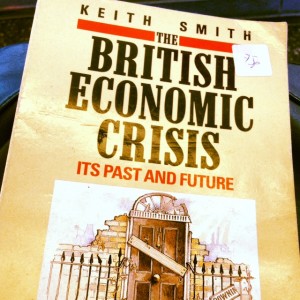
There’s a house on the way to the station whose occupant has been putting out books he or she is obviously trying to get rid of. So far they have been dull legal texts, but at the weekend I pounced on the trophy of [amazon_link id=”0140225021″ target=”_blank” ]The British Economic Crisis: Its Past and Future [/amazon_link] by Keith Smith. This was a 1989 Pelican paperback of a book first published in 1984 and reissued in 1986.

My first thought was, Hah! Call the 1980s an economic crisis! Then I started reading and grew gloomy. The essence of the problem Smith diagnosed was the weakness of manufacturing, and the absence of consistent R&D spending and investment – written against the backdrop of the North Sea Oil-driven rise in the exchange rate, which savaged export and industrial output in the early 80s. He also picks out other contributing problems such as the inadequate education and training of the UK workforce, the over-reliance on financial services and the failings of the welfare state.

His conclusion: “Sustainable improvement in British economic performance can only happen through a thorough-going reconstruction of the ‘supply side’ of the British economy.” In the 1990s we thought the Thatcher governments had tackled the supply side problems through privatisations, labour market reforms, and deregulation. But it would be hard, in the 2010s, to take any more cheerful a view of the country’s economic potential than Prof Smith did 30 years ago.

Depressing.

Which crisis would that be?


The power elite revisited

In [amazon_link id=”0199538751″ target=”_blank” ]Père Goriot[/amazon_link], Balzac wrote: “Le secret des grandes fortunes sans cause apparente est un crime oublié.” Brecht and Weill had their bankers in [amazon_link id=”041377452X” target=”_blank” ]The Threepenny Opera [/amazon_link]start out as street racketeers. C.Wright Mills, author of [amazon_link id=”B000U35R6Y” target=”_blank” ]The Power Elite[/amazon_link], took the same view of the financiers and industrialists he perceived to be controlling the America of his day – the 1950s, Cold War era. His analysis was even darker than Eisenhower’s construction of the military-industrial complex. Mills saw a polity and economy directed towards perpetual war in order to prolong power and profit.

[amazon_image id=”B000U35R6Y” link=”true” target=”_blank” size=”medium” ]The Power Elite.[/amazon_image]

The Power Elite was criticised by other sociologists such as Daniel Bell for its abstraction. Its themes were seen as too big, insufficiently rooted in empirical evidence and institutional analysis. And certainly, the 1950s are remote from our own times in so many ways. Communism and the Cold War seem long, long ago.

Yet Stanley Aronowitz’s intellectual biography, [amazon_link id=”0231135408″ target=”_blank” ]Taking It Big[/amazon_link], does well to remind us of Mills’ work and thought, which was extremely influential on the nascent New Left in the US, and has subsequently been largely forgotten. One reason is that Mills did so much to try to carve out the space for public intellectuals in American culture, albeit not with much lasting success – but at least demonstrating the scope for engagement with a wide public in accessible language.

The other is that for all the abstraction of the analysis of ‘the power elite’, the current crisis reminds us that the idea and reality of the elite is crucial. If only we had not forgotten about it between the 1960s and 2008. Events have reopened people’s eyes to the exercise of power by the wealthy and connected, and authors from Simon Johnson and James Kwak in [amazon_link id=”0307379051″ target=”_blank” ]13 Bankers[/amazon_link] to Ferdinand Mount in [amazon_link id=”1847378005″ target=”_blank” ]The New Few[/amazon_link] have started to analyse this again.

[amazon_link id=”0231135408″ target=”_blank” ]Taking it Big[/amazon_link] is a good introduction to the arc of Mills’ thinking, culminating in his newly-relevant analysis of power. It is also quite well written, something I can’t remember ever saying before about a book by an academic sociologist – Aronowitz has evidently taken Mills’ lead on accessibility. Although the author has a political perspective that I don’t share, I enjoyed reading it.

[amazon_image id=”0231135408″ link=”true” target=”_blank” size=”medium” ]Taking it Big: C. Wright Mills and the Making of Political Intellectuals[/amazon_image]

The Crash, Goldman Sachs, J.K.Galbraith and me

“The crash blighted the fortunes of many hundreds of thousands of Americans. But among people of prominence, worse havoc was worked on reputations. In such circles, credit for wisdom, foresight, and unhappily also for common honesty, underwent a convulsive shrinkage.”

As in the aftermath of 1929, so in the wake of 2008. This was J.K.Galbraith, in [amazon_link id=”014103825X” target=”_blank” ]The Great Crash 1929[/amazon_link]. He goes on to say that Goldman Sachs recovered its reputation relatively quickly, despite having been issuing dodgy investment trust securities at a rate of more than a quarter of a billion dollars less than a month just before the Crash. “It is difficult not to marvel at the imagination which was implicit in this gargantuan insanity,” Galbraith wrote.

It took economists a while longer to rebuild their reputation, he added. “Harvard economics professors ceased forecasting the future and again donned their accustomed garb of humility.” I had the privilege of meeting Professor Galbraith when I was a PhD student at Harvard in the early 1980s, and I must say that ‘humble’ would not be the first adjective to come to mind to describe him. Still, his book on the 1929 Crash is a great read.

[amazon_image id=”0140136096″ link=”true” target=”_blank” size=”medium” ]The Great Crash 1929 (Penguin Business)[/amazon_image]