Blog readers, you get to vote for which of these I should read next:
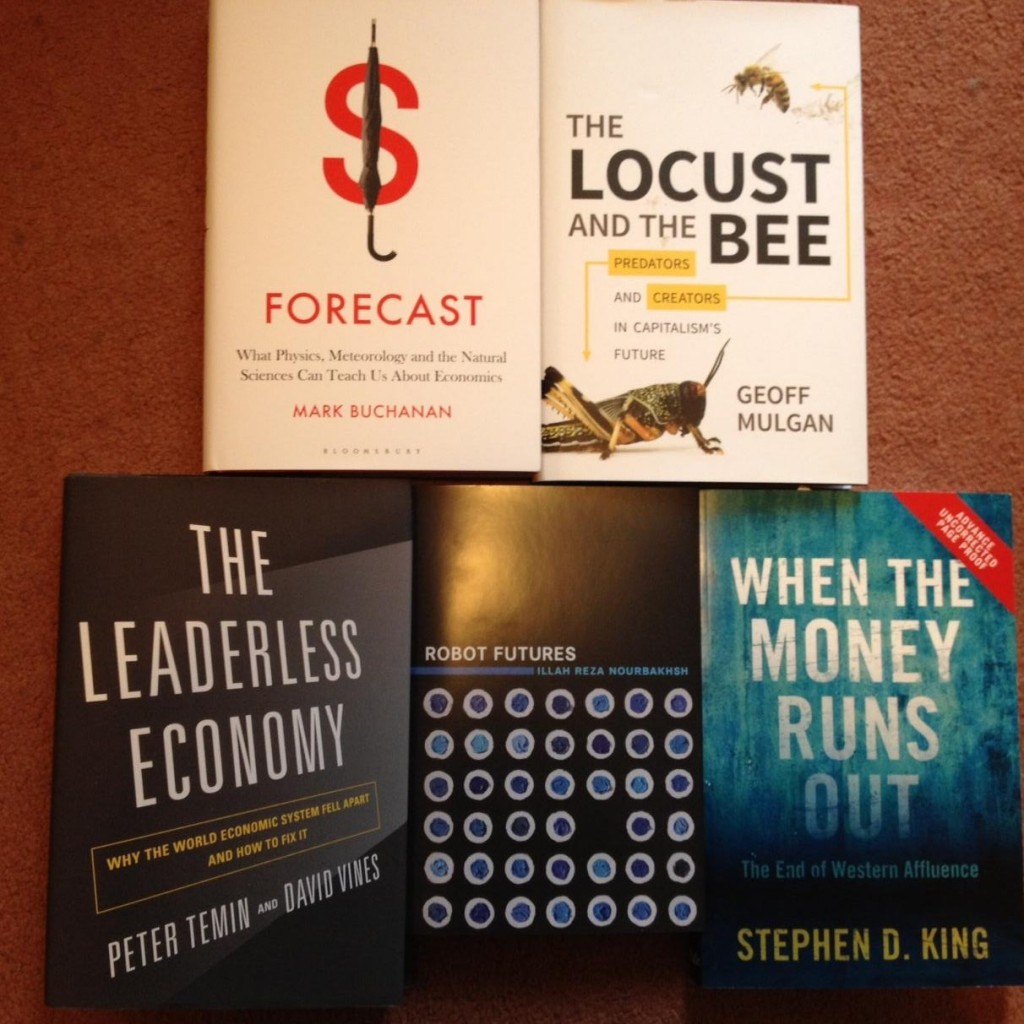
Which one is next?

Blog readers, you get to vote for which of these I should read next:
Which one is next?
[amazon_link id=”B00BIOFLWE” target=”_blank” ]America’s Assembly Line[/amazon_link] by David Nye is fascinating. It’s a history of the origins of the assembly line and mass production, with a strong focus on the motor industry, and traces the spread of mass production through other manufacturing and non-manufacturing sectors (such as housebuilding). The organisation of the line evolved over time, and varied in different places. The imperative of wartime production was an important driver. Post-war, the cybernetics revolution led to far greater automation. On the other hand, the Toyota lean production system brought in greater flexibility for workers on the line.
[amazon_image id=”B00BIOFLWE” link=”true” target=”_blank” size=”medium” ]America’s Assembly Line[/amazon_image]
The public loved the product of the assembly line, affordable mass-produced consumer goods. “In a typical American town, a working class family that couldn’t afford both a bathtub and a car was more likely to opt for a car,” Nye writes of the 1920s. (There’s a parallel with the well known factoid about the greater prevalence of mobile phones than toilets in Indian households now – any kind of means of communication seems peculiarly compelling.) Access to assembly line products, alongside the growth of a suburban middle class, spread far faster in the US than in Europe.
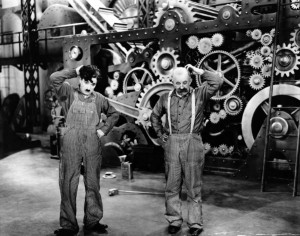
The relationship between machines and workers is an important theme in the book. Although Henry Ford famously paid $5 a day, double the going rate, many workers left before they qualified for it, so hard was the work. The unions had to fight hard to get recognition in the industry. The factories were notorious for robbing workers of any autonomy, and for speeding up the line to extract greater effort. Although 1927 had even brought a symphony to the Model T (premiered by the Boston Symphony Orchestra) he pressure of the assembly line soon became a frequent theme in films, songs and TV – Charlie Chaplin’s Modern Times being a prominent example.
The monotony and conformity of mass production also meant it was slow to spread in Europe, where the markets were anyway far smaller and therefore less able to sustain huge volumes. And there was a culture clash: “British workmen regularly stopped the assembly line for tea breaks.” More importantly, though, “No European nation could develop an American style production system unless it also embraced mass consumption.” None did before the war – the Soviet Union was most interested in Ford’s methods, but could not provide the workers capable of doing the jobs.
Through the post-war era, opinion divided between the welcome given to consumer products and welfare capitalism – Ford also offered savings plans, medical care in the factory, educational programmes – and the cultural distrust of conformity and the alienation of labour on the assembly line. The latter was, again, most pronounced in Europe. And yet European consumers were just as keen on cheap goods. Vice President Richard Nixon famously showed Nikita Kruschev around a model home at the American National Fair exhibition in Moscow in 1959 – Francis Spufford’ superb book [amazon_link id=”0571225241″ target=”_blank” ]Red Plenty[/amazon_link] brings this scene to life. Nixon presented Kruschev with a nice paradox about the benefits of mass produced goods and homes, in that American consumers had a vast choice: “We do not wish to have decisions made at the top by government officials who say all homes should be built in the same way.”
“Commodity fetishism meant that there was a widespread desire for what the assembly line produced but an equally widespread disdain for the work involved,” writes Nye. At the same time, concern began to grow – in line with automation – that the jobs involved were vanishing anyway. The fear of robots eliminating the need for humans emerged around this time.
No matter. Consumerist capitalism was even more heavily criticised by the counter-culture of the 1960s, culminating in 1968. And by the 1970s the far greater flexibility of the Toyota system was outperforming the rigidity of Fordism. By 1990, Volvo was advertising its abandonment of the assembly line. It had small teams assembling an entire vehicle. It took 4 months to train a Volvo worker, compared to 4 hours on a conventional line, but worker turnover was low and productivity high, and problems solved by individual teams with no spillover to the rest of the plant.
Yet the effect of automation on jobs remained a constant. The western economies ‘deindustrialised’. Detroit started its gothic decline – so well captured by photographers Yves Marchand and Romain Meffre in their book [amazon_link id=”3869300426″ target=”_blank” ]The Ruins of Detroit[/amazon_link]. and by the incomparable Bruce Springsteen, voice of blue collar America. Nye concludes: “Americans accepted mass production as though it were part of the natural order, with its subdivision of work, its interchangeable parts, and its organization of everyday life in terms of efficiency and productivity. Year after year they expected higher wages, more consumer goods and a general acceleration of experience. By 2013, however, this was an outdated and unsustainable economic order. The classic assembly line had been based on a large semi-skilled working class, not on robots and outsourcing.”
[amazon_image id=”3869300426″ link=”true” target=”_blank” size=”medium” ]The Ruins of Detroit[/amazon_image]
Robots, in short, don’t buy washing machines and fridges, and all the skills of the Mad Men won’t change that.
This book is an excellent companion read to the current robot debate – nicely summed up in this Economist article.
There are some books you can judge by the cover. [amazon_link id=”1845402626″ target=”_blank” ]In The Name of the People: Pseudo-Democracy and the Spoiling of Our World[/amazon_link] by Ivo Mosley starts out looking like one of them:
[amazon_image id=”1845402626″ link=”true” target=”_blank” size=”medium” ]In the Name of the People: Pseudo-Democracy and the Spoiling of Our World[/amazon_image]
What’s more, the blurb makes a point of explaining that the author is the grandson of the notorious fascist Oswald Mosley, so “he is acutely aware of the corruptibility of democratic governance.” The first chapters set out the argument that our electoral systems give us the illusion of people power but are merely mechanisms for a corrupt elite to perpetuate and enrich itself. The language is standard lefty academic rant, albeit more accessibly written than many such. ‘Here we go,’ I thought.
Still, the financial crisis, and the veils being lifted on the success of corporate lobbying, and the monstrous excesses of bonus culture, do lend rather strong support to the privileged elite idea.
And the book poses the interesting – still unanswered – question about whether new technologies and processes might make ‘true’ democracy rather more attainable. For the trouble with direct participatory forms of government, as opposed to the current system of electoral representation, is that the people have to be bothered to participate. And on the whole they’d rather chat to their friends, watch TV, play video games, and a million and one other things, before discussing political matters. Anybody involved in consultations or voluntary activities will know that very, very few people take part.
The final part of the book looks at some examples that have been more successful – albeit the same examples that crop up in every optimistic discussion of this kind. Porto Alegre, Christiania, James Fishkin’s deliberative processes. However, I don’t think it answers the questions it raises about the likelihood of participatory democracy driving out representative government and thereby delivering greater equality, higher environmental standards, a less dangerous financial system etc.
Personally, I’m still in the camp of trying to make representative government more accountable, as there are countervailing questions about whether the new technology-based mechanisms are making ill-informed populism and the tyranny of the majority greater dangers. But it’s an interesting debate and actually this short book is a better and more balanced guide to the issues than it pretends to be. The historical chapters are especially interesting and should help clarify for readers the distinction between representation and democracy, which is highly relevant to discussions about political reform and how on earth to start to rebuild general trust in the political system from its present shockingly low levels.
Some years ago it was my privilege to be involved with some work with James Heckman, commissioning him to look at skill policies in Scotland (the paper is published in [amazon_link id=”0691122563″ target=”_blank” ]New Wealth for Old Nations[/amazon_link]). So I’ve been aware of his absolute passion – this is no overstatement – for directing policies to help ensure children have the best possible chances in life. His careful econometric work, for which he won (with Daniel McFadden) the Nobel memorial prize in economics in 2000, identifies the causes of later disadvantage as lying in children’s earliest years, and in the development of non-cognitive skills and emotions as well as cognitive skills, on which so much policy attention is focused.
This work is encapsulated in a new Boston Review book he has written, [amazon_link id=”0262019132″ target=”_blank” ]Giving Kids a Fair Chance (A Strategy That Works)[/amazon_link], which includes as always some responses to Prof Heckman’s essay. The discussion is US-centric, but the analysis certainly applies elsewhere. The strategy promised in the subtitle is: “that predistribution – improving the early lives of disadvantaged children – is far more effective than simple redistribution in promoting social inclusion and, at the same time, at promoting economic efficiency and workforce productivity. Predistributional policies are both fair and economically efficient.” This is a rare and worthwhile combo – although, as he would point out, it does take the state into family life in ways that can feel uncomfortable, even when the families in question are impoverished or chaotic or damaged.
The responses make some good points. Emphasising early interventions should not make policy-makers give up on later interventions. Appreciating non-cognitive skills should not lead to the patronising and damaging assumption that children from poor backgrounds can’t make the grade academically. One contributor takes issue with Heckman’s emphasis on poor mothering rather than poor parenting, noting the damage caused by absent fathers.
Still, I agree with Carol Dweck’s summing up: “His review of the scientific evidence is compelling and makes the case that parental training and educational enrichment in the early years have critical and lasting effects on children.” There are not many areas of public policy where the evidence is so clear and experts from across the disciplines have such a high degree of consensus. Politicians have no excuse for not acting on it.
[amazon_image id=”0262019132″ link=”true” target=”_blank” size=”medium” ]Giving Kids a Fair Chance (Boston Review Books)[/amazon_image]
“If the General Election of December 1918 had been fought on lines of prudent generosity rather than imbecile greed, how much better the financial prospect of Europe might now be,” wrote Keynes in the ‘Reparations’ chapter of [amazon_link id=”1602390851″ target=”_blank” ]The Economic Consequences of the Peace[/amazon_link].
I’m certainly not suggesting there is a real parallel between now and then. But listening to the news about Cyprus (where the banks are closed for two more days – to ensure the banking system functions “smoothly”) does make one yearn for a bit of ‘prudent generosity’ among German politicians and voters ahead of September’s federal elections. German banks have the second largest non-Russian exposure to Cyprus, after the Greek banks, and the German banks are the most heavily exposed to the Greek banks and government too. German taxpayers are supporting German banks which lent tens of billions of Euros to Greece and Cyprus; this is a statement about accounting identities. Meanwhile the solution to a bankrupt financial system is – more debt?
Michael Pettis’s recent book [amazon_link id=”0691158681″ target=”_blank” ]The Great Rebalancing[/amazon_link], (reviewed here), looks at the domestic policies in Germany whose result is a permanent current account surplus with the inevitable consequence of capital outflows from Germany. Reading it convinced me that what Europe needs is a sort of German equivalent of the Marshall Plan for the Mediterranean economies, an investment in growth. Obviously a stupidly naive hope.
Back to the microeconomics…..
[amazon_image id=”1451008155″ link=”true” target=”_blank” size=”medium” ]The Economic Consequences of the Peace (Classic Reprint)[/amazon_image]
By continuing to use the site, you agree to the use of cookies. more information
The cookie settings on this website are set to "allow cookies" to give you the best browsing experience possible. If you continue to use this website without changing your cookie settings or you click "Accept" below then you are consenting to this.