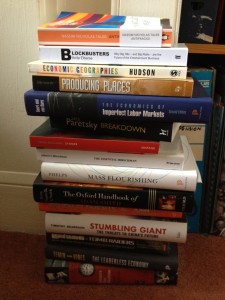
The Enlightened Economist Prize – 2013 Winner

A couple of weeks ago I posted the shortlist for the Enlightened Economist prize this year. The time has come to announce the winner – with the reminder that the rules are wholly idiosyncratic: the candidates are books I happen to have read this year, regardless of publication date; the choice is entirely down to me; and the prize (apart from the honour) is that I will take the author for a fine dinner should we find ourselves in the same city.

It has been a tough choice. In fact, so close that I want to announce two runners-up as well. They are [amazon_link id=”0691156840″ target=”_blank” ]The Bankers’ New Clothes[/amazon_link] by Anat Admati and Martin Hellwig and [amazon_link id=”0300197195″ target=”_blank” ]The Carbon Crunch[/amazon_link] by Dieter Helm.

[amazon_link id=”0691156840″ target=”_blank” ]The Bankers’ New Clothes[/amazon_link] makes a simple, powerful argument: that banks need to raise more capital. It is entirely persuasive that the extent of their leverage makes the financial system fragile, and it clearly and patiently demolishes all the counter-arguments made by the banks and their lobbyists. Why should banks, so central to the economy and in the business of risk, be allowed to get away with so much less capital versus debt than any other kind of business? Here is my original review.

[amazon_image id=”0691156840″ link=”true” target=”_blank” size=”medium” ]The Bankers’ New Clothes: Whats Wrong with Banking and What to Do about It[/amazon_image]

[amazon_link id=”0300197195″ target=”_blank” ]The Carbon Crunch[/amazon_link] is a wonderfully clear-eyed assessment of energy policy in the light of climate change, and in its respect for facts over myths could annoy environmentalists and climate change sceptics equally. It is a model of how applied economics should engage with policy questions, with recommendations that lie in the realm of everyday politics. It is also extremely well-written – everybody should at least read the chapter on wind power. My review here.

[amazon_image id=”0300197195″ link=”true” target=”_blank” size=”medium” ]The Carbon Crunch: How We’re Getting Climate Change Wrong – and How to Fix it[/amazon_image]

However, the winner is Jeremy Adelman’s [amazon_link id=”0691155674″ target=”_blank” ]The Worldly Philosopher[/amazon_link], a biography of Albert Hirschman. Hirschman’s life story is extraordinary, and his early years make for a gripping tale. What I particularly enjoyed, though, was the portrait of an economist whose economics had a context in the realities of the countries Hirschman studied, their history and politics and culture, and in his wide reading in philosophy and other subjects. As I noted in my review and an FT Alphachat podcast discussion with Tyler Cowen, Hirschman was out of touch with the direction economics took during his lifetime, but the subject is now turning away from abstraction and back (I think and hope) towards its roots as ‘worldly philosophy’.

[amazon_image id=”0691155674″ link=”true” target=”_blank” size=”medium” ]Worldly Philosopher: The Odyssey of Albert O. Hirschman[/amazon_image]

A worthy winner – congratulations to Professor Adelman!

Walls, visible and invisible

[amazon_link id=”1908526335″ target=”_blank” ]Walls: Travels along the barricades[/amazon_link] by Canadian writer Marcello Di Cintio is an excellent work of reportage from several of the world’s most intrusive physical barricades. His travels took him from Belfast to the West Bank, the US-Mexico border to that between Bangladesh and India, and others too – Cyprus, the Western Sahara, Ceuta and Melilla. It is very well written and like any good reporting, takes the reader to unknown places and makes them real.

The common theme is the walls or fences proclaimed as security measures in fact create and deepen divisions between the people on either side. The walls once built create the need to maintain them as distrust grows, inevitably, because social contacts between the people on either side are severed. It is hard to draw any conclusion other than that they should never go up in the first place.

[amazon_image id=”1908526335″ link=”true” target=”_blank” size=”medium” ]Walls: Travels Along the Barricades[/amazon_image]

These barricaded borders are an extreme example of the social and economic effects of any border. Economic activity is reduced around any line on the map. I’ve always been fascinated by the invisible borders that characterise every city. There is no built structure separating Tower Hamlets from the City of London but there could hardly be a sharper or less permeable division between two social groups than between the global elite working in the finance sector and the inhabitants of one of London’s and the UK’s poorest boroughs. And of the cities I know, London is one of the least geographically segregated.

Getting people to meet and spend time with people who are different – in all kinds of ways but including in the amount of money they have – is the only way any walls, visible of invisible, will ever come down. Reading about them is a start, I suppose, taking that first step of sympathetic imagination.

Top economists and Bob Dylan

This week I had a couple of days at the Global Economic Symposium in Kiel. It always has a very distinguished group of participants & at these events I always like to note what books people cite in their talks. Bill Janeway did a presentation on his own book [amazon_link id=”1107031257″ target=”_blank” ]Doing Capitalism in the Innovation Economy[/amazon_link], which doesn’t count.

[amazon_image id=”1107031257″ link=”true” target=”_blank” size=”medium” ]Doing Capitalism in the Innovation Economy: Markets, Speculation and the State[/amazon_image]

The others I heard mentioned were Isaiah Berlin’s Liberty[amazon_link id=”019924989X” target=”_blank” ]Liberty[/amazon_link], Wendell Berry’s [amazon_link id=”1582434875″ target=”_blank” ]What Are People For[/amazon_link], and Paul Seabright’s [amazon_link id=”0691146462″ target=”_blank” ]Company of Strangers[/amazon_link].

Wonderfully, too, Robert Johnson of INET quoted Bob Dylan in Love Minus Zero, No Limit:

In the dime stores and bus stations
People talk of situations
Read books, repeat quotations
Draw conclusions on the wall
Some speak of the future
My love she speaks softly
She knows there’s no success like failure
And that failure’s no success at all

Future democracy

Later today I’m speaking at Nesta’s FutureFest about future economic institutions, in what looks to be a terrific session, compered by Mark Stevenson, author of the excellent [amazon_link id=”1846683572″ target=”_blank” ]An Optimist’s Tour of the Future[/amazon_link]. Yesterday I popped in and heard Cambridge political scientist David Runciman give a thought-provoking talk on the future of democracy. I heard him speak on democracy in the 2011 Princeton University Press lecture, and his book [amazon_link id=”0691148686″ target=”_blank” ]The Confidence Trap: A History of Democracy from World War I to the Present[/amazon_link] is out soon.

[amazon_image id=”0691148686″ link=”true” target=”_blank” size=”medium” ]The Confidence Trap: A History of Democracy in Crisis from World War I to the Present[/amazon_image]

The quick summary (based on my tweets of a 15 minute talk) is that political institutions have not kept pace with technological change – indeed, they’ve hardly moved at all in the 25 years of dramatic advance in information and communications technologies. (Indeed, the mismatch between the pace of technological and social change is a commonplace.) However, he continued by saying that technology has in fact become the way political change has happened, to the extent it has. This manifests itself as technocracy – either the Chinese type, run by engineers, or the western type, run by economists and financiers. Technocracy is unsustainable, however. Democracy needs a reboot, by changing its scale of application, to the city level and to the supra-national, continental level.

It sounds intriguing enough to make the book a wanna-read.

David Runciman at FutureFest


Low investment – another moan

A quick update on my previous post bemoaning low investment in the UK economy. Stian Westlake of NESTA asked a good question: one of the books I cited, Keith Smith’s [amazon_link id=”0140225021″ target=”_blank” ]The British Economic Crisis[/amazon_link], was published in 1984. Was this not just ahead of a long upturn in UK productivity growth, one of the stronger productivity performers in the OECD until the 2000s?

He answered his own question with a link to a NIESR growth accounting paper (pdf) concluding that both capital deepening and skills (human capital) deepening made small contributions to the improved productivity performance from the mid-1980s to 2009. The paper concludes: “The majority of the improvement comes from factors affecting the level of technology and the efficiency of factor use.” This in turn was driven by FDI and openness to trade. The impact of FDI on management skills has been confirmed subsequently by John Van Reenen and others.

Stephen King of HSBC, author of [amazon_link id=”0300190522″ target=”_blank” ]When The Money Runs Out[/amazon_link],  pointed me to the chart below indicating the same thing.

Contributions to annual growth