Manchester, Marx (and Engels), and Me

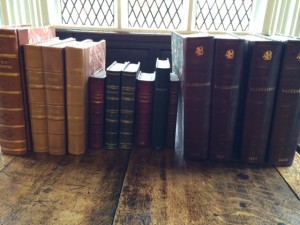
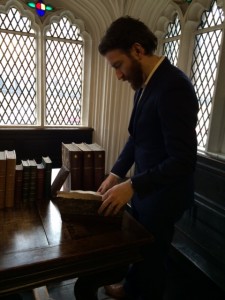
Yesterday I was in the magnificent Chetham’s Library in Manchester with Colm O’Regan, recording a radio programme featuring the desk at which Karl Marx and Friedrich Engels studied for 6 weeks in the summer of 1845. The librarian Michael Powell set out for us the yard of books the two had read during that visit, saying they were very dull including for example William Petty’s [amazon_link id=”B00A1G5MHY” target=”_blank” ]Essays in Political Arithmetick[/amazon_link].

A yard of reading by Marx and Engels

A yard of reading by Marx and Engels

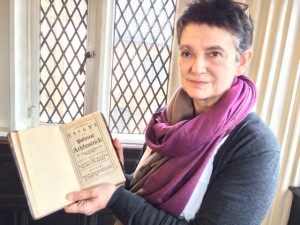
Well, be still my beating heart! As the author of a brief (but affectionate) history of [amazon_link id=”0691169853″ target=”_blank” ]GDP,[/amazon_link] I was delighted to find it had been one of Marx’s early economics texts. Here I am holding the very copy that K.M. read (no marginalia, unfortunately). Rooting around on Google Scholar this morning, I find that Marx emphatically considered Petty to be the founding father of political economy, in [amazon_link id=”1840226994″ target=”_blank” ]Capital[/amazon_link] citing Petty’s description of capital as ‘past labour’. (Bizarrely, Google said it had witheld some search results because of data protection law – ??)

Me holding Petty

Me holding Petty

Here is Colm, metaphorically scratching his head about one of the other books, a super-dull history of trade since ancient times, in three volumes. More information about our podcasting project in the weeks ahead.

Colm O'Regan dipping into the history of trade

Colm O’Regan dipping into the history of trade

Marxian economics is a chasm in my education, although I did try to read Capital when young.[amazon_link id=”0140445684″ target=”_blank” ]Capital: Critique of Political Economy v. 1 (Classics S.)[/amazon_link] The [amazon_link id=”0141397985″ target=”_blank” ]Communist Manifesto[/amazon_link] is good and stirring stuff of course, and sitting in the Chetham’s Library, which could have served in a Harry Potter film, you understand why they had spectres in mind. However, for me Engels’ book, [amazon_link id=”0199555885″ target=”_blank” ]The Condition of the Working Class in England[/amazon_link], is one of the finest pieces of analytical economic reportage, and a true call to arms.

[amazon_image id=”0199555885″ link=”true” target=”_blank” size=”medium” ]The Condition of the Working Class in England (Oxford World’s Classics)[/amazon_image]

Update: the entire list of books read that summer by Marx and Engels, kindly provided by the librarian Michael Powell, is:

Aikin, John                                 Description of the country from thirty to forty miles around Manchester (London, 1795)

D’Avenant, Charles                     Essays on peace at home and abroad (London, 1794)Discourses on the publick revenues and on the trade of England (London, 1698)

Eden, Frederick Morten                The state of the poor, 3 vols. (London, 1795)

Gisbourne, Thomas                     Inquiry into the duties of men in the higher ranks and middle classes of society in Great Britain (London, 1795)

Macpherson, David                     Annals of commerce, manufactures, fisheries and navigation, 4 vols. (London, 1805)

McCulloch, John Ramsay            The literature of political economy (London, 1845)

Petty, William                               Essays in political arithmetick (London, 1699)

The absences that matter

I was reminded by this article about a hoax submission to the annual international conference of the Society for Social Studies of Science, purporting to be a paper proposed for a panel called ‘On the Absence of Absences’. Author Peter Dreier writes: “I not only wanted to see if I could fool the panel organizers and get my paper accepted, I also wanted to pull the curtain on the absurd pretentions of some segments of academic life. To my astonishment, the two panel organizers—both American sociologists—accepted my proposal.” As he recounts, having jumbled pretentious jargon words together for an abstract, he simply didn’t go to the conference, thus becoming an Absence. Maybe some of the conference participants thought that was intentional.

The account cites the 1997 book [amazon_link id=”B00ENKP2TM” target=”_blank” ]Intellectual Impostures[/amazon_link] by Alan Sokal and Jean Bricmont (1998 in English). Sokal, a physicist, submitted a parody article to the American cultural studies journal Social Text, titled ‘Transgressing the Boundaries: towards a transformative hemeneutics of quantum gravity.’ It claimed reality (eg gravity) is a social construct. The article was published – in a special edition of Social Text “devoted to rebutting the criticisms leveled against post-modernism and social constructivism by several distinguished scientists.” Talk about irony.

[amazon_image id=”B00ENKP2TM” link=”true” target=”_blank” size=”medium” ]INTELLECTUAL IMPOSTURES Postmodern Philosophers’ Abuse of Science.[/amazon_image]

Sokal immediately revealed the hoax, and he and Bricmont use the book to evaluate the consequent firestorm and to drive home their argument that postmodernists abuse concepts and terms from maths and physics (eg Baudrillard claiming modern warfare takes place on non-Euclidean space, Lacan stating that the structure of the neurotic subject is ‘exactly the torus’ etc. Sokal and Bricmont make clear they are not attacking all social science, or all French or structuralist philosophy. For example, they point out that Derrida does not write the meaningful drivel they attack, although Deleuze, Kristeva, Lacan do. The bulk of the book analyses a number of offending texts. I read it at the time, and thoroughly enjoyed the demolition job. While respecting the necessity of jargon in academic disciplines, I was predisposed to agree that much of the cultural studies material I occasionally read was literally meaningless.

It ends with an epilogue making some key points, including: It’s a good idea to understand what one is talking about if using scientific terms, even in a loosely metaphorical way; not all that is obscure is profound; science is not a ‘text’, reality and evidence exist (even though their perception and discussion is socially shaped); etc. They end by asking – does it matter? Is postmodernism the biggest problem facing the world?

Sokal and Bricmont conclude that the spread via academia of an absence, the absence of clear thinking and respect for empiricism, is a serious issue. And the obscurantism and pretentiousness of the intellectual/academic left – which has not abated since 1997, as the Peter Dreier experiment indicates – has contributed to the populism rampant today, and the evident preference of voters who are not well-off, privileged or highly educated for people who do ‘speak their language’.

Upcoming books

I have a lot of very enticing proof/manuscript copies of forthcoming books to read at the moment. There are some treats on the way folks!

All these to look forward to

All these to look forward to

I’ve written a review of Branko Milanovic’s [amazon_link id=”067473713X” target=”_blank” ]Global Inequality[/amazon_link] for Democracy, and have read & enjoyed both [amazon_link id=”0393249131″ target=”_blank” ]Platform Revolution[/amazon_link] by Parker, Van Alstyne & Choudary and [amazon_link id=”1681771373″ target=”_blank” ]The Great Invention: The story of GDP[/amazon_link] by Ehsan Masood – will review the former here and am reviewing the latter for Nature.

Now I’ve started on Ethan Bueno De Mesquita’s Political Economy for Public Policy – not sure when it’s due to be published but of great interest for the course I teach (Economics for Public Policy, ECON20431 at Manchester). Then it will be Deirdre McCloskey’s [amazon_link id=”022633399X” target=”_blank” ]Bourgeois Equality[/amazon_link], the third of her ambitious trilogy (the previous ones were [amazon_link id=”0226556743″ target=”_blank” ]Bourgeois Dignity[/amazon_link] and [amazon_link id=”0226556646″ target=”_blank” ]The Bourgeois Virtues[/amazon_link]). That’s due out in April. The others in the picture are out in May so will have to wait a bit.

Paradise lost and remade

I’ve enjoyed reading Louise Fresco’s [amazon_link id=”0691163871″ target=”_blank” ]Hamburgers in Paradise: the stories behind the food we eat[/amazon_link], but find it hard to sum up – almost certainly because I’ve read it in short chunks at night. Indeed it lends itself to that manner of reading because there are ‘stories’ and the chapters have lots of short sections. My take-away (hah!) is that the book tries to find a path between the naivety of the anti-globalisers, and anti-GMO campaigners, the romanticism of the slow food types in a world where 7 billion people need feeding on a necessarily industrial scale, and the complacency of those who dismiss the campaigners. She does believe a lot needs to change about the way food is produced, distributed, sold and consumed. Maybe this is why I like it so much – the message ‘it’s really complicated and there are uncomfortable trade-offs’ rings true.

[amazon_image id=”0691163871″ link=”true” target=”_blank” size=”medium” ]Hamburgers in Paradise: The Stories behind the Food We Eat[/amazon_image]

The chapter on GMOs is a good example. Fresco starts with the continuities. Genetic modification is a continuation of practices dating back to the agricultural revolution – domestication was the first step – and has accelerated in the past century with systematic hybridization. Modern plant breeding is a continuation of the past 10,000 years. The fears aroused by genetic modification – and that’s only in Europe – are to that extent misplaced. But Fresco does not dismiss the fear, for as she notes there has been a discontinuity, both in the use of transgenic techniques, and in the situation in which this kind of modification takes place – not by famers but by a large multinational, playing down side effects, hiding information, and clearly aiming to garner for its shareholders all the new benefits of the techniques. As she notes also, many farmers could improve yields with existing techniques – if they knew how – without going for GM versions. Cassava, a staple food without which millions of people in Sub Saharan Africa, is a prime target for genetic improvements to reduce its toxicity, and enhance growth of its mineral-rich leaves, but the yield in central Africa is only 15% of the yield in Brazil. It will never match that but there is plenty of headroom.

The book begins and ends with Paradise and the Fall, due to Eve’s hunger for (forbidden) knowledge. The underlying thread is the danger of playing with nature – when this has to be done to feed the world’s growing population and when for so much of human history in so many places food has been scarce. She ends with the hope for a new kind of paradise: “We can hope to find there our true human nature, not as spoiled mortals for whom food falls out of the trees, not as greedy leeches who appropriate everything that comes within our grasp, nor as naive worshippers of an idyll, but in full consciousness of what a scientific understanding of the ecology of the earth can bring us in the light of our real needs.”

She continues: “Without food there is no evolution and no civilisation. We are what we eat, literally, through the molecules we absorb from nature. What it means to be human is concentrated in food and our understanding of it.” A very humane book, ranging widely over subjects from obesity to the organic and slow food movements, from fish farming to the landscape, full of new-to-me information, and beautifully written.

A fresh perspective

The latest in the Perspectives series – [amazon_link id=”190799453X” target=”_blank” ]A Better Politics: How Government Can Make Us Happier[/amazon_link] by Danny Dorling – has arrived at Enlightenment Towers. It’s always exciting to see them. This one asks what policies are implied by taking the evidence from well-being research seriously. Danny touched on one issue in an article in the Guardian today.

[amazon_image id=”190799453X” link=”true” target=”_blank” size=”medium” ]A Better Politics: How Government Can Make Us Happier (Perspectives)[/amazon_image]

It follows hard on the heels of David Fell’s [amazon_link id=”1907994505″ target=”_blank” ]Bad Habits, Hard Choices[/amazon_link], reviewed here by Koen Smets. It won’t be too long before we publish the next one – Are Trams Socialist? by Christian Wolmar. So an exciting start to 2016 for Perspectives.

[amazon_image id=”1907994505″ link=”true” target=”_blank” size=”medium” ]Bad Habits, Hard Choices: Using the Tax System to Make Us Healthier (Perspectives)[/amazon_image]