More books to read

Another catalogue landed at Enlightenment Towers – Polity Press for July to December. A few I like the look of (it is of course a lefty list). [amazon_link id=”0745672574″ target=”_blank” ]Gutenberg’s Europe: The Book and the Invention of Western Modernity[/amazon_link] by Frederic Barbier. It promises parallels with the digital revolution. [amazon_link id=”1509504877″ target=”_blank” ]Platform Capitalism[/amazon_link] by Nick Srnicek – the blurb makes the conclusion clear: these are just big, bad monopolies. And the author is billed as a ‘rising star of critical theory’, possibly my least favourite subject discipline, not least because it’s so hard for me to understand. But it might be worth a read. I like the look of [amazon_link id=”0745681980″ target=”_blank” ]Cotton[/amazon_link] by Adam Sneyd – “the grubby politics of the fluffy white stuff.” Sounds like he’ll agree with the rather tendentious arguments in Sven Beckert’s [amazon_link id=”0141979984″ target=”_blank” ]Empire of Cotton[/amazon_link], but I have a limitless appetite for the fluffy white stuff as the daughter of cotton mill workers. There’s also Oliver Stuenkel’s [amazon_link id=”1509504575″ target=”_blank” ]Post-Western World: How Emerging Powers are Remaking the Global Order[/amazon_link]. I can buy the line that we take too western-centric a vew of the world. Finally, [amazon_link id=”0745696805″ target=”_blank” ]Borderlands[/amazon_link] by Michel Agier, an anthropologist – arguing that more of us are living in the ‘cosmopolitan condition’ in which the experience of the unfamiliar is becoming familiar.

[amazon_image id=”0745672574″ link=”true” target=”_blank” size=”medium” ]Gutenberg’s Europe: The Book and the Invention of Western Modernity[/amazon_image] [amazon_image id=”0745681980″ link=”true” target=”_blank” size=”medium” ]Cotton[/amazon_image]  [amazon_image id=”1509504575″ link=”true” target=”_blank” size=”medium” ]Post-Western World: How Emerging Powers are Remaking Global Order[/amazon_image]  [amazon_image id=”0745696805″ link=”true” target=”_blank” size=”medium” ]Borderlands: Towards an Anthropology of the Cosmopolitan Condition[/amazon_image] [amazon_image id=”1509504869″ link=”true” target=”_blank” size=”medium” ]Technology After Capitalism (Theory Redux)[/amazon_image]

National accounts as metaphor

I happened to be reading (as you do) an essay by Thomas Schelling in an out-of-print 1958 NBER volume, [amazon_link id=”B0006D9M14″ target=”_blank” ]A Critique of the United States Income and Product Accounts[/amazon_link]. It’s a very thought-provoking challenge to the very idea that the double (or in fact quadruple) entry system is appropriate for aggregate economic measurement. He argues that they are an elegant theoretical construct but few of the numbers have any practical interest. He suggests the drive for consistency can be counter-productive: “There is no need to impose consistency on our tables if, in fact, businessmen evaluate a significant magnitude wrongly, or just differently from the economist; both estimates are of economic significance.”

Schelling also writes: “The fact is that the real accounts do not balance, only money accounts do. I think this point is insufficiently appreciated. …[W]hat we call “real” magnitudes are not completely real; only the money magnitudes are real. The “real” ones are hypothetical.” Real values don’t follow the rules of accounting, he emphasises.

This brought to mind the illustrations in Andre Vanoli’s [amazon_link id=”1586034693″ target=”_blank” ]A History of National Accounting[/amazon_link] (another out-of-print volume – is this a theme?) of the simplified social accounting matrices set out by Richard Stone in his work in the early days of modern national accounting. Increasingly large, they have only a small proportion of cells with anything in them. The actual numbers don’t matter; the point is the logical relations between them. As Schelling says in his essay, they might just as well be asterisks or emoticons (well, he doesn’t say emoticons but they would do fine). It’s ironic that what appears to be the area of economics closest to the coal face of actual data – national accounting – is no less saturated with theoretical (‘hypothetical’) constructs than any other area of economics.

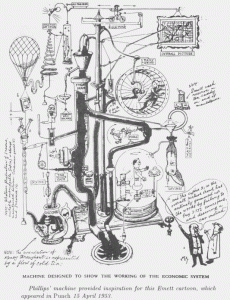
The famous Punch cartoon of the Phillips Machine still has bite

The famous Punch cartoon of the Phillips Machine still has bite

HT [amazon_link id=”0141187123″ target=”_blank” ]Susan Sontag[/amazon_link] for the title of this post

War, peace and economics

I finally read Margaret MacMillan’s magnificent [amazon_link id=”1846682738″ target=”_blank” ]The War That Ended Peace[/amazon_link] (a book big enough that I waited for the paperback).

[amazon_image id=”1846682738″ link=”true” target=”_blank” size=”medium” ]The War that Ended Peace: How Europe abandoned peace for the First World War[/amazon_image]

For obvious reasons, looking at the rise of nationalism and populism now, people are doing comparisons between the 1930s and now, but this book makes it clear there are some parallels as well with the first decade or so of the 20th century. Differences too – thankfully, we have the opposite of a military spending arms race at the moment. But MacMillan underlines the lack of comfort to be derived from the argument that nationalism is too costly in economic terms to get out of hand: “Trade and investment between many of the belligerents were increasing in the year before 1914. Britain and Germany indeed were each other’s largest trading partner. … Bankers and businessmen involved in exports and imports generally looked at the prospect of a major war with dismay; it would bring high taxes, disrupt trade, and cause them severe losses.” Few thought it would come to that. As Keynes famously wrote, in [amazon_link id=”1505906482″ target=”_blank” ]The Economic Consequences of the Peace[/amazon_link]:

“The inhabitant of London could order by telephone, sipping his morning tea in bed, the various products of the whole earth, in such quantity as he might see fit, and reasonably expect their early delivery upon his doorstep; he could at the same moment and by the same means adventure his wealth in the natural resources and new enterprises of any quarter of the world, and share, without exertion or even trouble, in their prospective fruits and advantages; or he could decide to couple the security of his fortunes with the good faith of the townspeople of any substantial municipality in any continent that fancy or information might recommend. He could secure forthwith, if he wished it, cheap and comfortable means of transit to any country or climate without passport or other formality, could despatch his servant to the neighboring office of a bank for such supply of the precious metals as might seem convenient, and could then proceed abroad to foreign quarters, without knowledge of their religion, language, or customs, bearing coined wealth upon his person, and would consider himself greatly aggrieved and much surprised at the least interference. But, most important of all, he regarded this state of affairs as normal, certain, and permanent, except in the direction of further improvement, and any deviation from it as aberrant, scandalous, and avoidable. The projects and politics of militarism and imperialism, of racial and cultural rivalries, of monopolies, restrictions, and exclusion, which were to play the serpent to this paradise, were little more than the amusements of his daily newspaper, and appeared to exercise almost no influence at all on the ordinary course of social and economic life, the internationalization of which was nearly complete in practice.”

[amazon_link id=”1846682738″ target=”_blank” ]The War That Ended Peace[/amazon_link] is a wonderful book. Although there were many places and times at which people could have made different choices, it shows the first world war to have been a true tragedy, a disaster almost bound to happen given the history and context of Europe at the dawn of the 20th century, even though almost all Europeans found it hard to believe a generalised armed conflict would happen.

Historical parallels can and are overdone, but they are still important because every statement, every choice, made about Europe and its nations is shaping the history and context of the future. I am one of the 90% of economists believing Brexit would be damaging for the UK economy, for years. But it isn’t all about the economy, unfortunately.

Forum reading

I’ve been attending the OECD Forum this week, and as ever have met many interesting people. I always note at a conference the books people are talking about, as it can be zeitgeisty. So here are the ones I picked up this time.

Cesar Hidalgo – himself author of the fascinating [amazon_link id=”0141978023″ target=”_blank” ]Why Information Grows[/amazon_link] – highly recommended [amazon_link id=”0316306088″ target=”_blank” ]Disrupted[/amazon_link] by Dan Lyons.

[amazon_image id=”0141978023″ link=”true” target=”_blank” size=”medium” ]Why Information Grows: The Evolution of Order, from Atoms to Economies[/amazon_image]  [amazon_image id=”B01CV0WC7U” link=”true” target=”_blank” size=”medium” ]Disrupted: Ludicrous Misadventures in the Tech Start-up Bubble[/amazon_image]

I met two authors talking about their books, Philippe Legrain on [amazon_link id=”1782924809″ target=”_blank” ]European Spring[/amazon_link]. And Pedro Domingos, author of [amazon_link id=”0241004543″ target=”_blank” ]The Master Algorithm[/amazon_link]. Quote of the Forum came from the latter: “Algorithms are only human.”

[amazon_image id=”1782924809″ link=”true” target=”_blank” size=”medium” ]European Spring: Why Our Economies and Politics are in a Mess – and How to Put Them Right[/amazon_image] [amazon_image id=”0241004543″ link=”true” target=”_blank” size=”medium” ]The Master Algorithm: How the Quest for the Ultimate Learning Machine Will Remake Our World[/amazon_image]

One session was shaped around a book by Peter Diamandis, [amazon_link id=”1501105248″ target=”_blank” ]Bold[/amazon_link]. Not so sure I’ll read this one as I wasn’t crazy about his previous one, [amazon_link id=”145161683X” target=”_blank” ]Abundance[/amazon_link]. Too breathless for someone nerdy like me. But I know many people liked it.

[amazon_image id=”1501105248″ link=”true” target=”_blank” size=”medium” ]Bold: How to Go Big, Create Wealth and Impact the World[/amazon_image]

There were some ‘Meet the Author’ sessions I didn’t get to, including Paul Mason on his [amazon_link id=”0141975296″ target=”_blank” ]Postcapitalism[/amazon_link] and Brooke Harrington on [amazon_link id=”0674743806″ target=”_blank” ]Capital Without Borders[/amazon_link].

It’s all about GDP

Who would have thought economic statistics would become such a hot topic? Certainly not me when I decided a couple of years ago to write a book about GDP for non-specialist readers. It isn’t as if GDP has lacked for critics. Over the decades there have been both environmentalist and feminist critiques, not to mention the blossoming interest in the direct measurement or targetting of happiness or subjective well-being. Still, there is a new wave, more focused on the political economy and historical context of the policy focus on GDP growth and rankings. There are (at least) two conferences on statistics over the next few months, following a joint RES/RSS/IFS conference earlier this month. Surely the scholarly debate, like the policy interest reflected in the Bean Review, is a precursor of change?

The latest book I’ve read is Matthias Schmelzer’s [amazon_link id=”1107130603″ target=”_blank” ]The Hegemony of Growth: The OECD and the Making of the Economic Growth Paradigm[/amazon_link]. The book begins with what has become familiar territory, the development of the forerunner of GDP and the system of national accounts in world war II, building on pioneering work by Colin Clark and Simon Kuznets. What became GNP (and GDP) differed crucially from these pioneers’ ideas, however, by moving away from a clear relationship with economic welfare, and embedding Keynesian macroeconomics. As Schmelzer writes: “The emergence of macroeconomic policies based on such theoretical constructs as consumption, demand, savings, investment, expenditure and their relationships made the rigorous measurement of these aggregates a public necessity, reaching far beyond the mere interest in the comparative wealth of a country and the different production factors.”

[amazon_image id=”1107130603″ link=”true” target=”_blank” size=”medium” ]The Hegemony of Growth: The OECD and the Making of the Economic Growth Paradigm[/amazon_image]

The book provides a distinctive focus by exploring in detail the role of the OECD in the spread and normalisation of the new accounting standards and, by the late 1950s or early 1960s, the adoption of GDP growth as a policy target. The organisation’s forerunner, the OEEC, had been the distributor and overseer of Marshall Aid throughout Europe. The American administration had, as it still does, great influence over its approach. The heating up of the Cold War led the Kennedy Administration to insist on the centrality of growth, making GDP as much a weapon of the Cold War as it had been of the Second World War. Schmelzer says: “The public acceptance of economic expansion as a political goal, as well as the active support of influential societal groups such as capital, labour or the press, had to be actively produced.”

He goes on to describe how orienting the OECD around the goal of growth took it steadily into areas of policy previously not linked to the economy at all, such as science policy and education. In addition, through the aid donors’ club at the OECD, the Development Assistance Committee, the idea became firmly embedded that economic growth and development were essentially the same. Through both geographical reach and policy expansionism, the book portrays the OECD as a key organisation in shaping the ‘growth paradigm’ – even though it also, paradoxically, also gave birth to the earliest, and influential, critique of ‘growthmanship’ in the shape of the Club of Rome report.

The book ends by speculating that the famous ‘hockey stick’ of exponential growth might be about to become an equally familiar S-curve because of ‘secular stagnation’, not least because of environmental limits. Schmelzer argues that GDP growth is part of the paradigm of ‘high modernism’ so brilliantly described in Seeing Like A State. The ‘hegemony of growth’ may be ending; it is certainly changing as the context has changed so dramatically. My money is on the idea of growth being transformed in order to measure better sustainability and economic welfare, but this is exactly what all the new wave of scholarship is investigating. The outcome will be just as contingent and negotiated through political and historical processes as the emphasis on GDP growth was in the first place.

This book provides an interesting perspective on the GDP debate; I hadn’t previously registered the importance of the OECD’s role in particular. The author has clearly dug deep into the archives and provides a lot of fascinating material, shedding new light on what is steadily becoming increasingly well explored territory. There are other new books for the non-specialist out on this subject. I have reviews on two out soonish, Ehsan Masood’s [amazon_link id=”B019G14YKK” target=”_blank” ]The Great Invention[/amazon_link] (in Nature) and Philipp Lepenies’ [amazon_link id=”0231175108″ target=”_blank” ]The Power of a Single Number[/amazon_link] (in the Journal of the History of Economic Thought).

[amazon_image id=”B01FKTBW3O” link=”true” target=”_blank” size=”medium” ]The Power of a Single Number: A Political History of GDP by Philipp Lepenies (2016-04-26)[/amazon_image] [amazon_image id=”B019G14YKK” link=”true” target=”_blank” size=”medium” ]The Great Invention: The Story of GDP and the Making and Unmaking of the Modern World[/amazon_image]

These titles join an older batch of general titles; not only my own [amazon_link id=”0691169853″ target=”_blank” ]GDP: A Brief but Affectionate History[/amazon_link] but also Zachary Karabell’s [amazon_link id=”1451651228″ target=”_blank” ]The Leading Indicators[/amazon_link], Dirk Philipsen’s [amazon_link id=”B01FEKF3UC” target=”_blank” ]The Little Big Number[/amazon_link], Lorenzo Fiaramonti’s [amazon_link id=”1780322720″ target=”_blank” ]Gross Domestic Problem[/amazon_link], Sen, Stiglitz and Fitoussi’s [amazon_link id=”1595585192″ target=”_blank” ]Mismeasuring Our Lives[/amazon_link].

[amazon_image id=”0691169853″ link=”true” target=”_blank” size=”medium” ]GDP: A Brief but Affectionate History[/amazon_image] [amazon_image id=”1451651228″ link=”true” target=”_blank” size=”medium” ]The Leading Indicators: A Short History of the Numbers That Rule Our World[/amazon_image] [amazon_image id=”0691166528″ link=”true” target=”_blank” size=”medium” ]The Little Big Number: How GDP Came to Rule the World and What to Do about It[/amazon_image] [amazon_image id=”1780322720″ link=”true” target=”_blank” size=”medium” ]Gross Domestic Problem: The Politics Behind the World’s Most Powerful Number (Economic Controversies)[/amazon_image] [amazon_image id=”1595585192″ link=”true” target=”_blank” size=”medium” ]Mis-Measuring Our Lives[/amazon_image]

And there are more. Morten Jerven looks at African economic statistics in [amazon_link id=”B00FKYOLGU” target=”_blank” ]Poor Numbers[/amazon_link]. Brett Christophers addresses the measurement of finance in [amazon_link id=”B00ZY8VFQ6″ target=”_blank” ]Banking Across Boundaries[/amazon_link]. Expect more to come!

[amazon_image id=”B00FKYOLGU” link=”true” target=”_blank” size=”medium” ]Poor Numbers: How We are Misled by African Development Statistics and What to Do About it (Cornell Studies in Political Economy (Paperback)) (Paperback) – Common[/amazon_image] [amazon_image id=”1444338285″ link=”true” target=”_blank” size=”medium” ]Banking Across Boundaries (Antipode Book Series)[/amazon_image]