
From woolly to concrete liberalism

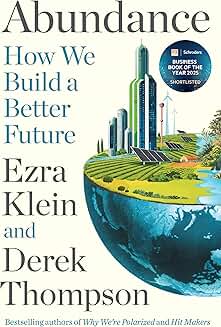
I got round at last to reading Abundance by Ezra Klein and Derek Thompson, and enjoyed the book. It’s a good read and makes its case well. The pro-growth case has traction beyond the US of course. UK ministers have been on about planning regulations hampering growth ever since the July 2024 election, and a John Collison article in the Irish Times recently got the Irish chatterati talking about it.

Did I agree with the case? Yes and no. I do think restarting economic growth – in an environmentally increasingly sustainable way – is essential. Social and political phenomena have many causes so the electoral success of far right populism (anathema to me as an old fashioned woolly liberal) is not caused in a simple way by the absence of growth since the mid-2000s. But that absence is certainly part of the story. My views about this have long been shaped by my PhD adviser Ben Friedman, and his book The Moral Consequences of Economic Growth. (As for the sustainability component – of course that’s essential, but I can’t think of any far right party/government that is not claiming climate change is a hoax. So significant political change has to come first.)

So Abundance does identify some barriers to growth and describe the implications. But the book is also strangely non-political in the sense that I didn’t find anything about how to get from here to the sunlit uplands of there. The book says, “What we are proposing is less a set of policy solutions than a new set of questions around which our politics should revolve.” OK, nobody wants another list of 10 bullet point policy solutions in the final chapter. But what is the political economy of getting from today’s polarised and disgruntled world of concentrated power and authoritarianism to the Abundance-land of pro-concrete liberalism, where building new things is welcomed by communities and technology works for everybody?

Top marks for optimism to the authors, and I enjoyed the read, but it didn’t rattle my pessimism about the current moment.
81eKUZFJv7L._AC_UY327_QL65_


Reshuffle – or how productivity happens

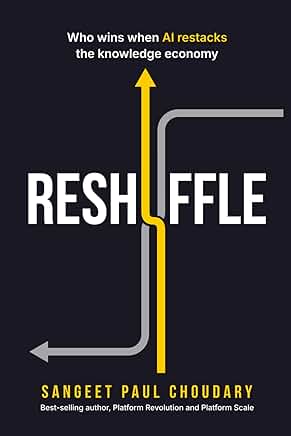
Term time is not conducive to doing a lot of reading, but I have managed a couple of interesting books recently. One was Abundance – I’ll jot down some thoughts about that later. The other was Reshuffle: Who wins when AI restacks the knowledge economy by Sangeet Paul Choudary, which I read and then listened to a presentation by the author organised by the Dynamic Competition Initiative.

I liked the book because it focuses on an aspect of the impact of AI that is underemphasised in public discussion and to some extent in academic circles. That’s its likely catalysing significant organisational change. So much discussion focuses on labour market change and the specific tasks within jobs that will be automated, and how tasks will be rebundled into new jobs. This is a rich literature, flagging up the interaction between the automatability of tasks and the level of expertise required in each task. However, less attention has been paid (though this is changing) to the consequent changes in processes, work flows and business models.

The core point in Reshuffle is that understanding AI’s impacts on the economy requires thinking about tasks as nested within organisations, which in turn sit within systems of production. The focus needs to be directed towards the broader structural architecture, the book argues. It has a construct of being ‘above’ or ‘below’ the AI – I think this means having or not having agency in decision-making – with implications for distribution. “Much of the value associated with a job is not derived from the task alone but also from the system within which the task is executed.”

I wholeheartedly agree with this perspective, that value creation in organisations has an essential social dimension. Firms are more than a collection of individuals. There was years ago an excellent book making exactly this point, Chasing Stars by Boris Groysberg.

The book also majors on the way AI will unbundle some knowledge tasks from humans – often described as codifying tacit knowledge – and the consequences. Such forms of knowledge are more flexible (there is no human or long-term contractual relationship involved) and can be more easiry reproduced or rebundled. So for these reasons I like Reshuffle.

On the other hand, the author wrote it as an airport-style business book, a perfectly valid decision but irritating for me – it’s somewhat repetitive and fond of diagrams that seem less clear than the words. More irritating is the econ-bashing. Yes, economists have been focused on task-based labour market approaches, but there is now a lot of  economic research taking an institutionalist, transactions cost perspective, building on Luis Garicano’s now-classic work, and the earlier tradition of institutional economics all the way back to Coase.

Nevertheless, Reshuffle is an interesting read, with some useful insights – and can indeed be read on a flight or train ride.

51YqwXRnjzL._AC_UY436_QL65_