
American exceptionalism, inequality version

Yesterday on my travels I read a short book, [amazon_link id=”0300209584″ target=”_blank” ]Income Inequality: why it matters and why most economists didn’t notice[/amazon_link], by Matthew Drennan. Professor Drennan is an urban planning expert, so having read the book’s blurb, I expected it to be a critique of the economics profession, and braced myself.

[amazon_image id=”0300209584″ link=”true” target=”_blank” size=”medium” ]Income Inequality: Why it Matters and Why Most Economists Didn’t Notice[/amazon_image]

It ended up not being what I expected. In fact, the book repeats Raghuram Rajan’s argument in [amazon_link id=”0691152632″ target=”_blank” ]Fault Lines[/amazon_link] – that low-income Americans went into debt to increase their consumption levels as well as buy homes, keeping up somewhat with the rich thanks to easy credit. One of the central chapters has a long appendix reporting some econometric work claiming to establish causality between higher income inequality and higher debt. However, it is not sufficiently detailed to be able to assess the empirical work, while too technical to be of interest to the general reader. So the central section of the book is a bit odd.

It’s a fair cop to say the generality of the economics profession did not pay enough attention to rising income inequality. The biggest lasting impact of Piketty’s [amazon_link id=”067443000X” target=”_blank” ]Capital in the 21st Century[/amazon_link], and the work with Atkinson and Saez on which it was based, will turn out to have been consciousness raising. Nobody is ignoring it now. However, there are now several important books on this subject: as well as [amazon_link id=”0691152632″ target=”_blank” ]Faultlines[/amazon_link] and [amazon_link id=”067443000X” target=”_blank” ]Capital in the 21st Century[/amazon_link], Mian and Sufi’s [amazon_link id=”022608194X” target=”_blank” ]House of Debt[/amazon_link], Atkinson’s [amazon_link id=”0674504763″ target=”_blank” ]Inequality[/amazon_link], Francois Bourguignon’s [amazon_link id=”069116052X” target=”_blank” ]The Globalization of Inequality[/amazon_link] and Branko Milanovic’s forthcoming [amazon_link id=”067473713X” target=”_blank” ]Global Inequality: a new approach for the age of globalisation[/amazon_link]. I didn’t find much novelty in Drennan’s [amazon_link id=”B017DNAI3A” target=”_blank” ]Income Inequality[/amazon_link], although it is at least a short introduction.

Above all, though, my reaction to the book wasn’t that it was about economics, more that it was about America. We do tend to forget that inequality is greater in the US than most other OECD countries, and has risen more. Perhaps it can act as the canary in the cage for the rest of us, but a good part of the story lies in US politics and institutions. After all, just look at the Republican primary contenders.
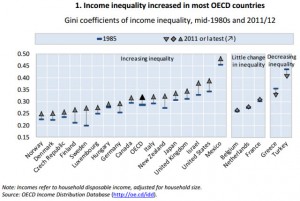
OECD income inequality

OECD income inequality

Authors at the Festival of Economics

The annual Bristol Festival of Economics is under way and seems to be contining to build in popularity. As ever, there is a terrific roster of books by the participants. Adair Turner kicked things off with a discussion of his new book [amazon_link id=”0691169640″ target=”_blank” ]Between Debt and the Devil: Money, Credit and Fixing Global Finance[/amazon_link].

[amazon_image id=”0691169640″ link=”true” target=”_blank” size=”medium” ]Between Debt and the Devil: Money, Credit, and Fixing Global Finance[/amazon_image]

Also featured are:

Robert Shiller, [amazon_link id=”0691168318″ target=”_blank” ]Phishing for Phools[/amazon_link] (co-authored with George Akerlof)

[amazon_image id=”0691168318″ link=”true” target=”_blank” size=”medium” ]Phishing for Phools: The Economics of Manipulation and Deception[/amazon_image]

Vince Cable, [amazon_link id=”1782394494″ target=”_blank” ]After the Storm[/amazon_link]

[amazon_image id=”1782394494″ link=”true” target=”_blank” size=”medium” ]After the Storm[/amazon_image]

Joris Luydendijk, [amazon_link id=”1783350644″ target=”_blank” ]Swimming with Sharks: My journey into the world of bankers[/amazon_link]

[amazon_image id=”B010KNF704″ link=”true” target=”_blank” size=”medium” ]Swimming With Sharks: My Journey into the World of the Bankers[/amazon_image]

Cameron Hepburn, [amazon_link id=”0199676887″ target=”_blank” ]Nature in the Balance[/amazon_link] (with Dieter Helm) and [amazon_link id=”B005LNKHP4″ target=”_blank” ]The Economics and Politics of Climate Change[/amazon_link].

[amazon_image id=”0199676887″ link=”true” target=”_blank” size=”medium” ]Nature in the Balance: The Economics of Biodiversity[/amazon_image]  [amazon_image id=”B005LNKHP4″ link=”true” target=”_blank” size=”medium” ]The Economics and Politics of Climate Change[/amazon_image]

Martin Sandbu, [amazon_link id=”B00WAM14PQ” target=”_blank” ]Europe’s Orphan: The future of the Euro[/amazon_link]

[amazon_image id=”B00WAM14PQ” link=”true” target=”_blank” size=”medium” ]Europe’s Orphan: The Future of the Euro and the Politics of Debt[/amazon_image]

Katrine Marcal, [amazon_link id=”B00XWVGN0K” target=”_blank” ]Who Cooked Adam Smith’s Dinner?[/amazon_link]

[amazon_image id=”B011T7OXXW” link=”true” target=”_blank” size=”medium” ]Who Cooked Adam Smith’s Dinner?: A Story About Women and Economics by Katrine Marcal (5-Mar-2015) Paperback[/amazon_image]

Martin Ruhs, [amazon_link id=”B00LLP19BM” target=”_blank” ]The Price of Rights: regulating international labour migration[/amazon_link]

[amazon_image id=”B00LLP19BM” link=”true” target=”_blank” size=”medium” ]The Price of Rights: Regulating International Labor Migration by Ruhs, Martin (2013) Hardcover[/amazon_image]

Francois Bourguignon, [amazon_link id=”069116052X” target=”_blank” ]The Globalization of Inequality[/amazon_link]

[amazon_image id=”069116052X” link=”true” target=”_blank” size=”medium” ]The Globalization of Inequality[/amazon_image]

Emran Mian, [amazon_link id=”0099572222″ target=”_blank” ]The Banker’s Daughter[/amazon_link]

[amazon_image id=”0099572222″ link=”true” target=”_blank” size=”medium” ]The Banker’s Daughter[/amazon_image]

Julian LeGrand and Sarah Smith, [amazon_link id=”0230553001″ target=”_blank” ]The Economics of Social Problems[/amazon_link] (with Carol Propper)

[amazon_image id=”0230553001″ link=”true” target=”_blank” size=”medium” ]The Economics of Social Problems[/amazon_image]

Alex Bowen, [amazon_link id=”9814551848″ target=”_blank” ]The Global Development of Regimes to Combat Climate Change[/amazon_link]

[amazon_image id=”B00KWZIRI0″ link=”true” target=”_blank” size=”medium” ]The Global Development of Policy Regimes to Combat Climate Change: 4 (The Tricontinental Series on Global Economic Issues)[/amazon_image]

and my own – newly out in paperback

Diane Coyle, [amazon_link id=”0691169853″ target=”_blank” ]GDP: A brief but affectionate history[/amazon_link]

[amazon_image id=”0691169853″ link=”true” target=”_blank” size=”medium” ]GDP: A Brief but Affectionate History[/amazon_image]

ShodanAlexM
Adair Turner opening Bristol Festival of Economics 2015, talking debt, housing & economic recovery. #economicsfest https://t.co/461vvsUSXB
11/11/2015 18:54

Bankrupt banks

I’ve been browsing through a new book, [amazon_link id=”0817918841″ target=”_blank” ]Making Failure Feasible: How Bankruptcy Reform Can End Too Big to Fail[/amazon_link], edited by Kenneth Scott, Thomas Jackons and John Taylor. The book is the product of a Hoover Institution project formed in 2009 to address concerns about the moral hazard that would result from bank bailouts. The project quickly concluded that a bank ‘resolution’ procedure was vital, and proposed a Chapter 14 of the US Bankruptcy Code to create a mechanism ready to be applied to restructure or liquidate any large financial institution of systemic importance that gets into trouble.

[amazon_image id=”B015M9SQYK” link=”true” target=”_blank” size=”medium” ]Making Failure Feasible: How Bankruptcy Reform Can End Too Big to Fail[/amazon_image]

The book spells out the rationale for a bank resolution mechanism and explains in more detail how the Chapter 14 would work. It argues that the proposal would make it easier for US banks to comply with the ‘living will’ requirement of the Dodd-Frank Act. As the book notes in a later chapter, however, a domestic resolution procedure, even for the US, is only a partial answer for banks that are of global importance. The Bank of England and IMF have said there are 16 of these institutions. And there is, the cross border chapter here says, no consensus internationally about the right approach to bankruptcy. So if there is another global financial crisis in the short term, we will be in huge trouble again.

Still, it is good to see that people have been working on detailed bankruptcy proposals – although the detail will be of interest mainly to banking specialists, which I’m not. Let’s hope the regulators get on to the global complexities soon.

So you want to be a superforecaster?

On my travels to and from the fabulous Kilkenomics Festival this weekend, I read [amazon_link id=”184794714X” target=”_blank” ]Superforecasting: The art and science of prediction[/amazon_link] by Philip Tetlock and Dan Gardner. It’s a very interesting book. If you liked Daniel Kahenman’s [amazon_link id=”0141033576″ target=”_blank” ]Thinking, Fast and Slow[/amazon_link], Nate Silver’s [amazon_link id=”0141975652″ target=”_blank” ]The Signal and the Noise, [/amazon_link]and Gerd Gigerenzer’s [amazon_link id=”0241954614″ target=”_blank” ]Risk Savvy[/amazon_link], you’ll like this book too.

[amazon_image id=”184794714X” link=”true” target=”_blank” size=”medium” ]Superforecasting: The Art and Science of Prediction[/amazon_image]

Essentially the book describes the outcome of the research project that followed on from Tetlock’s famous demonstration in [amazon_link id=”0691128715″ target=”_blank” ]Expert Political Judgment[/amazon_link] that experts are not good at predictions. One group of experts failed to do better than random guesswork – and did worse for long term forecasts. Another group did better than this but could rarely beat a simple rule of thumb such as ‘predict no change’ or ‘extrapolate the trend’. The follow up project was stimulated by the introspection of the US intelligence community post 9/11, looking to see whether it would be possible to make forecasts of political or economic events any better than the earlier dispiriting results suggested.

The bulk of the book explains that yes, it is, but it’s hard work requiring techniques and habits that help people avoid the normal cognitive short cuts (‘fast thinking’) we humans take. For example, make sure you start with what the authors call ‘the outside view’. Looking at the drop in popularity of a prime minister after an election? Start out by seeing what has happened to the ratings in the past. Watch out for the ‘bait and switch’ habit of answering an easy question rather than the hard one. Break up complex questions into smaller questions to narrow the territory of your ignorance. Take as many different perspectives as you can. Consult others and welcome diverse views – be on the alert for groupthink.  Be prepared to change your mind. Be alert to conclusions based on your strong feelings or beliefs about an issue (the Keynesians vs Austerians debate is singled out as one where the participants are captive to their prior beliefs). All of the tips are gathered in a how-to-be-a-superforecaster appendix to the book.

Summarised like this, it sounds obvious perhaps. But the book is stuffed with examples demonstrating how hard it is to put the advice into practice. Indeed, the experiment showed that some people can do far, far better than the majority, including ‘experts’ – but there are not many of them. They have specific characteristics: for example, clever (but not Mensa geniuses), open-minded, self-critical, numerate, comfortable with probabilities, willing to change their mind – plus determination. Tetlock is still looking for volunteers to have a go (www.goodjudgment.com).

The book ends with a discussion of two critiques. One is whether Nassim Taleb’s Black Swans imply superforecasting is a chimera – if history moves in jumps because a black swan appears, that must be unforecastable. The other is Daniel Kahneman’s hypothesis that even superforecasters will lose their mojo because their very success will make them as vulnerable to the same cognitive patterns as the ‘experts’ who did no better than randomness or algorithms; we are all vulnerable to complacency or ‘fast thinking’. Tetlock concludes that history does show that the possibilities for the future are radically open but nevertheless argues that his results show that: “People can, with considerable effort, make accurate forecasts about at least some developments that really do matter.”

He does, for me, describe his results convincingly, although the ‘considerable effort’ bit seems a huge barrier to seeing superforecasting habits spreading more widely. But it doesn’t matter if you end up agreeing more with the critiques; this is still a very useful guide to cultivating your own good cognitive habits and critical thinking abilities. I’ll be trying to put the lessons here into practice myself – although not to the extent of starting anything foolish like macroeconomic forecasting.

Kilkenomics – laughs and books

I’m off later this morning to Kilkenomics, the brilliant festival of comedy and economics in Kilkenny, and taking a look at the programme reveals that the authors of many fine books will be there. Radical econo-politicians Yanis Varoufakis ([amazon_link id=”178360610X” target=”_blank” ]The Global Minotaur[/amazon_link]) and Corbyn’s guru Richard Murphy ([amazon_link id=”1907720286″ target=”_blank” ]The Courageous State[/amazon_link]) will be there. The mutli-talented Gillian Tett ([amazon_link id=”1844087573″ target=”_blank” ]The Silo Effect[/amazon_link]) and her FT superstar colleague Martin Wolf ([amazon_link id=”0718197968″ target=”_blank” ]The Shifts and the Shocks[/amazon_link]). There’s also the radical economist George Cooper ([amazon_link id=”0857193821″ target=”_blank” ]Money, Blood and Revolution[/amazon_link]), Joris Luydendijk ([amazon_link id=”1783350644″ target=”_blank” ]Swimming With the Sharks[/amazon_link]), Professor June Carbone ([amazon_link id=”0190263318″ target=”_blank” ]Marriage Markets[/amazon_link]), Larry Elliott ([amazon_link id=”009952368X” target=”_blank” ]The Gods that Failed[/amazon_link]), Nassim Taleb ([amazon_link id=”0141038225″ target=”_blank” ]Antifragile[/amazon_link] and [amazon_link id=”0141034599″ target=”_blank” ]The Black Swan[/amazon_link]), Philippe Legrain ([amazon_link id=”1782924809″ target=”_blank” ]European Spring[/amazon_link]), Stephen Kinsella ([amazon_link id=”1905483694″ target=”_blank” ]Ireland in 2050[/amazon_link]) and Steve Keen ([amazon_link id=”1848139926″ target=”_blank” ]Debunking Economics[/amazon_link])

[amazon_image id=”1844087573″ link=”true” target=”_blank” size=”medium” ]The Silo Effect: Why putting everything in its place isn’t such a bright idea[/amazon_image]  [amazon_image id=”1783350644″ link=”true” target=”_blank” size=”medium” ]Swimming With Sharks: My Journey into the World of the Bankers[/amazon_image]  [amazon_image id=”0190263318″ link=”true” target=”_blank” size=”medium” ]Marriage Markets: How Inequality is Remaking the American Family[/amazon_image]  [amazon_image id=”1905483694″ link=”true” target=”_blank” size=”medium” ]Ireland in 2050: How we will be Living[/amazon_image]

I can’t miss the chance to plug the new paperback edition of [amazon_link id=”B0168T5AHE” target=”_blank” ]GDP: A Brief But Affectionate History[/amazon_link]. London-based folks, I’m doing a talk on GDP and matters digital on Monday 16th November at the LSE.

[amazon_image id=”0691169853″ link=”true” target=”_blank” size=”medium” ]GDP: A Brief but Affectionate History[/amazon_image]

Just before that comes the Bristol Festival of Economics – next weekend, record sales but some tickets left.