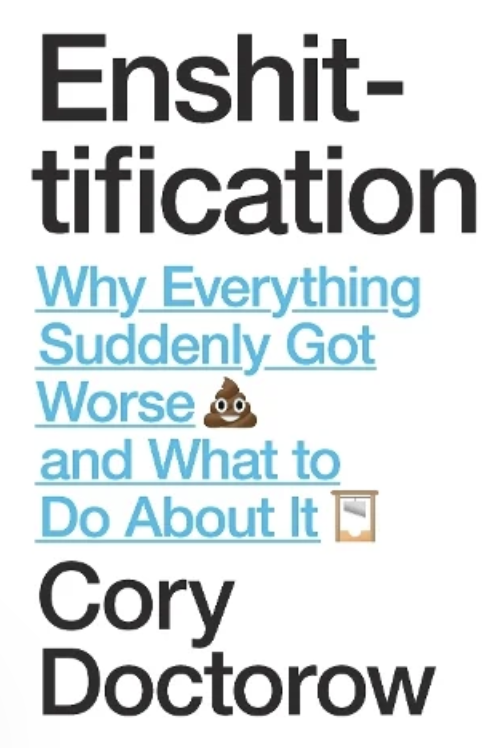
It’s been hard to remain unaware of Cory Doctorow’s concept of ‘enshittification’ – it was after all a 2024 word of the year. But I finally got round to the book Enshittification: why everything suddenly got worse and what to do about it, which is an excellent read. It has four sections: Natural History, Pathology, Epidemiology and Cure. The first three – as these headings indicate – describe the problem (through case studies – Twitter, Amazon, Facebook and the iPhone), anyalyse its structure, explain how it came about and spreads (policy choices), and proposes some counter-actions.
There are two key revelations for me. One is the sustained role of intentional policy actors in enabling big (mainly tech) companies to get away with this. For example, although the adverse effects of the DMCA are well-known, I had not previously known that it was made possible by US official Bruce Lehman doing what he described as ‘an end-run around Congress’ by bringing in the WIPO and international treaties that then had to be implemented in US law. The US law was then enforced extra-territorially by US Trade Representatives threatening tariffs on countries which did not implement similar domestic legislation. This long predated Trump’s passion for tariffs.
The other is the importance of interoperability. As Doctorow puts it, all computers are “Turing complete universal von Neumann machines” – they can run any programme. “The fact that every computer can run every valid program means that every enshittificatory gambit has a potential disenshittificatory countermanoeuvre.” The obstacle to doing so is – the DMCA and threat of legal action for breach of copyright by jailbreaking the software restrictions.
Everyone who does anything online is wearily familiar with the deteriorating experience, which makes the Cure section especially interesting. Policy was the cause, and policy is the cure. Doctorow emphasises antitrust policy and regulation. Economists who have studied digital markets will warmly agree. Enforcing interoperabiility is a key weapon – if we can’t force the companies to behave better, we could make them less important, reduce their gatekeeper status. Also, the more I think about it, the more I believe copyright law needs a broad rethink; it isn’t serving society well in sectors other than tech.
So there is technically well-informed good sense in these. But it leaves me thinking – as with many things I’ve read recently – that the barriers are political. There are clear policy options, implementable, and yet they seem outside the famous Overton Window. In this excellent Chicago Booth podcast with Cory Doctorow, he observes that political science has under-theorised the role of policy domains such as anti-trust, and this seems correct. Perhaps the EU, now that US hostility has been made so plain in the new National Security Strategy, will stop trading its digital enforcement for favours on tariffs; as the tariff weapon has already been fired it has lost some threat potential.
Hard to predict. But I have a strong sense, given evident public anger about the state of modern market economies, that something, somewhere, will start to give. It probably won’t be pretty.